HUMAN
RIGHTS WATCH
Day of the
Disappeared
Rights Group Urges Passage of Bill Vs.
Enforced Disappearance
As the rank of
desaparecidos grows nationwide, a human rights group says it becomes
more urgent to pass the proposed bill criminalizing enforced
disappearance.
BY
DEE AYROSO
Bulatlat
 |
Enforced or
involuntary disappearance has been called the “worst form of human rights
violation” and “a crime against humanity”. International human rights law
describes it as the disappearance of a person at the hand of the state.
The families of the disappeared, who often spend the rest of their lives
searching for their missing loved ones, also become victims, neither
having the remains to bury nor any proof of death or life.
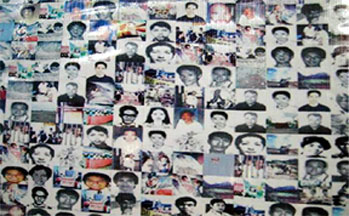
A
tarpaulin sheet of
pictures of desaparecidos |
Enforced
disappearances are usually aimed to silence the victim himself and sow
terror in the community or among members of a target group, such as
activists – effectively silencing both the current and potential voices of
dissent. Enforced disappearances entail the violation of basic human
rights, such as the rights to liberty, personal security, humane
treatment, fair trial, equal protection under the law, and be presumed
innocent until proven guilty.
June 4 is
observed as the International Day of the Disappeared. Enforced
disappearances became prevalent in Latin America where agents of
tyrannical regimes implemented it as a policy against political
dissenters. Thus, desaparecido, the Spanish term for “the
disappeared”, became the term for those who were abducted and vanished by
their own government. In the Philippines, it is usually associated with
the Marcos dictatorship. But recently, human rights groups report that the
rank of desaparecidos under the Macapagal-Arroyo government has
been growing.
Karapatan
(rights), a human rights alliance, said this makes the passing of a bill
criminalizing enforced disappearance more urgent. The law would help deter
would-be perpetrators, said the rights group.
House Bill
4959, the consolidated bill defining and penalizing enforced disappearance
has been passed on third reading at the House of Representatives on June
1. The bill was a consolidation of HB 1556 authored by representatives of
the party-list groups Bayan Muna, Anakpawis and Gabriela, and HB 11 mainly
authored by Rep. Edcel Lagman.
The bill
aims to penalize perpetrators of enforced disappearance, or when one is
removed from the protection of the law for 36 hours, such as when a person
was arrested or abducted and deprived of his rights to a counsel or to
inform his family.
The bill
clearly defines the crime as one committed by agents or officials of
government, or other “private individuals acting in behalf of” the
government. It will also prohibit solitary detention and “secret detention
places” or safehouses.
Life
imprisonment will be meted out on proven perpetrators.
Some 2,000
Missing
The first
documented Martial law desaparecido was 27-year-old Charlie del
Rosario, youth leader of Kabataang Makabayan and Movement for a Democratic
Philippines who disappeared on March 19, 1971. Del Rosario was abducted
by suspected intelligence agents inside the campus of the Lyceum of the
Philippines (now the Polytechnic University of the Philippines) in
Manila.
Today, the
number of desaparecidos could reach 2,000: 759 under the Marcos
Dictatorship, 810 under the Aquino administration, 19 under Ramos, and 38
under the three-year Estrada administration.
For the five
years under the Arroyo administration, some 168 victims of forced disappearance had been documented
by Karapatan as of May this year. Some who were abducted turned up as “salvage” (summary
execution) victims, but most remain missing.
The
perpetrators, mostly identified by witnesses as elements of the military,
police and paramilitia groups, remain unchecked and unpunished. In some
cases, there were no witness to the abduction, which makes it difficult to
identify the specific unit involved. Human rights advocates, however
insist that from the Martial law era to the present, state agents hold a
track record and have been the most capable in committing such crime
against perceived enemies of the state.
It has been
a known practice by AFP and police elements to bring victims of
warrantless arrests to safehouses, where they are interrogated and
tortured before charges are filed against them in court. The latest of
such case was that of the Erap 5 who were abducted in Quezon City by
members of the Intelligence Service of the AFP, and were interrogated
while tied and blindfolded for two days before they were surfaced and
charged in court. One of the five, Ruben Dionisio cried that he was
tortured and forced to admit that he was a member of the New People’s
Army.
Most victims
of warrantless arrests took even weeks before they were surfaced, so as to
heal torture wounds. In most cases, the victims were never found.
Under the
proposed law, any person detaining or keeping a victim of forced
disappearance has the duty to report the victim’s whereabouts to his
family, a legal counsel, and to nearest office of the police, the Armed
Forces of the Philippines, the local government unit, Commission on Human
Rights and a human rights group.
The proposed
law aims to ease the search of the victims’ families as it compels the
police, the AFP, the National Bureau of Investigation, and even hospitals
and morgues to put in writing the result of an investigation or any other
information about a forced disappearance.
Families of
desaparecido will be given indemnification by the government under
the proposed law. If passed, the law will form a monitoring group to be
composed by the Commission on Human Rights and the Department of Justice,
which will work closely with the relatives of the victims, the police, AFP,
representatives of the two houses of Congress and human rights groups.
A relative
of desaparecido who requested anonymity said that even if the bill
was passed, it might have been too late for her kin, although it could
help discourage more abductions.
“It would be
more effective if it would be implemented by a new administration which
would ensure that human rights violators in our society will be punished,”
she said.
BACK TO
TOP ■
PRINTER-FRIENDLY VERSION ■
COMMENT
© 2006 Bulatlat
■
Alipato Publications
Permission is granted to reprint or redistribute this article, provided
its author/s and Bulatlat are properly credited and notified.