
The State of the Nation—53 Years Later
The State of the Nation—53 years later—remains a mirror not just of the government’s agenda, but of the contradictions that define Philippine society.


The State of the Nation—53 years later—remains a mirror not just of the government’s agenda, but of the contradictions that define Philippine society.

Civil society is not asking for favors. It is asserting its rightful role in shaping the future.

A far different reality happens in the Philippines characterized by disenfranchisement, environmental degradation, and deepening inequality.

“The Ombudsman may have dismissed the cases, but it cannot dismiss the truth.”

The deaths of Espe and Mulabay add to a growing list of activists who have been killed in recent years, including Antonio Diwayan, Elioterio Ugking, and Ali Macalintal.

Without warning, Umaaligid just shook us out of stupor and indifference not just on a personal level but on how these struggles relate to societal ills. Umaaligid resonates with the victims of tokhang, extrajudicial killings, enforced disappearances, torture, police brutality, illegal arrests, indefinite detention, sexual assault, betrayal, redtagging, etc.

“He talks about corruption, but refuses to hold the most corrupt accountable. Look at Vice President Sara Duterte—clear evidence of fund misuse, yet nothing has happened.”

Kilusang Magbubukid ng Pilipinas assailed Marcos’s claim of success of his administration’s P20/kilo rice program, saying that it is artificial, limited, and only resulted in farmers' difficulty.

By siding once again with Meralco’s coal project, it’s nothing less than a death sentence for the people of Quezon,” said Fr. Warren Puno, regional coordinator of the South Luzon Eco-Convergence of Caritas Philippines and parish priest of Our Lady of Peace and Good Voyage Parish in Atimonan.

The Commission reminded the state of its obligations under the United Nations Convention Against Torture and its Optional Protocol, which require humane treatment of persons deprived of liberty (PDLs) and safeguard against inhumane or degrading conditions.

APARSUK co-head Angel Sarmiento embraces Molbog resident Tarhata Pelayo after injunction hearing. Photo by Francessca Abalos/Bulatlat

Angelica Nasiron, the latest victim of the criminal charges filed against the indigenous residents of Sitio Marihangin, said that the cyberlibel cases are attempts to “intimidate and silence my fellow indigenous people still fighting for our place in Marihangin [sic].”

Inside Batasan, Marcos Jr. identified accomplishments in infrastructure, health care, and food subsidy. But activists said that the speech was marked more by omissions than solutions.
“There was no mention of the elephant in the room—the corruption and impunity,” said Renato Reyes Jr., president of BAYAN.

For think tank group Center for People Empowerment in Governance (CenPEG), Marcos Jr’s first half is a “period marked by deepening socio-economic inequality, persistent political patronage, and intensifying geopolitical entanglements that undermine Philippine sovereignty.”
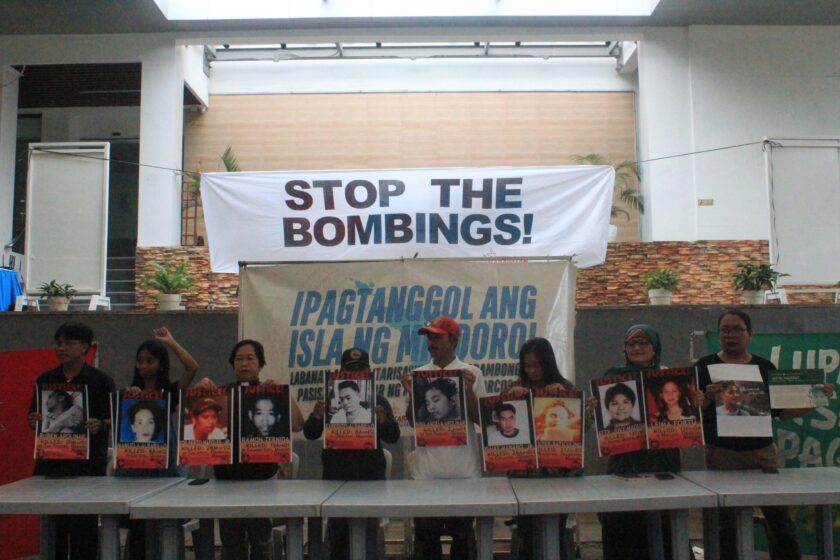
“What’s in place is essentially a de facto martial law, with bombings, forced evacuations, harassment, and intimidation. This is not mere military presence; it is systematic repression.”

People Surge, a national alliance of disaster survivors, said that many affected communities remain without housing, livelihood, or sustained support.

"The Marcos Jr. administration is clinging to a failed and anti-farmer policy of rice importation. It is time to repeal the Rice Liberalization Law, break up the rice trading monopoly, and implement a genuine program for food self-sufficiency."

“In Southern Tagalog, farmers are already burdened by lost harvests and incomes. The people are not just struggling, they are being abandoned.”

Ahead of the upcoming State of the Nation Address, Kalikasan People’s Network for the Environment slammed Marcos Jr’s recent statement that massive flooding and other disasters are the ‘new normal’, asserting instead that those are the result of systemic corruption, the DENR’s criminal neglect, and the ‘greenlighting’ of corporate-driven development projects.

“It is infuriating that unrepentant plunderers occupying high positions in government can maneuver and invoke bureaucratic rules and technicalities to escape punishment, even as they continue to commit serious crimes against the Filipino people,”
A community of readers and supporters that help us sustain our operations through microdonations for as low as $1.