
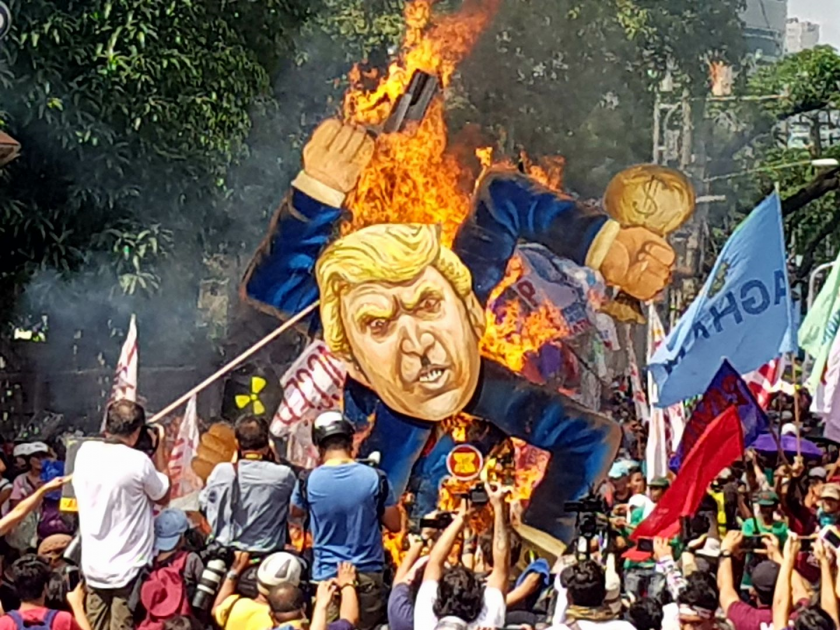
So I would say, what caused the amnesia is the ideological apparatus, with its coercive mechanisms, of the U.S. colonial government in the Philippines, so that quite mediocre administrators as well as stupid, lazy functionaries were able to “educate” millions of Filipinos to believe that the rule under America was for their own individual and collective good. And to some extent, well, compared to the Spaniards, they did institute a universal system of education, built hospitals, roads, etc. needed to establish a dependent neo-colonial order, not solely for the survival and maintenance of the natives. And they allowed Filipinos to become educated so as to become employees in the government, but these are all part of the change, what I would more accurately describe as a change in the mode of production. Ideology, culture, modes of everyday thinking and behavior, follow this transformation in the social-material relations of production.
The U.S. was a capitalist country at the turn of the century, and it was trying to make the Philippines into a capitalist dependent economy. So that the first thing the colonial rulers had to do was to train people, you know, to discipline the colonized to perform the function of workers and subaltern bureaucrats in a dependent, peripheral capitalist economy. And they did that, they tried to change to some extent feudal institutions that we had inherited from the Spaniards. The U.S. eliminated the preponderant power exercised by the church, they tried to show that individuals in the Philippines could improve their situation, they could become educated and free themselves from bondage from their landlords but it was half-hearted in a way. They only did it in order to develop a “middle class” that would run the government gradually, you know this strata actually became the oligarchy, the rich Filipinos now who were educated under American rule and who now succeeded the American colonial administrators, who now run the government but only under the influence of the U.S..
So there was that ideological control that I think the American colonial system was able to implement successfully in the Philippines. That, in rough summary, explains why Filipinos themselves do not know their history. And that even my parents said, when they were in school, in the 30s and 40s, they knew more about American history than Philippine history. Pettybourgeois parents can recite the names of all the major cities in the U.S. but they hardly know what happened in the Philippines before the Americans came, or for that matter, what happened to Sakay and other insurrectos who carried on the underground resistance, the Colorums, the Sakdals, and so on. So the collective amnesia can be explained by the successful disciplinary regimentation of the collective Filipino psyche (if you can admit this notion) which Renato Constantino called “the miseducation” of Filipinos which still persists. Notice Filipinos from every sector echoing the Wall Street/New York Times praise of the shopping malls scattered around the country which allows consumers of every nationality – of course, those with money –to sample multicultural fashions, cuisines, products from every culture and region – and this is the kind of education with supposedly global aims and orientation imposed by the State on all pedagogical agencies, institutions, etc.
So that is one explanation. I suppose the other explanation is that given the poverty, the unemployment in the Philippines, and the fact that there are three million – close to three million Filipinos in the U.S., there is all this kind of illusion that if Filipinos can leave the Philippines and come to the U.S., they would attain success and some version of “the good life” first imbibed from TV, Hollywood films, school textbooks, etcetera, and that is the image that has been projected by Hollywood, by mass advertising in TV and now the Internet, by the Western-controlled corporate media which has, you know, effective hegemonic control of the Philippine media, publications, etc. And so the educational system continues to reinforce the old idea that the American way of life is what the Filipinos should emulate. Actually it is a complicated issue, since capital rules not just by force but by consensus or persuasion – it’s more economical, and also more sustainable, than the Arroyo method of brute force – but I would say that those are the main points that I would use to explain why there is this collective forgetfulness, this amnesia.
What do you think – are there other root causes that explain the current stagnation in the Philippines? If, for instance, you compare the isles with other neighbouring countries like Korea in the late 1950s – the Philippines then was something.
Yes, well, there are some basic political, economic, you might say social conditions that did not change in the Philippines and which changed in countries like South Korea, Taiwan, Malaysia, and so on. I think, the first thing the most people mention, and I won’t elaborate any more on the continued American influence and control over Philippine politics and economics, but that is the general background.
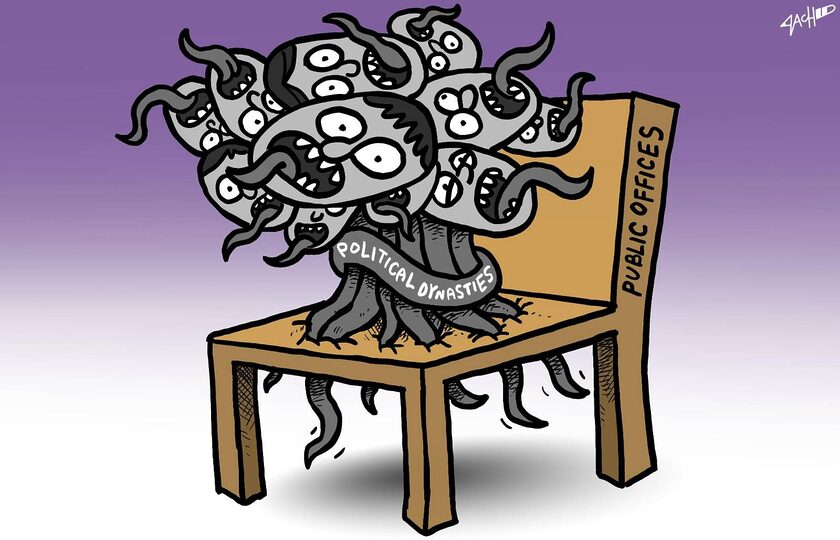
The main point is that the country has not moved out of a kind of semi-feudal situation where you have, you know, extensive agricultural lands still owned by a few families. Now you will remember, in any system that is changing from the old medieval system, the old feudal system to the capitalist mode, you always have a change in the ownership of land, the ownership of the basic resources and means of production. And I think that what happened in South Korea and Taiwan is a good example, because in these socioeconomic formations, before they could develop the initial stage of industrialization, before they could really develop the means, the resources of the country, they had to get rid of the power of the old landlord class, the traditional ruling bloc, because that was the class coalition that prevented any kind of release of all the physical as well as spiritual energies of the people.
 Save as PDF




0 Comments