
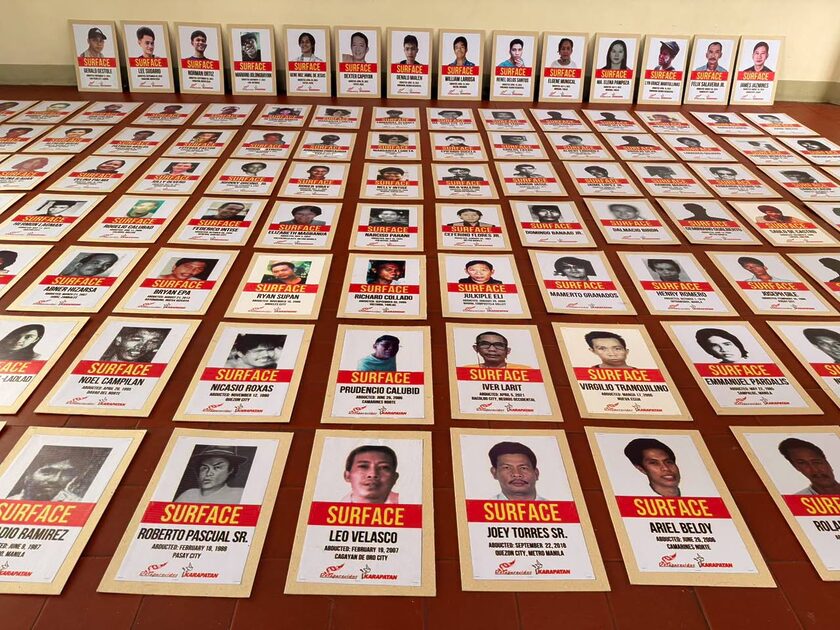
Aside from the previous demonstrations of government military-police complicity with these heinous acts (Amnesty International, United Nations Rapporteurs, even by Arroyo’s Melo Commission), the recent Human Rights Watch report (28 June) reaffirmed the international principle of command responsibility – the top officials of the State, the President, the Armed Forces of the Philippines high command, and other security officials (particularly Norberto Gonzales and Justice Secretary Raul Gonzalez), are all accountable for the forced “disappearances,” torture, and murders of activists and other innocent civilians. Three generals have come out in support of Senator-elect Antonio Trillanes IV’s plan to investigate the involvement of military officials and other State agents in the continuing atrocities. Finding itself on the defensive, the Arroyo clique retools via mock-repentant compromises, cajoling, hypocritical apologies, and – by the end of the day – convenient scapegoats, and desperate appeals for more U.S., International Monetary Fund (IMF) and World Bank (WB) sympathy.
One example of the Arroyo regime’s hard-headed refusal to acknowledge responsibility is the revelation that three kidnapped victims – Sherlyn Cadapan, Karen Empeño, and Manuel Merino – have been witnessed by many to be in military custody. A petition for habeas corpus filed last July 17, 2006, was already served to Generals Romeo Tolentino and Jovito Palparan; but the military chiefs denied any wrongdoing. Gen. Hermogenes Esperon and Sec. Eduardo Ermita can repeat to kingdom come their tiresome refrain that the government has no stated policy of killing political enemies or critics who are publicly stigmatized as “communist fronts” by government propaganda and media flunkeys, by Oplan Bantay Laya I and II, and countless covert schemes. Who are they trying to fool?
It might be instructive to recall how UN Special Rapporteur Prof. Philip Alston’s comment last February that the government’s “passivity bordering on an abdication of responsibility” fell on deaf ears. Secretary Gonzalez, however, perked up and berated Alston for being “blind, mute and deaf.” In his report to the UN Human Rights Council last March 27, Alston reiterated that “based on my fact-finding, there is no reasonable doubt that the military is responsible for a significant number of the killings.” So, whatever protestations of Arroyo, Esperon and Ermita to the contrary, Alston’s earlier criticism that the military “remains in a state of almost total denial” cannot be met with more asinine denials. Indeed, no one so far has been prosecuted; no military or police personnel has been investigated, or brought to trial.
We all know that denials are cheap and easy for tricksters in public relations. This is the confidence game Norberto Gonzales is playing when he recently quipped that “leftist propaganda is successful” (Inquirer, July 3). The same goes for hundreds of abducted victims, the most recent being Jonas Burgos in Manila, Nilo Arado and Luisa Posa Dominado in Iloilo, and more starkly, the torture of Pastor Berlin Guerrero by the Naval Intelligence Security Forces and elements of the Cavite Provincial police last May (see Carol Pagaduan-Araullo’s “Smoking Gun,” Bulatlat June 10-16).
Unravelling the Web of Lies
Despite hedged admissions that the counterinsurgency program may not be sensitive to human rights – Secretary Ermita’s coy response to the European Union’s mission that categorized the political killings as a serious liability that may interrupt European aid and investments – Arroyo persists in spinning her “web of lies,” to quote Dr. Carol P. Araullo.
Araullo, chairperson of Bayan, captured the prevailing climate of opinion in her recent column “Streetwise” (BusinessWorld June 28): “Outrage, long pent-up and mounting, is bound to explode over the killings, unabated by universal condemnation and earnest appeals. In the short term, it can find expression in public support for the trailblazing efforts of the Puno Supreme Court to use the judiciary’s ‘expanded powers’ under the 1987 Constitution as a guardian of civil liberties and human rights….That outrage may also bring about the popular will and force that could oust the fascist criminals from power and put a stop to the extrajudicial killings and enforced disappearances.” Prophetic words for the powerful who no longer have a future.
One of the most militant and formidable opponents of the State terrorism practised by the Arroyo regime, aided with U.S. Special Forces courtesy of Washington/the Pentagon, is Sen. Ana Maria Consuelo “Jamby” Madrigal. Senator Madrigal has already earned a well-deserved reputation as a leader in the crusade against government corruption and for social reform. She is sustained by a legacy of nationalist activism in her family: she is the granddaughter of the national martyr, Supreme Court chief justice Jose Abad Santos; and her grand-uncle is the well known revolutionary Pedro Abad Santos, the founder of the Socialist Party of the Philippines (which later joined forces with advanced sections of the working class to form the Communist Party of the Philippines in the 1930s). Before becoming a Senator, she was active in managing several charitable foundations such as Books-for-the-Barangay Foundation, the Abad Santos Madrigal Foundation, and ABLE Foundation, to help the poor, especially women and children. In the Senate, Jamby Madrigal chairs two senate committees: one on Youth, Women and Family Relations, and another on Cultural Communities.
Three of Senator Madrigal’s recent nationalistic bills are strikingly progressive and deserve national-democratic support: first, the repeal of the Downstream Oil Industry Deregulation Act of 1998, the bill to protect the national patrimony by repealing the Mining Act of 1995 (RA 7942), and another to impose a total log ban. While attending a religious procession on October 4, 2005 with other activists, Senator Madrigal was hit by Manila Police water cannons—a kind of baptism of fire for her.
 Save as PDF
0 Comments