
To generations of labour activists, Crispin “Ka Bel” Beltran is an iconic figure – a towering model who has survived five presidents in his fight for the working poor. The 75-year old aging warrior is still very much in the fray, albeit a bit slower in gait and a voice now muted with age.
BY TED ALCUITAS
Philippine Asian News Today
Vancouver, B. C.
Posted by Bulatlat
Vol. VIII, No. 13, May 4-10, 2008
To generations of labour activists, Crispin ‘Ka Bel’ Beltran is an iconic figure – a towering model who has survived five presidents in his fight for the working poor.
The 75-year old aging warrior is still very much in the fray, albeit a bit slower in gait and a voice now muted with age.
This was evident when he spoke in Vancouver last April 5 on the first leg of his cross-Canada tour with colleagues Satur Ocampo and Luz Ilagan to appear before the subcommittee of the House Standing Committee on Foreign Affairs and International Trade. The partylist solons urged the Canadian government to conduct a hearing into the human rights situation and to tie its aid to the human rights record of the Philippines, a record that has been staunchly denounced by international bodies including a Canadian fact-finding team – the Philippines-Canada Human Rights Task Force on the Philippines (PCTFHR).
First meeting
I first met Ka Bel during the 1997 No to APEC! conference in Vancouver. At the time, he was head of the Kilusang Mayo Uno (KMU), the country’s largest trade union.
Then in 1998, at a rally in front of the U.S. Embassy in Manila, I witnessed a fiery speaker on top of a truck haranguing the Americans, this man with his hoary voice who could speak with rage until his voice was almost inaudible. It was one of my first up-close experience with his fiery oratory – one reason perhaps, that Gloria Macapagal-Arroyo doesn’t want him in the streets.
Our paths crossed again at the founding congress of the International League of People’s Struggle (ILPS) in Amsterdam in 2001 where he co-chaired the proceedings and was elected Chair of the International Coordinating Group. He had just been elected as a congressman for the partylist Bayan Muna – his first foray into the electoral process.
Our next meeting in December 2006 was more somber.
Members of the Canadian Fact-fining Mission to the Philippines organized by the PCTFHR visited Beltran while under detention in the hospital. He was in hospital pajamas in a small private room at the Philippine Heart Center in Quezon City where he was confined under a 24-hour guard. He was moved to the hospital after his health deteriorated while detained at the military prison after his arrest.
Repression of the labour movement
Ka Bel was illegally arrested on Feb. 25, 2006 when President Arroyo declared a State of Emergency accusing him and five of his Partylist colleagues of trumped-up charges of rebellion. Of the six, only Ka Bel was caught – a ‘trophy catch’ for the beleaguered Arroyo administration that was looking for scapegoats to blame the country’s ills on. The six became known as the ‘Batasan 6’ and their case dragged on until July 2007 when the Supreme Court dismissed the charges and Beltran was freed.
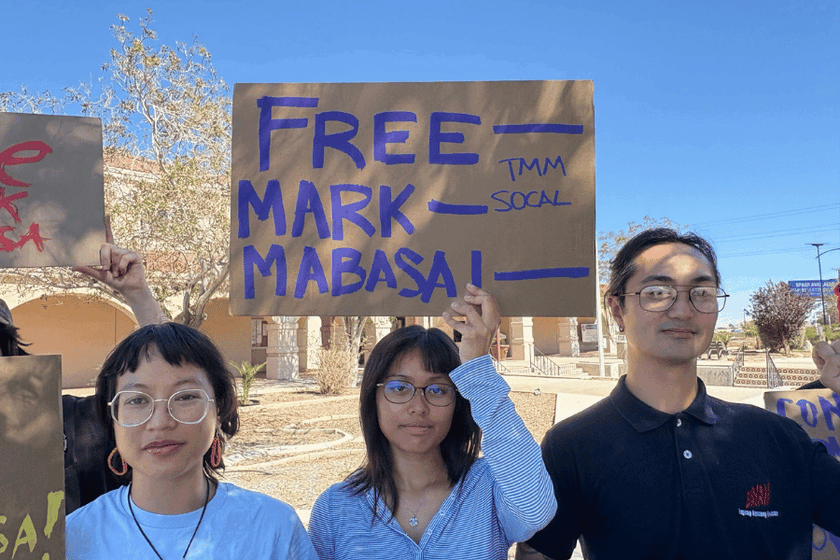
His arrest and imprisonment sparked a world-wide ‘Free Ka Bel ‘ movement. From Germany to Japan, Australia and the Netherlands and other places including Canada, people rallied for his release.
This arrest and imprisonment was not the first one for the veteran labour leader who has been a thorn on the side of Philippine presidents beginning from Marcos, who first arrested and imprisoned him in 1982. In 1984, he made a daring jailbreak and went underground surfacing only when Corazon Aquino took power in 1986 to resume his work with the labour movement.
Parliamentary struggle
Beltran won a second term in 2004 under the partylist Anakpawis (Toiling Masses) representing labour and the urban poor.
In the 2007 elections, Beltran was again reelected for a third term despite the fact he was not able to campaign as he was still detained at the time – a feat that proves his popularity with the people.
He admits that parliamentary struggle is not the only form of struggle to change Philippine society, but that it is the parliament of the streets and the people that will change society.
Nevertheless, he uses the parliamentary platform to push for a ‘People’s Agenda’ – authoring laws for the poor and the marginalized sectors. Since his election in 2001, he has campaigned vigorously for the passage of a law that will give a legislated P125 across-the-board wage increase for all workers. The bill, which already has passed the House, is languishing in the Senate.
Family man
While his work as a labour leader is well-known, he is reticent about his private life.
The former taxi driver turned- labour leader and now a parliamentarian, has been married to his wife of fifty years and has 10 children and 27 grandchildren. The former Rosario ‘Ka Osang’ Soto, who hails from Malolos, Bulacan, met Ka Bel under inauspicious circumstances.
The young Ka Osang left her grandmother’s house after an argument one day and was wandering in the streets of Manila and in a daze, walked into a waiting taxi – driven by the 26-year old Ka Bel. They married after that fateful meeting and has supported each other ever since.
Last December 2006, they celebrated their 50th wedding anniversary in prison – at the hospital’s chapel where Ka Bel was detained. Close friends and colleagues from the Congress attended the ceremony under heavy guard.
Canadian connection
Despite his many ‘brushes’ with the state, Ka Bel continues to champion the cause of the working poor whenever he has the opportunity. In fact he not only champions the poor in the Philippines but also the so-called Overseas Filipinos (OFWs). For Vancouver OFWs particularly, he is an advocate and ally in their continuing struggle for their rights.
When SIKLAB, the acronym for Sulong, Itaguyod ang Karapatan ng mga Mangagawa sa Labas ng Bansa (Organization to Advance the Rights of Filipino Overseas Workers) was launched in 1995, he was the guest speaker and has continued his links with the organization to this day.
One of his first congressional bills asked the House of Representatives to investigate alleged abuses suffered by Filipinos in Canada working under the Live-in-Caregiver Program of the federal government.
During his imprisonment, Canadian Senator Sharon Carstairs, head of the International Parliamentary Union’s Human Rights Committee, personally intervened for him and visited him at his hospital prison. Senator Carstairs intervention came about through the work of the (PCTFHR).
During his short stay in Canada, he made sure to thank his supporters who kept faith with him during his ordeal and promised to continue the struggle for as long as he has the strength.
To many, Ka Bel is indeed a “hero” for in the words of Jose Maria Sison’s epic poem “What Makes a Hero” – a hero serves the people to his very last breath. Posted by (Bulatlat.com)
 Save as PDF



0 Comments