

Sidebar story: The uneven cost of Siargao’s tourism boom
MANILA— Over the past year, a noticeable wave of young Israeli travelers has arrived on Siargao Island. While there have long been Israeli visitors—even before the recent war—there is a new influx of younger ones, many coming directly from military service, including deployments in warzones like Gaza. Some come to surf or recover, drawn to Siargao’s beauty and relative peace. But their presence, often marked by aggressive behavior, loud partying, and disregard for local customs has begun to unsettle the community.
“You can feel the difference,” said 27-year-old Maria Tokong, a proud Siargaonon, in an online interview with Bulatlat. “They don’t come here just to visit—they act like they own the place.”
For a small island still rebuilding from a pandemic and a typhoon, the sudden influx of a tightly knit foreign group has created a cultural friction point. And now, with structures like the Chabad House rising without consultation, Maria and others feel the space they call home is being slowly and deliberately reshaped without them.
Built in August 2023 by Rabbi Mendel Shpindler and his wife Rivka, the Chabad House in Siargao is not just a place of worship but a center for parties, exclusive gatherings, and what feels to locals like cultural occupation. “They host their own parties, their own activities, as if Siargao is just theirs to take,” Maria said.
For many locals like Maria, the facility feels less like a spiritual sanctuary and more like an exclusive space carved out without dialogue, consent, or respect. When asked how she and her community feel about the Chabad House, she answered, “Why are they even putting it up when we already have our own? It will be a threat. Israelis think of this place as somewhere they can do anything they want.”
“We are not speaking out to exclude, but to protect. To remind everyone: this is not just a destination, it is our home.” Maria is clear: Siargaonons are not calling for division, but recognition. “Come as a visitor and come as our guest… But you do not need to build a church or religious structure to represent your faith here. We already have our own, rooted in generations of devotion and tradition.”
There was no community consultation, she says, no genuine attempt to understand the people who live here. “This is a threat to us—nag-dominate sila diri,” Maria said in Cebuano, meaning “they are dominating us here.”
Though Chabad states it is not affiliated with the Israeli government, the deeper concern is not about religion—but about the attitude some Israeli guests bring: the dominance, entitlement, and disregard for the local way of life. As Maria puts it: “This isn’t just about tourism anymore. This is about erasure.”
The behavior that follows, Maria said, has crossed many lines. She and other residents have experienced multiple disturbing encounters. “Early in the morning, they make loud noises—I even had to stop them on the road. Even when you ask them nicely to slow down, mas magpaspas sila—they drive even faster, as if on purpose. It feels intentional, like they’re showing they don’t have to follow our rules,” she recounted.
Online and in community circles, Siargaonons have also shared troubling stories: some Israeli tourists have been caught tampering with Airbnbs, trespassing, defecating in refrigerators, leaving resorts trashed, and walking out without paying. Others reportedly leave bad reviews on small, locally owned businesses—hurting livelihoods out of spite. Some locals remain silent, worn down by fear or fatigue. But Maria refuses to be quiet. “They should be aware that even a simple verbal abuse is a threat. Calling locals ‘slaves’—calling staff ‘slaves’—that needs more awareness,” she said.


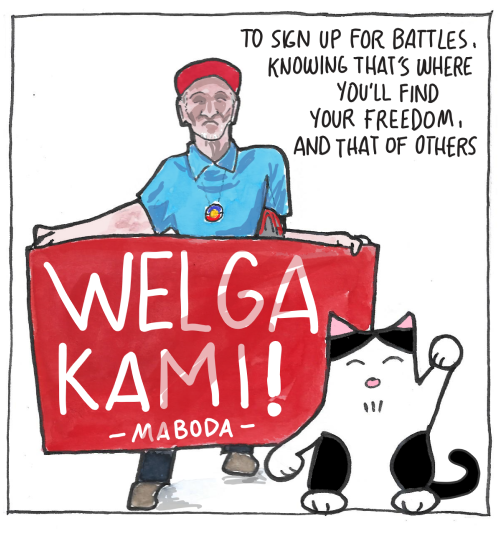
Neighboring islands started to come and slowly unite as seen the same patterns on other tourist islands, even sent protest stickers to Maria and her group to take action and in support for solidarity. (Photos sent by residents of Malapascua Island)
In her Facebook post, Maria wrote, “We are feeling less at home in our home. It makes me feel out of place in the very land where my umbilical cord was buried,” she shared. “But I speak up, because I refuse to let our identity, our peace, and our safety be erased. I say and speak this through my voice, and through my actions.”
The issue is not simply one of bad behavior, but of deeper dislocation. “When structures are built without the community, when events are held without understanding the place, when parties replace the stillness of the full moon—that’s not just change. That’s displacement,” she wrote.
Locals push LGU and Marcos Jr. to act
On May 25, just weeks after the midterm elections, the Israeli consulate paid a visit to Maria and held a dialogue. However, according to her, the conversation offered little in terms of resolution. “They insisted on having the Chabad center there,” she recalled.
More troubling for her was the fact that instead of addressing community grievances, the consulate brought Israeli businessmen into the dialogue, who were simply made to say “sorry.” For Maria, it felt more like a formality than a genuine attempt at accountability or understanding.
Another dialogue took place on July 8, when the new mayor and administration convened a meeting with Maria and fellow residents. In this session, the LGU asked the group to submit a position letter outlining their demands. Maria said, “They told us… the LGU have asked us to give a position letter. That gives us an opportunity to send our demands.”
For the community, this was a crucial step—not only in voicing their opposition to the Chabad House, but also in demanding formal recognition, protection, and participation in decision-making on their own land.
While there have also been community efforts to hold townhall-style meetings, Maria insisted these are not enough. These spaces, she said, often end up being co-opted. Israelis who attend tend to dominate the discussions, often overpowering the voices of local residents.
In that letter and in interviews, Maria and others have made clear their direct and urgent calls to the local government and the Marcos Jr. administration. They are asking for strengthened profiling and identification of tourists, particularly those coming from warzones, given the ongoing global conflicts and the sensitive nature of a communal island like Siargao.
As Maria explained, “We are not equipped to handle cases and be involved in those behaviors.” She emphasized the need to speak out about the harassment and the unsettling presence of Israeli tourists. “Siargao is a peaceful place — we already have a rich culture, they are making us scared,” she said.
As Ferdinand Marcos Jr. prepares for his fourth State of the Nation Address, promising “progress” and “unity,” many in Siargao are left wondering whether those promises include them. “I hope he listens and I hope he hears us,” Maria said. “I don’t know if he even knows about it. If he really is advocating progress and unity, then make us feel that.”
Resistance from Gaza to Siargao
Maria and her community are no longer waiting in silence. In the same way that Palestinians in Gaza continue to bravely resist occupation and the erasure of their homeland, so too do the people of Siargao rise in defiance.
Maria vowed that they will not be passive in the face of intimidation, that they will not allow their island to become a playground of Israeli soldiers at the cost of its people.
They are calling on fellow Filipinos to stand with them—not out of pity, but out of shared principle. Because what is happening in Siargao is not an isolated incident; it is part of a larger story of communities across the world defending themselves from being overwritten. “We should be heard,” Maria says.Like the brave people of Gaza who continue to hold on to their identity under siege, the Siargaonons are teaching us that hope is not something we wait for—it is something we build together. In the spirit of paglig-on, as Maria said—to resist, to be strong—they are standing firm. (AMU, RVO)
 Save as PDF



0 Comments