
By Viggo Sarmago
Bulatlat.com
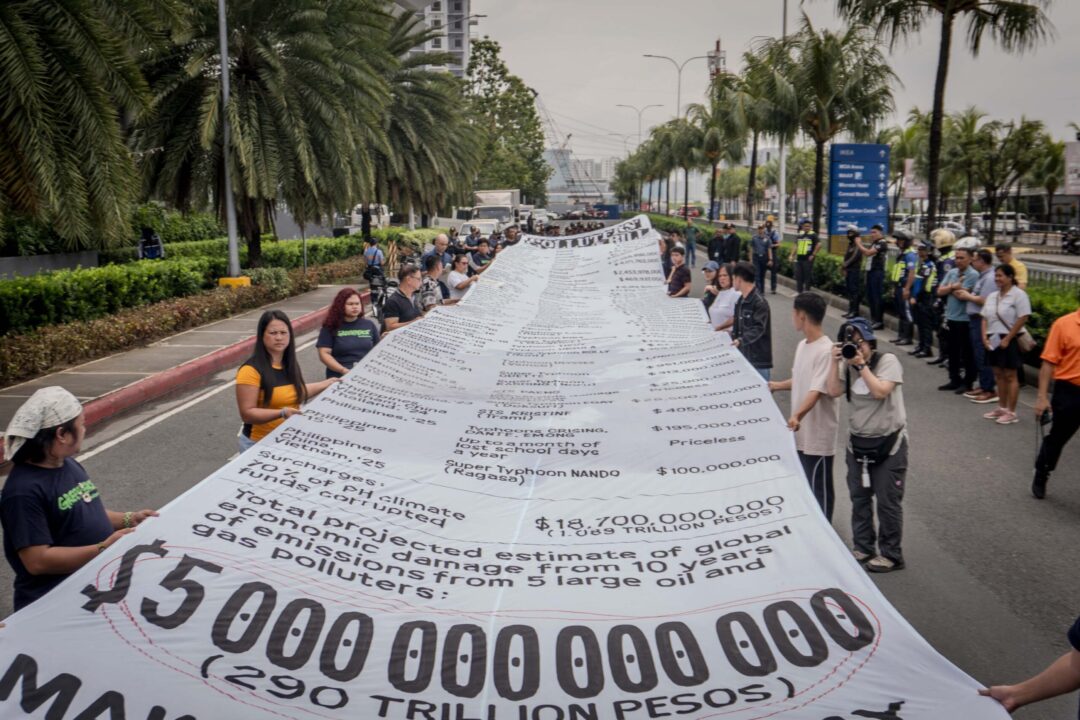
MANILA – Climate survivors, together with Greenpeace Philippines, staged a creative demonstration to demand accountability from what they described as major polluters. On October 7, they unfurled the “Polluter’s Climate Bill,” symbolizing the debt major polluters owe to the affected communities. ” It also reflected the projected $5 trillion in global economic damage caused by 10 years of gas emissions from major polluters.
Protesters at the Conrad Manila, close to the 7th meeting of the Fund for Responding to Loss and Damage (FRLD) board, called on Ferdinand Marcos Jr. to use climate funds effectively in order to help the most climate-vulnerable communities.
Years of state inaction and corruption have compounded the damages and losses induced by natural calamities. The bill even emphasized the P1.089 trillion (approximately $18.7 billion) worth of damage that resulted from the corruption found in the flood control projects and climate funds.
To address this, Greenpeace is pushing for the passage of the Climate Accountability Bill that would compel polluters not only to pay but would also hold them liable for the environmental destruction.
“This is where national legislation can be utilized; (this bill) will allow the state to hold dirty corporations accountable and let the government set up funds to gain revenue by tracking emissions from companies…These funds should then be directly accessible to affected communities, so it is important for us to push this to urge Bongbong Marcos to take action,” the group’s Campaigner Jefferson Chua explained in a mixture of Filipino and English.

Meanwhile, as funds are misused or pocketed, communities across the Philippines continue to bear the brunt of climate disasters and corporate greed.
Anne Casquejo and Trixy Elle, climate survivors from Batasan Island, Bohol, shared that recurring storms have destroyed their homes and disrupted their livelihood. They are also allegedly under pressure from provincial authorities to relocate by 2028.
Arnold Obguia, a climate survivor from Bilangbilangan Island, urged Marcos to show genuine leadership and genuine strategies to address the climate crisis.

Derek Cabe from the Nuclear Coal-Free Bataan Movement, meanwhile, highlighted the persistent influence of the fossil fuel industry affecting their community and called for genuine and sustainable energy. She also criticized renewed efforts to promote nuclear energy, calling them “false solutions” to the climate crisis.
Cabe pointed out that nuclear power brings with it uranium mining and radioactive waste, which may not guarantee their community’s safety. “Instead of going for ‘false solutions,’ what should be immediate are plans for climate adaptation and mitigation, which even in my local government are still questionable at best, so it is what we have to prioritize…while also holding polluters accountable,” she expressed.

But without legitimate plans of action and roadmaps to adapt to and mitigate the climate crisis, the groups think that the enactment of the “Polluter’s Climate Bill” will take longer. “Admittedly, how we can justly transition (to a sustainable future) is difficult to answer; the main question is what system do we have to change and change to?” Chua said.
“We need to overhaul the system: our approach to our relationship with the Earth…We might have to change our mode of production and consumption,” he added.
Jimmy Ceguerra, a community leader from Marikina, also underscored that a just transition must be people-centered and nature-centered, not profit-driven, referencing the construction of the upper Wawa Dam, located in Rizal. “People often mistake that dams help with flooding, but if you study the construction of the Wawa Dam, it was not built with the intention to mitigate floods; it was built for the consumption of Manila Water…When you build a dam, there will be communities and forests that will be displaced…but were they consulted about it? How will they be relocated? ” he explained.
The groups ended by calling for projects to be grounded in the needs of local communities and ensure that they participate in the just transition. That there should be programs to ensure that workers are not undermined in the transition. And that systemic problems require systemic solutions. (AMU, RVO)
 Save as PDF



0 Comments