

BANGKOK – Human rights violations tend to occur in secret, making the data underreported or even unreported. Human Rights Measurement Initiative (HRMI), a global independent non-profit organization, keeps track of data and measures the compliance of governments in their international human rights obligations through the Rights Tracker.
Keshia Mahmood, Southeast Asia Engagement Lead of HRMI, told Bulatlat in an interview that they aim to amplify the voices of activists and human rights advocates on the ground and make sense of the numbers.
“A lot of times, we tend to hear, especially from governments, that the human rights violations are unable to track and measure and that they are isolated cases,” Mahmood said. “That’s why we provide the evidence to demonstrate that this is not an isolated incident and is part of a larger trend. This is what our data shows.”
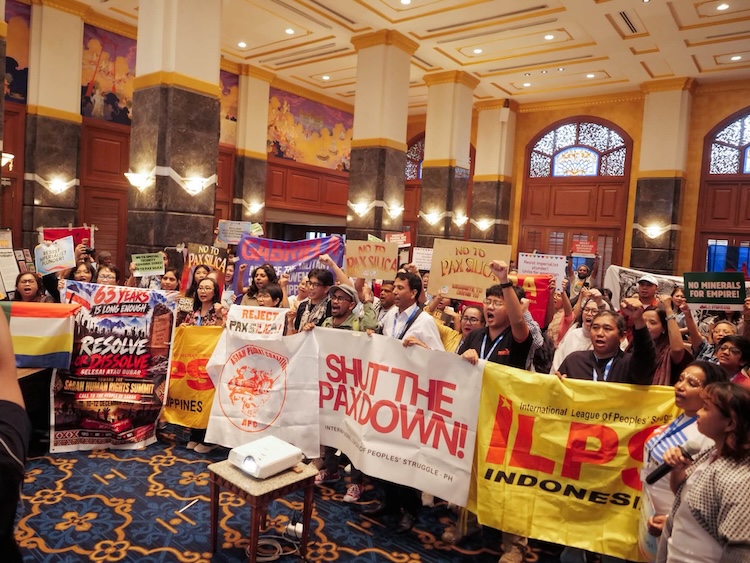
Mahmood is among the participants of the International Civil Society Week 2025 at the Thammasat University, Bangkok, Thailand. She met with fellow human rights workers, demonstrated the use of the Rights Tracker, and had a knowledge exchange with civil society. Over 1,000 activists and civil society joined the international gathering from November 1 to 5.
Read: Global activists strengthen solidarity in times of crises
Navigating the tool
Currently, HRMI measures 14 human rights: 5 economic and social rights (rights to food, health, education, housing, and work) and 9 civil and political rights which include Safety From The State (freedom from arbitrary arrest, forced disappearance, death penalty, extrajudicial execution, and torture and ill-treatment) and Empowerment Rights (freedom of assembly and association, opinion and expression, participation in government, and religion and belief).
Based on the Rights Tracker, the Philippines’ government fails to reach the required performance benchmark for Quality of Life rights. The maximum value of 100 percent, shown in the graph below, is what the Philippines is actually able to achieve at its current income level. However, the Philippines scores only 75.2 percent, which tells us that the government is only doing 75.2 percent of what should be possible right now with the resources it has. Since anything less than 100 percent indicates that a country is not meeting its current duty under international human rights law, HRMI has found that the Philippines has a long way to go to meet its immediate economic and social rights duty.

“This score tells us that the Philippines is only doing 75.2% of what should be possible right now with the resources it has. Since anything less than 100% indicates that a country is not meeting its current duty under international human rights law, our assessment is that the Philippines has a long way to go to meet its immediate economic and social rights duty,” the Rights Tracker analysis reads.
Mahmood stressed that HRMI economic and social rights data draws on baseline indicator data and values available in international databases put together by various international agencies, and uses the award-winning SERF Index methodology to compare countries’ human rights outcomes with their income level.
“In measuring economic, social, and cultural rights, we do it in a statistical methodology using an award-winning peer reviewed SERF index. We are able to do it purely research-based,” Mahmood added. “We measure almost all the countries in the world. For some, we have data up to 20 years.”
There is a different methodology for measuring the obligations in civil and political rights since it is gathered directly from the human rights workers, experts, journalists, and researchers in the field.
“It is an expert survey methodology. So the information comes from human rights experts on the ground, involved in primary data gathering. They are the ones who know the context the best,” Mahmood said.
In the case of the Philippines, the civil and political rights measurements are not yet available. HRMI is set to conduct the survey with the human rights experts next year. This is also the reason Mahmood is reaching out to civil society leaders and human rights workers in the ICSW 2025 to facilitate the surveys for the country’s situation.
Bangladesh’s data on civil and political rights show how the safety from the state and empowerment are measured.

Based on the data, the Bangladesh government’s performance in civil and political rights are not good. The report stated: “Bangladesh’s Safety from the State score of 2.4 out of 10 suggests that many people are not safe from one or more of the following: arbitrary arrest, torture and ill-treatment, forced disappearance, execution, or extrajudicial killing.”
In terms of empowerment, the data reflect a lower score of 1.9 out of 10, suggesting that many people are not enjoying their civil liberties and political freedoms.

HRMI’s data has been used by civil society and international organizations (e.g. Amnesty International, International Service for Human Rights) in the development of Universal Periodic Review reports, research, and national and international level advocacy. They are also being used by the National Human Rights Institutions (NHRI), and sometimes by the governments themselves.
What is more appealing is that the Rights Tracker already tracked the vulnerable populations (or people at risk) in certain human rights. In 52 countries, they identified 41 people-at-risk groups. Some of them are indigenous peoples, women, LGBT people, children, people with disabilities, older people, journalists, human rights advocates, and trade unionists.
Complimenting local efforts
“What we aim to do is for this global data to complement the localized monitoring reports,” Mahmood said, stressing that their existing roster also gives context to the global human rights situation and the interconnectedness of economic, social, and cultural rights, as well as civil and political rights.
In the Philippines, human rights group Karapatan is consistent in monitoring the violations in civil and political rights. A look at their statistics and resources show the number of civil and political rights violations per quarter, year, and even across administrations.
Karapatan’s recent data report 129 extrajudicial killings (counterinsurgency-related), 288 arbitrary/illegal arrest, 15 enforced disappearances, 571 fake surrenders, and thousands more victims of indiscriminate firing, forced evacuation, and harassment. Meanwhile, the total number of political imprisonment is 737, with 164 arrested during the administration of Ferdinand Marcos Jr.
In last year’s report, Bulatlat underscored the importance of quantitative data in assessing the human rights situation of a country, especially when duty-bearers attempt to downplay violations. An example is the number of drug-related extrajudicial killings (EJK) under the administration of former President Rodrigo Duterte. Government data reported 6,000 EJK victims, while human rights watchdogs reported more than 30,000.
Read: Empowering people to monitor human rights violations through Citizen Data
Mahmood hopes to work with local human rights organizations to start data gathering in countries where civil and political rights data are not yet available. “We think of our tracker as an advocacy tool. We get the data then we give it back to the hands of these advocates, and support them by empowering them with evidence they need to go on about their advocacy and help them with their work.” (DAA)
—
Disclosure: The author is participating in the International Civil Society Week (ICWS) as a Young Journalist Fellow.
 Save as PDF

0 Comments