

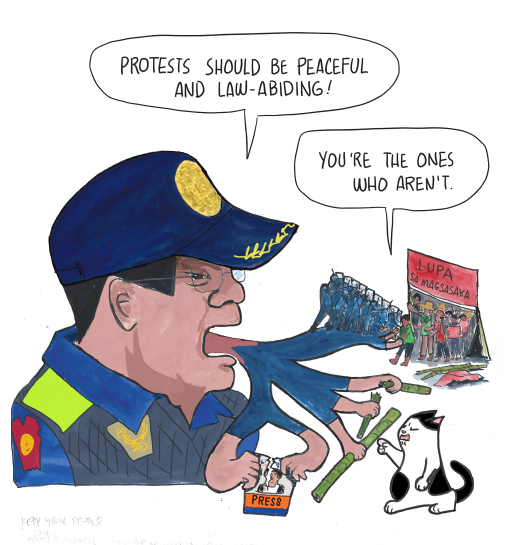
Tinig ng Plaridel condemned the police’s “brazen assault on campus press freedom,” saying the incident revealed the regime’s desperation to stifle critical coverage amid growing public outrage over corruption scandals.
By Shan Kenshin Ecaldre
Bulatlat.com
CABUYAO CITY — Student journalists and advocates nationwide denounced what they called a “brazen and dangerous” attempt by the Philippine National Police Anti-Cybercrime Group (PNP-ACG) to censor Tinig ng Plaridel (TNP), after X (formerly Twitter) notified the publication that police sought the removal of one of its news posts.
The targeted post features a video footage of youth activists burning a mock copy of a subpoena issued by the PNP- Criminal Investigation and Detection Group (CIDG)
to UP Diliman University Student Council Chairperson Joaquin Buenaflor, during a protest outside Camp Crame on October 27. The action was part of a youth-led mobilization condemning state harassment, police brutality, and what demonstrators described as “escalating government corruption.”
Censorship disguised as “law enforcement”
According to TNP, X informed the newsroom on November 11 that PNP-ACG reported the post for allegedly violating unspecified Philippine laws. Campus journalists slammed the claim as arbitrary and a clear abuse of state machinery to intimidate critical youth media.
UP Solidaridad, the broad alliance of student publications and writers in UP Diliman, said the report was part of a deliberate campaign to silence dissent.
“This harassment against TNP is a direct attack on freedom of the press and the right to free expression,” the alliance said. “The PNP-ACG weaponized its authority to silence documentation of youth resistance. This is censorship, plain and simple.”
Solidaridad emphasized that TNP’s coverage was ethical, factual, and within the bounds of responsible journalism, and that no state institution holds the mandate to suppress reportage exposing wrongdoing by authorities.
Crackdown on youth, not ‘national security’
The College Editors Guild of the Philippines (CEGP) linked the police action to what it described as a broader campaign by National Task Force to End Local Communist Armed Conflict (NTF-ELCAC) to repress critical youth formations and independent campus publications.
“The PNP is toothless against plunderers who flee abroad but relentless in attacking youth who expose corruption,” the Guild said in a statement. “This is part of a systemic crackdown by the Marcos administration to muzzle journalists and suppress dissent.”
CEGP also pointed to the timing of the incident, as the country grappled with the devastation wrought by Typhoons Tino and Uwan.
“State resources are being funneled into political repression instead of helping disaster-stricken communities,” the Guild added.
TNP: We will not be silenced
In a statement, Tinig ng Plaridel condemned the police’s “brazen assault on campus press freedom,” saying the incident revealed the regime’s desperation to stifle critical coverage amid growing public outrage over corruption scandals.
“It has become clearer that not even campus media is spared,” TNP said. “The PNP-ACG’s censorship tactics bare the regime’s desperation as Filipinos grow more averse to the stench of festering corruption.”
TNP vowed to exhaust all legal remedies and continue reporting despite harassment, red-tagging, and surveillance of student journalists.
“Point your crackdown at the plunderers you harbor, not at the youth who dare to hold you accountable.”
Campus Press Freedom Bill pushed forward
Campus press groups renewed calls for the immediate passage of the long-delayed Campus Press Freedom Bill, which seeks to institutionalize protections against censorship, budget cuts, prior restraint, and administrative and police interference in student publications.
Over recent years, campus publications have documented an alarming pattern of red-tagging, legal threats, digital sabotage, and police surveillance, especially in coverage linked to protests, human-rights violations, or corruption.
Advocates warn that the latest move against TNP signals a dangerous escalation.
“The succeeding attacks against campus press prove why the bill is urgently needed,” CEGP said. “An attack on one is an attack on all.” (RTS, RVO)
 Save as PDF




0 Comments