
“Instead of finally putting teeth into the constitutional prohibition against political dynasties, this counterfeit bill does the exact opposite.”
CAGAYAN DE ORO — House Bill (HB) No. 8389 or the proposed Anti-Political Dynasty Act was recently passed by the House of Representatives on third and final reading, with 267 legislators voting in favor. However, many groups have described it as a “watered-down” and “bogus” version.
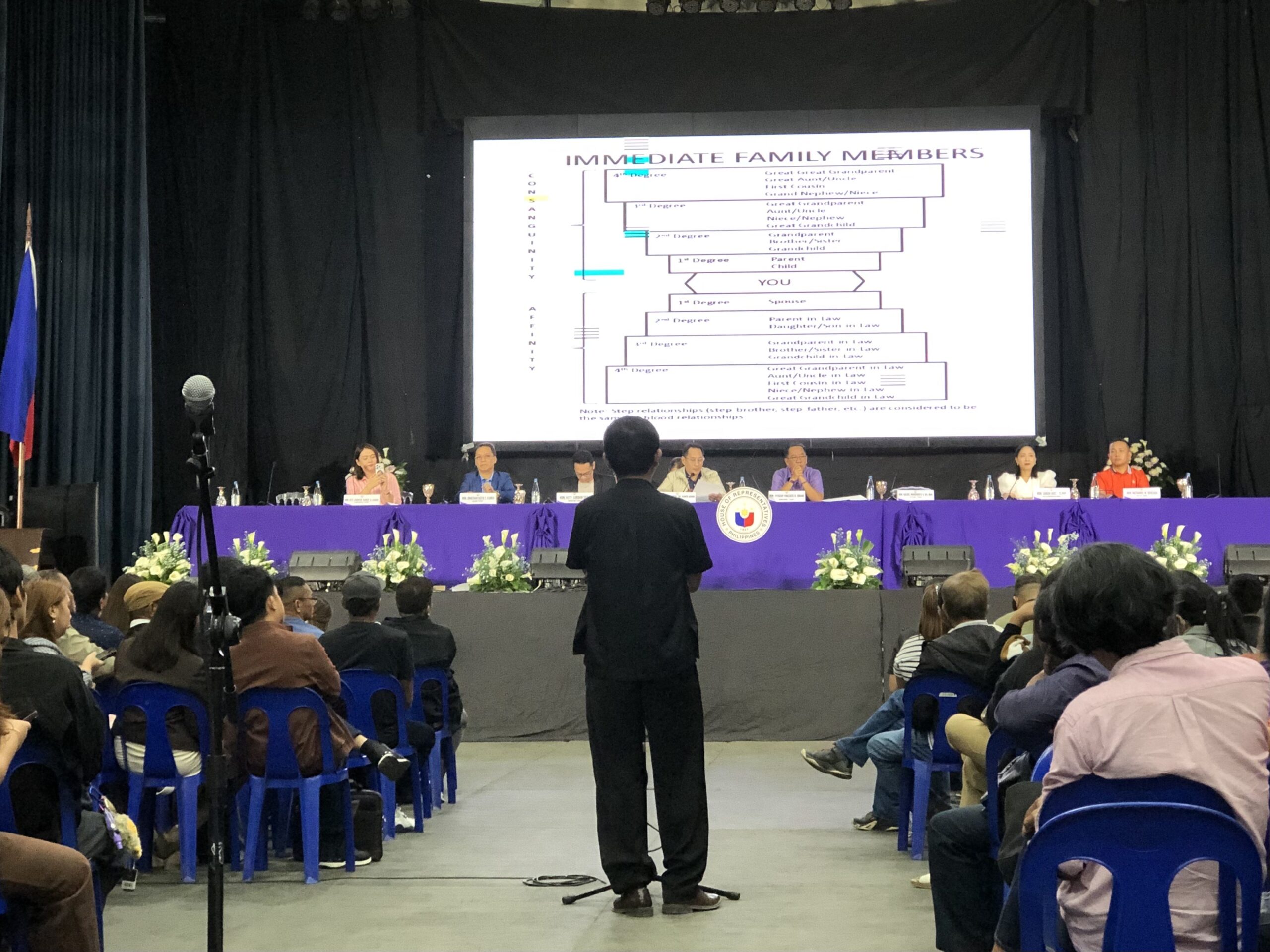
HB 8389 is a substitute bill consolidating 17 similar measures. Under the bill, spouses or relatives, whether illegitimate or half-blood, within the second degree of consanguinity or affinity are prohibited from holding simultaneously any elective position at the national level, which refers to positions of president, vice president, and senators.
The same prohibition applies to those who want to run as members of the House of Representatives and in provincial, city, and municipal governments, respectively.
This means that if a person holds an elective national position, for example, his or her relatives within the prohibited degree of relationship are barred from holding any elective position at the national level. However, they could run or hold elective positions at a different tier—a provision assailed by advocates.
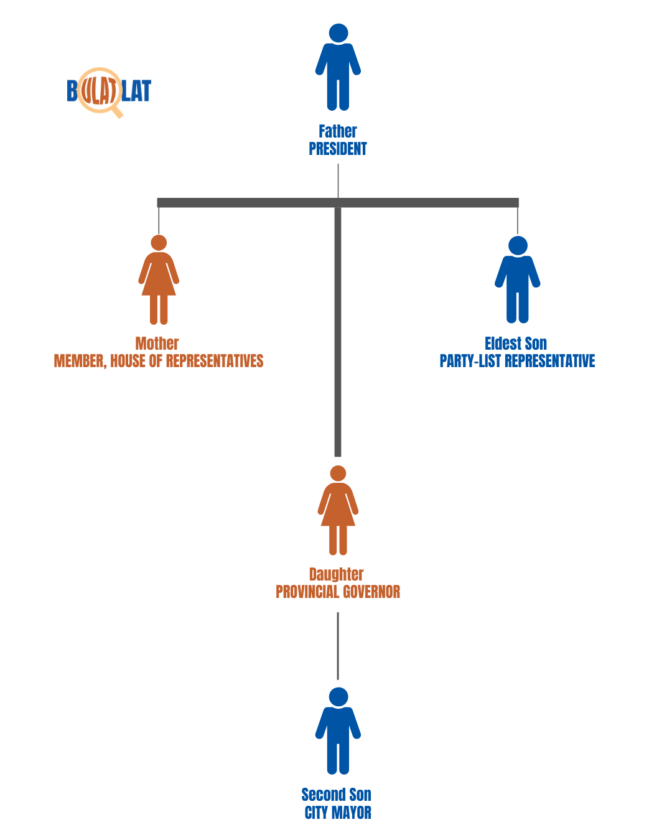
This pattern is notably reflected in HB 6771, one of the consolidated bills, filed by House Speaker Faustino “Bojie” Dy III and presidential son Ilocos Norte 1st District Rep. Ferdinand Alexander “Sandro” Marcos, although they proposed a wider degree of relationship which is within the fourth degree.
HB 6771 served as a working draft when the House version of the bill passed the committee level, where ACT Teachers Party-list Rep. Antonio Tinio described the procedure as a clear example of “railroading” the approval.
Nine of the 17 consolidated bills proposed only prohibition within the second degree of consanguinity or affinity despite public clamor for wider coverage.
Read: Mindanao folks prefer wider anti-political dynasty law
There was also no provision in HB 8389 pertaining to the prohibition of “succession,” which prohibits those relatives of an incumbent official from immediately succeeding to the position of the latter. Such a provision was specified in some of the consolidated proposed measures of the bill like HB 381 and HB 909, to name a few.
In a statement, the Taumbayan Ayaw sa Magnanakaw at Abusado Network Alliance (Tama Na) said that the proposed measure only imposes restrictions within each government level instead of directly prohibiting the simultaneous occupancy of public office by relatives.
“It is therefore clear that the Anti-Dynasty Law passed by Congress is deceptive and bogus,” Tama Na said.
On June 8, two days after the approval, the lower chamber transmitted the bill to the Senate.
Senate version
The Senate has yet to pass its version which is still pending on second reading.
But Senate Bill (SB) No. 1901, or the proposed Anti-Political Dynasty Act, has similar provision to HB 8389 when it comes to coverage (within the second degree of consanguinity or affinity), and it has almost the same scenarios prohibiting political dynasty relationships.
The difference in the Senate version is that spouses or relatives within the prohibited degree of relationship are not allowed to simultaneously hold or run for a seat within and across the party-list system.
Spouses or relatives are also prohibited from holding any elective position under the party-list system and any national or local elective office in successive, simultaneous, or overlapping terms.
Both the House and Senate versions have the same definition of national level, while local elective office, under SB 1901, refers to seats in the House of Representatives and all elected officials of local government units.
The Senate version also specifies that “succession or appointment,” whether in a permanent or temporary capacity, shall be considered as holding an elective office.
For Tama Na, the ideal anti-political dynasty legislation was the proposed measures introduced by lawmakers under the Makabayan bloc, namely HB 209 filed by Tinio and Kabataan Party-list Rep. Renee Co and HB 4784 filed by Gabriela Women’s Party Rep. Sarah Jane Elago.
Both bills prohibit a person from holding or running for any national or local office simultaneously with another person within the fourth degree of consanguinity or affinity. The prohibited degree of relationship also applies to the prohibition of succession.
“The anti-dynasty law must have real teeth so that politicians cannot manipulate or circumvent its provisions,” Tama Na said.
The proposed measures filed by Makabayan bloc lawmakers, however, were not part of the consolidated bills under HB 8389.
Betrayal
Carlos Isagani Zarate, former Bayan Muna representative, said that the passage of HB 8389 was a “historic betrayal” of the Constitution’s mandate, calling the bill instead a “Dynasty Preservation Act.”
“Instead of finally putting teeth into the constitutional prohibition against political dynasties, this counterfeit bill does the exact opposite. It provides a legal roadmap for dynasties to expand their empires with absolute impunity,” he said in a statement.
Prior to the 20th Congress, HB 3587 in the 16th Congress was reportedly the last anti-political dynasty bill that reached the House plenary. Zarate and another former Bayan Muna representative Neri Colmenares were among the authors. However, it did not progress from second reading.
Under HB 3587, spouses or relatives within the second degree of consanguinity or affinity were not allowed to hold or run any national or local elective office in the same election.
In an earlier statement, Tinio, Elago, and Co said they withdrew their support for the latest substitute bill, which they saw as a measure seeking to “regulate” instead to prohibit political dynasties.
Read: Anti-dynasty bill passed by House panel criticized: ‘Prohibit, not regulate’
Zarate viewed political dynasties as a root cause of systemic corruption. He said that it also stifles genuine democratic participation in the country, depriving capable leaders from the marginalized and working-class sectors.
The former lawmaker urged the Filipino people to continuously expose the flaws of the bill. “We must not let this legal deception pass unchallenged,” he said. “We should break these chains of dynastic rule.” (DAA)
 Save as PDF







0 Comments