
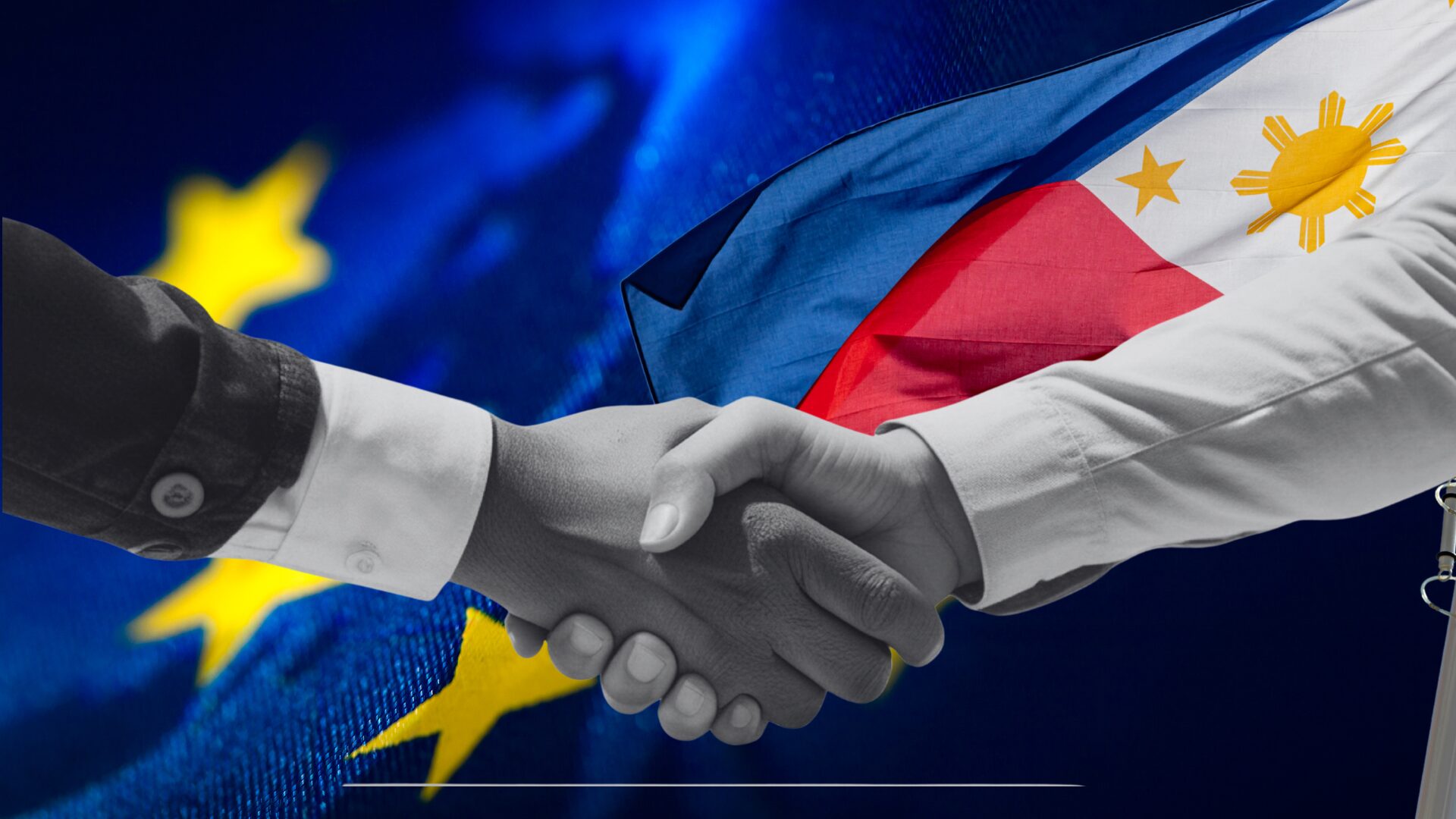
Communities suffer when trade agreements disregard human rights.
MANILA — The European Union (EU) is currently negotiating a Free Trade Agreement (FTA) with the Philippines and Filipino human rights defenders and Europe-based civil society are wary that this would exacerbate the human rights situation in the country.
“The resumption of FTA negotiations should not proceed as though the human rights crisis in the Philippines does not exist,” said Sol Taule, deputy secretary general of human rights group Karapatan, in a statement.
Taule and former political prisoner Amanda Echanis met with members of the European Parliament in Brussels, Belgium namely Marta Temido, Rudi Kennes, Marc Botenga, Catarina Vieira, Jörgen Warborn, and Francisco Assis. They discussed how the current state of human rights in the Philippines and how the previous trade agreements failed to significantly improve the lives of the marginalized sectors in the Philippines.
“Any agreement that claims to promote sustainable development must be assessed based on its impact on grassroots communities and people’s rights and livelihoods, particularly those of workers, farmers, Indigenous peoples, and human rights defenders,” Taule said.
In a related development, more than 20 European civil society organizations expressed serious concern that the EU’s drive to secure access to critical raw materials and expand market access is increasingly taking precedence over human rights, environmental integrity, climate objectives, the rule of law, and the protection of affected communities.
The signatories include the International Coalition for Human Rights in the Philippines (ICHRP) – Germany, Misereor, Aktionsbündnis Menschenrechte-Philippinen (AMP), Global Witness, International Action for Peace, Transnational Institute, We Social Movements, German NGO Forum on Environment & Development, Philippinenbuero e.V., PowerShift e.V., United Evangelical Mission, WEED e.V., Ecologistas en Acción, European Coordination Via Campesina, European Trade Justice Coalition, Franciscans International, and Friends of the Earth Europe, among others.
“Nearly a decade after the EU suspended FTA negotiations in 2017 due to serious human rights concerns regarding the killings in the ‘war on drugs,’ the Philippine government has failed to introduce the institutional and legislative reforms necessary to dismantle structures of impunity, guarantee access to justice, and prevent future violations. Instead of strengthening human rights protections, authorities have continued to rely on repressive laws and practices that enable abuse,” the organizations noted.
Initial provision of the EU-Philippines FTA states that its objective is to “liberalize and facilitate trade and investment, as well as to promote a closer economic relationship between the Parties.”
Initial negotiations for EU-Philippines trade and investment were launched in December 2015. However, it was put on hold in February 2017 due to the blatant human rights violations in the country associated with Rodrigo Duterte’s so-called “ war on drugs.”
There are more than 30,000 victims of drug-related extrajudicial killings, according to human rights watchdogs. Only five cases resulted in conviction, according to Amnesty International Philippines, but some of them remain on appeal.
While Duterte is currently facing charges on crimes against humanity of murder and attempted murder before the International Criminal Court (ICC), human rights violations persist under the administration of Ferdinand Marcos Jr. Drug-related killings continue, with UP Third World Studies documenting more than 1,200 victims as of this writing.
Karapatan also documented more than 130 extrajudicial killings related to counterinsurgency, 16 victims of enforced disappearance, and more than 800 victims of arbitrary and unjust arrests. The group also noted that the peasant/farmers sector face the highest toll of attacks.
Echanis underscored that this is associated with the persistent challenges confronting rural communities, including land monopoly and landgrabbing by big landlords and corporations, the absence of genuine agrarian reform, and the harmful effects of trade liberalization policies that exposed local producers to unfair competition.
“For decades, Filipino farmers have been told that free trade would bring prosperity and development, yet most remain impoverished, burdened by rising production costs and low farmgate prices, and with limited access to land and productive resources,” Echanis added.
The European Commission’s 2019 Sustainability Impact Assessment had already flagged that an EU-Philippines free trade agreement could pose human rights risks, especially for indigenous communities, women, and children.
Some of the concerns it cited are potential uptick in child labour, the drive for land conversion due to the growth in manufacturing, threat to indigenous communities’ ancestral lands, and more land disputes.
The EU-based organizations state that despite major shifts in the political, economic, and geopolitical landscape, no revised or independent Human Rights Impact Assessment has been carried out since trade negotiations picked back up.
“The EU faces a clear political choice. It can align its trade policy with its stated values, legal obligations, and climate and environmental commitments — or it can proceed with an agreement that risks entrenching repression, dispossession, biodiversity loss, deforestation, and environmental destruction in the name of economic and strategic interests, especially for export-oriented corporations,” they said.
The groups fear that if the EU-Philippines FTA negotiations will conclude under the current conditions in the country, it would set a dangerous precedent for future trade negotiations.
They urged the EU to conduct a comprehensive and independent human rights impact assessment and to press the Philippine government to take concrete steps to address impunity and implement reforms related to extractive industries, counter-terrorism laws, and protection of human rights defenders.
This year, the Philippines faced greater human rights scrutiny. It has been included in the Monitor Watchlist of global alliance CIVICUS World Alliance for its crackdown on dissent and criminalization of activists.
The country was also among the lowest performing countries in Southeast Asia when it comes to human rights compliance, based on the New Zealand-based Human Rights Measurement Initiative.
Read: Philippines on human rights watchlist due to crackdown on dissent
Read: Philippines’ human rights record worse than average in Southeast Asia
The Philippine government lost its bid for a non-permanent seat at the United Nations Security Council (UNSC), an organ that can make legally-binding decisions that UN member-states are obligated to implement. It failed to secure the required two-thirds majority of the UN member-states, losing to Kyrgyzstan for the representation of the Asia-Pacific group.
Read: Philippines’ failed bid for UNSC seat reflects human rights record
“Unless there is meaningful, measurable progress on human rights, environmental protection, and climate safeguards, the EU must halt negotiations and refrain from concluding or ratifying the agreement,” the groups added. (RTS, RVO)
 Save as PDF


0 Comments