
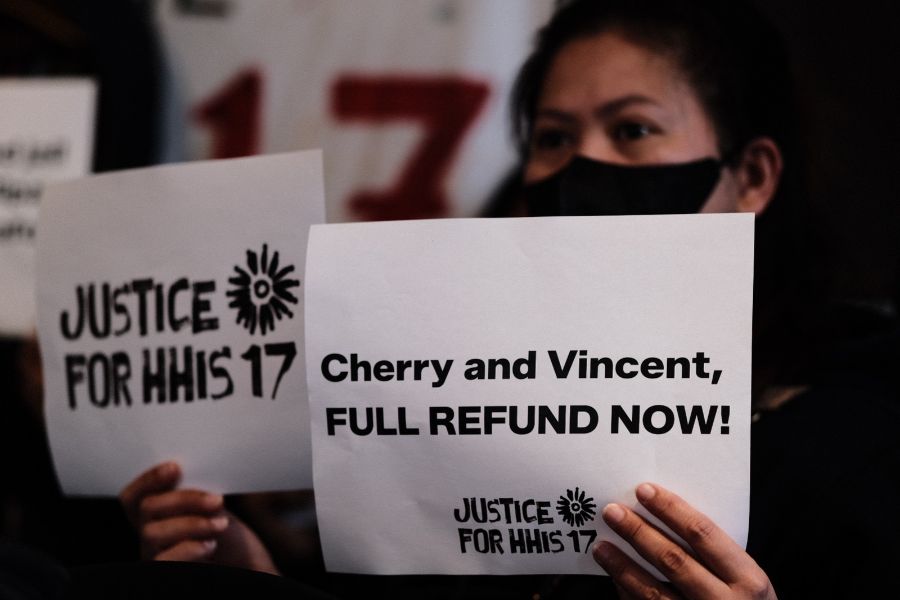
TORONTO – Seventeen Filipino temporary foreign workers (TFW) in British Columbia (B.C) have come forward to campaign against fraudulent recruitment agency Helping Hands Immigration Services (HHIS) that trafficked them into precarious conditions.
In a press conference held with Migrante BC and Damayan BC, the workers described how they became victims of labor trafficking, including being forced to work long hours, receiving inadequate pay, and experiencing wage theft.
The 17 migrant workers who came from Taiwan, worked over four months in Newfoundland as seasonal workers at a seafood processing plant. After their seasonal employment, they were referred to HHIS recruiters Cherry May Ricafort and Vincent Macalipay to process extension of work permits. According to the workers, the two allegedly took advantage of the situation knowing that they were newcomers and that their work statuses were about to expire.
“We left the Philippines with our hopes and dreams. With the desire for a better future for our families, we took risks working in different countries,” one of the workers said.
In the Canadian immigration system, the Temporary Foreign Worker Program allows Canadian employers to hire foreign workers to fill temporary jobs when qualified Canadians are not available.
There are two main types of work permits in Canada, an employer-specific work permit or commonly known as a closed-work permit, and an open work permit (OWP). A Labour Market Impact Assessment (LMIA) is a document that an employer in Canada may need to obtain before hiring a foreign worker.
HHIS recruiters Ricafort and Macalipay promised to process the workers’ two-year LMIA and work permit for harvester/laborer work in British Columbia. The recruiters received an initial fee of CA$5,000-8,000 (~P221,000 to P354,000) that was sent to Ricafort’s personal bank and some to a registered business account Strive Employment and Labour Contractors Services Ltd. (Business #745000836).
After receiving initial payments, the recruiters instructed the workers to travel to Vancouver to sign an agreement. Under the agreement, the workers had to undergo a probationary period to prove they are capable of performing farm work. However, some of them were brought to work at hotels, some were brought directly to farms in Keremeos.
Five workers were sent to different hotels to work as housekeepers. Some were assigned to Best Western Plus at Marina Drive and the others at Grand Park Hotel in downtown Vancouver.
Ricafort instructed the workers to keep quiet and not talk to anyone about their working conditions. The workers spent two months working at the hotels before learning that they were being paid CA$7.50 (~PHP330) per room cleaned instead of the proper hourly pay which was never explained to them before they started working. The minimum wage in the province is CA$18.25/hr (~P800) and living wage in Vancouver is CA$27.85/hr (~P1,230).
When they learned that there was no LMIA waiting for them, the workers decided to withdraw their application and asked for a refund. But Macalipay told the workers that it was non-refundable, and threatened the workers that if they don’t vacate their temporary housing, he would call the police and the Canada Border Services Agency (CBSA) because they have no legal status in Canada and they can be deported.
Twelve of the workers were deployed to three farms in Keremeos, Lidhar Farm Lasser Produce and Mom and Pops Farm Market and were instructed not to tell coworkers about their situation and employment status and that they could only talk to Ricafort and Macalipay about their employers.
“Many of us worked for long hours, about 80 to 100 hours per week but we only got paid for 40 hours and were deprived of a day off. Our employers would remit our salaries to Cherry and Vincent. Before we get our monthly pay, our recruiters would deduct CA$500 (~PHP 22,115) from all of us for the ‘processing fee’,” a worker said.
The workers also disclosed that they were told that they would be charged CA$120 (~P5,300) per month for their accommodation but when they received their salaries, each of them had been charged with CA$350 (~PHP 15,480).
At Mom and Pops Farm Market, the workers learned that Macalipay told their employers that they had a two-year work permit. However, when they talked to their employers, they revealed they do not have plans on obtaining LMIAa for them. When the workers discussed their situation among themselves, they learned that other farm workers are experiencing similar conditions.
At Lidhar Farms, some of them repeatedly asked Macalipay about their LMIA, their wages, and the deductions. They were told that their pay would be fixed once their work permit gets fixed but they were also told that that’s how much the employer can afford to pay them. Because of the lack of clear response on their documents and pay, they pushed back and said that they will not go back to work until they were given their work permits. Their demands were not granted, leaving them feeling compelled to continue working despite their objections.
Their employer from Lidhar Farm got mad and confronted them and eventually told them to leave the farm. That’s when they got connected to Migrante BC and Damayan BC who helped them leave the farm.
Now the workers are waging a campaign against their illegal recruiters and demanding protection for migrant workers who have been victimized by fraudulent recruiters.
“Not an isolated case”
Adam Arca, deputy secretary general of Migrante BC, highlighted that this is not an isolated case but a broad trend all over the globe and in Canada that “takes advantage of and deliberately targets desperate and hope-driven migrants who are forced from their homelands to provide for their families only to be treated as commodities in a profit-driven system through labour trafficking.”
According to Arca, the precarious situation of migrants in Canada has resulted in the desperate attempts to find work which malevolent consultancies and employers take advantage of for their own gain. He said that so far, the Canadian government has not acted systemically enough to aid victims of labor trafficking, but rather, enabling it.
Arca also criticized the Philippine government, saying the state contributes to the problem. “We are seeing 10,000 Filipinos leave the country every day to work abroad due to the legacy of the Labour Export Program (LEP) introduced in 1974 by Ferdinand Marcos Sr by the same corrupt governance that reigns true today through his son and has effectively expedited the mass migration of people out the country to counteract governmental debt, civil unrest, and a lack of public services to support people at home. All over the world now, Filipino migrants are being labour trafficked, bombed on, violently deported and unjustly detained.
“Both Canada as a labor-importing country and Philippines as a labor-exporting country solidifies their role as aiding in and enabling labor trafficking and labor exploitation of migrants within the global economy,” Arca added.
Bulatlat received reports that, immediately after the press conference, migrant-rights groups in British Columbia were informed of at least eight other confirmed cases involving HHIS, with potentially more victims yet to come forward.
The Justice for HHIS 17 campaign, led by Migrante BC and Damayan BC, is seeking legal, financial, and case support to sustain its efforts. (RVO)
 Save as PDF






0 Comments