
By Aurelia Solaba
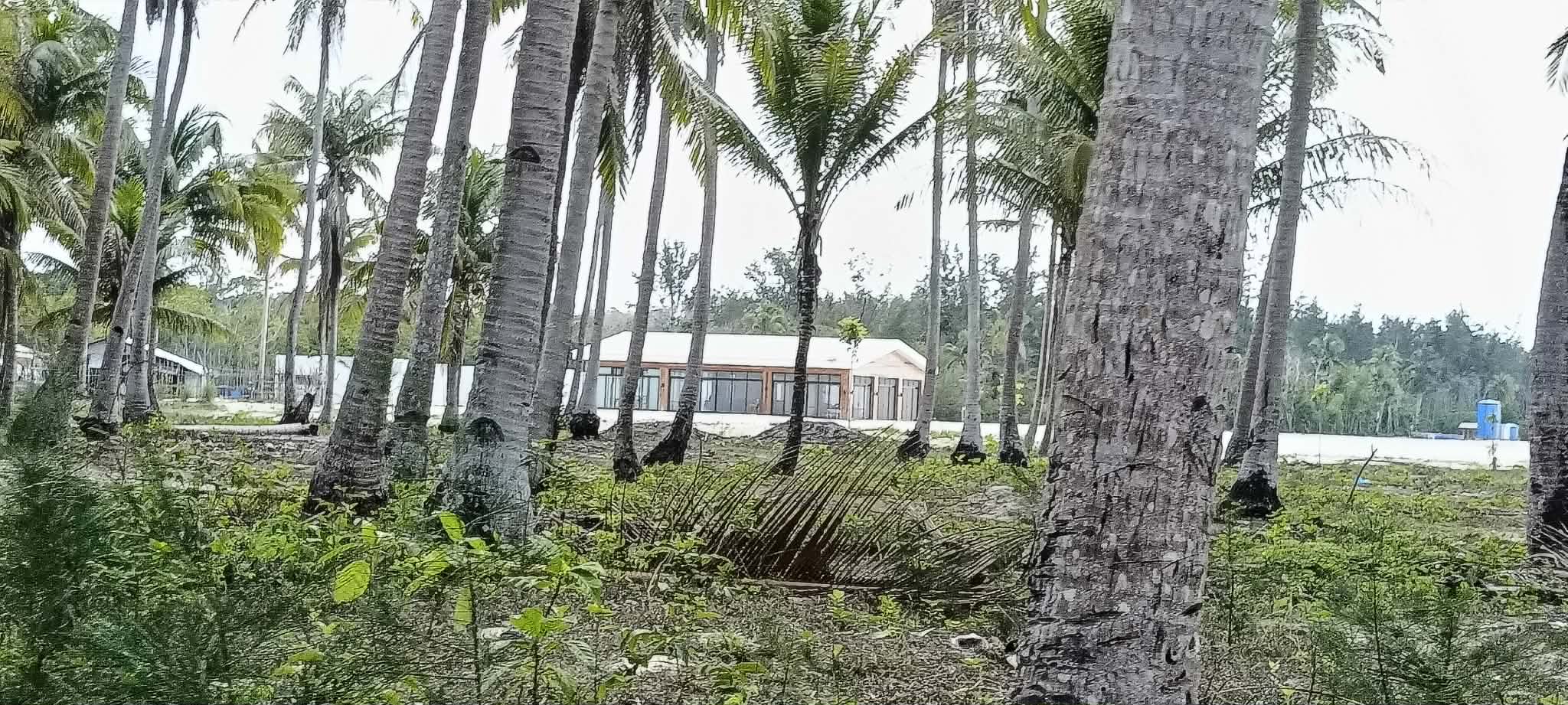
The homes of the Cuyonon, Kagayanen, and Palaw’an indigenous residents of Barangay Sebaring, Bugsuk Island, Palawan have been at the mercy of changing tides not just from the flow of the seawater but also from the whims of a powerful company.
Just like their neighbors in Sitio Marihangin, the community is facing displacement because of ecotourism plans in the area. Unlike Sitio Marihangin, however, San Miguel Corporation has no direct involvement.
Barangay Sebaring’s opponent is an entirely different enterprise, the Normal Holdings and Development Corporation.
Cycle of relocation
In 2018, the company purchased the mother title of Barangay Sebaring from the Gabinete family. The deal did not include the islanders’ homes but the corporation wants their land anyway.
Alex (not their real name), an ally of the islanders, said that the residents’ part of the barangay exists because “umurong yung dagat” (the sea receded) and the shoreline expanded. The newly formed beachfront was beyond their original ancestral domain which was the titled property of Honorio Gabinete and Pedro Gabinete.
As a result, the community relocated to excess land now known as Lots 4625, 4626, and 4628.
“When the island got bigger, the [Gabinete heirs] subdivided it and sold it to us so that we would have a place to live because the Gabinetes just let us stay here,” Hannah (not her real name), an indigenous Kagayanen resident of Barangay Sebaring, said. She added that the sale occurred in 2002.
Eight years later, the community is once again facing relocation. Only this time it is paired with repeated incidents of harassment and allegations of administrative abuse.
Never free
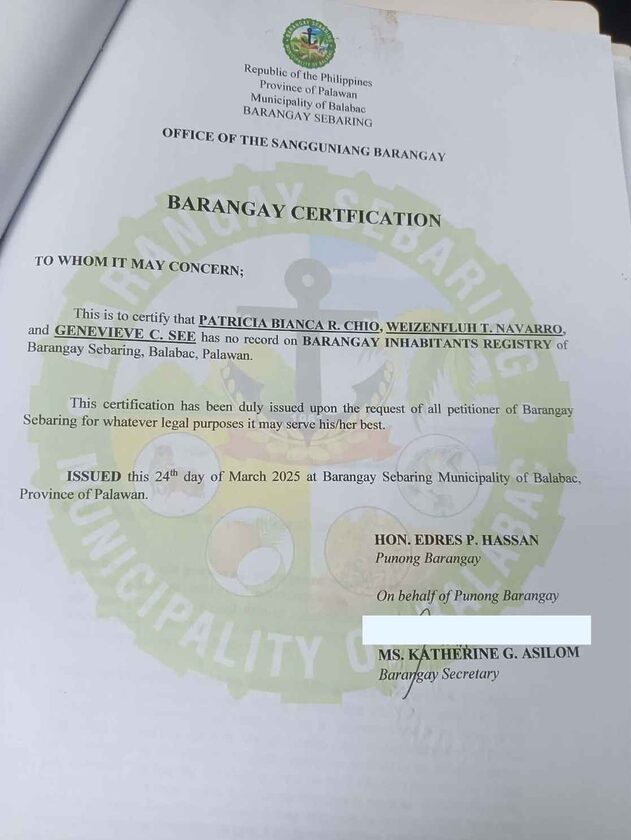
On January 27, 2025, the community received Department of Environment and Natural Resources (DENR) notifications that Patricia Bianca Chio, Weizenfluh Navarro, and Genevieve See applied for free patents over the lots they call home.
Hannah and other legal documents mentioned Rodrigo Salo-Ay as Navarro’s co-claimant, however his name is absent from the Notices of Application.
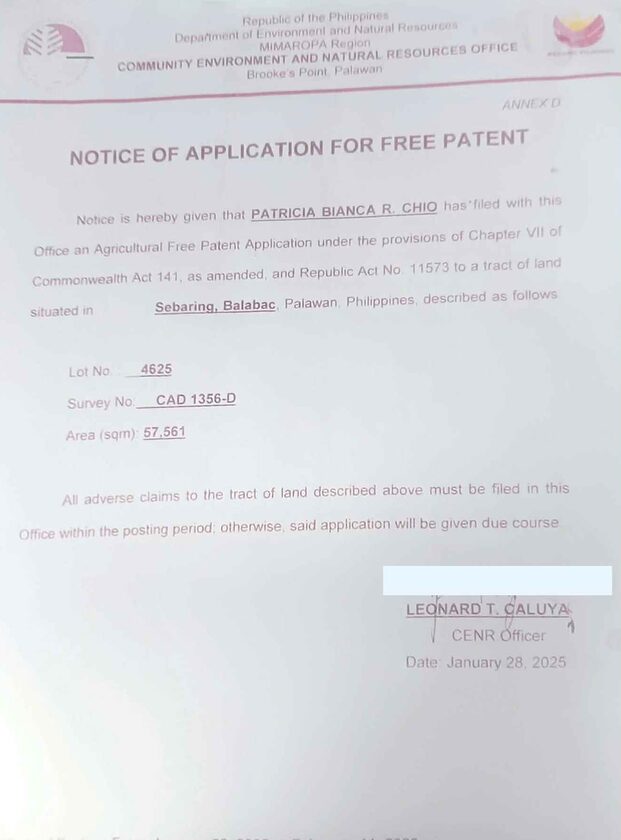
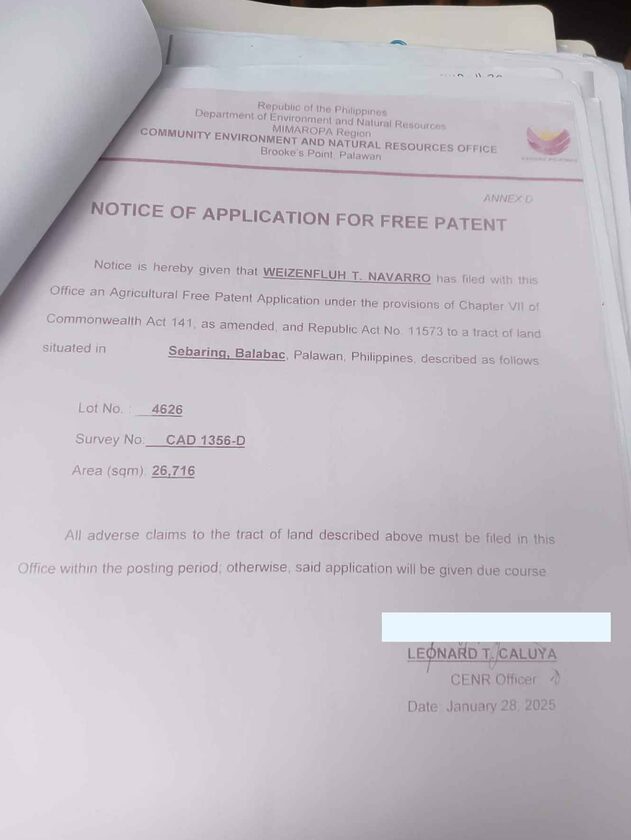
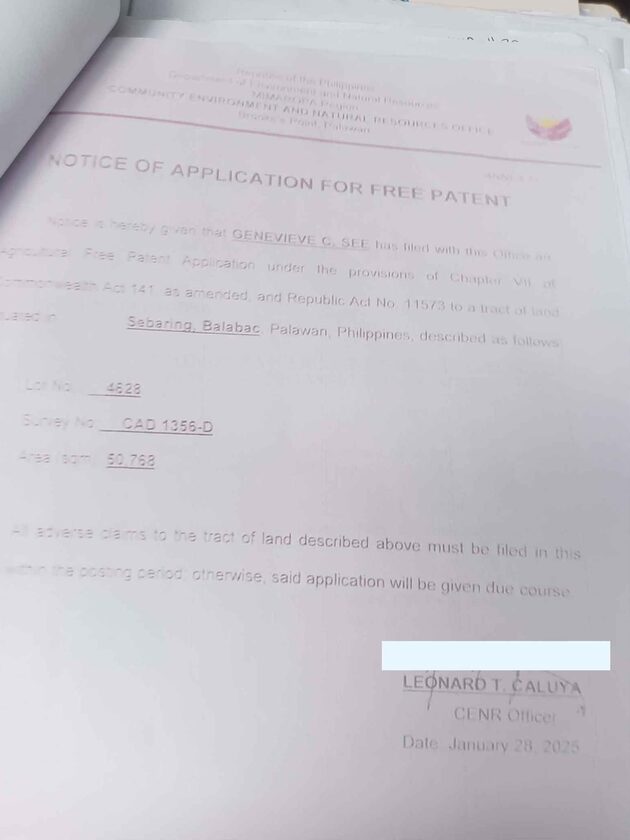
Notices of Application for Free Patent to claim Lots 4625, 4626, and 4628 that were distributed to indigenous residents of Brgy. Sebaring. | Contributed Photographs
According to Romilano Calo, chairperson of the Sambilog – Balik Bugsuk Movement that has been assisting the residents, the four individuals are supposed affiliates of Normal Holdings and Development Corporation.
If recognized, the free patents will give legal titles for Lots 4625, 4626, and 4628 to the four individuals without need for payment. However, a prerequisite for a free patent is that claimants have freely and openly occupied an area for at least 10 years.
Until now, Hannah said that nobody in Barangay Sebaring has ever seen Chio, Navarro, Salo-Ay, or See.
Hannah and her community refused to accept the sudden loss of their homes to outsiders. Within 15 days, on February 11, 2025, they filed their first verified protest against the Notices of Application at the Brooke’s Point Office of the DENR.
The case was rejected.
“The DENR Brooke’s Point [office] denied [our protest] because they said that we need a [Certificate of] File Action that would be provided by our barangay. We called… our attorney [from Sambilog] and they said, we don’t need a File Action because those who applied [for Free Patents] are not really from Barangay Sebaring,” Hannah said.
Emboldened by their attorney’s advice, they filed a new protest on March 28, 2025, where the DENR required them to prove their occupation of the disputed lots. For Alex, the barangay’s denial of Certificates of Residency to some community members of Barangay Sebaring complicated the issue.
Hannah and Calo opined that the Sebaring barangay office has allied itself with Normal Holdings and Development Corporation.
“We don’t have direct evidence to show that the barangay captain is directly involved in this [land dispute issue],” Alex said. “But what we do know is there is a refusal to perform the duties of the barangay itself.”
Cost
Despite the lack of official support, the community continues to exhaust administrative remedies for addressing the dispute.
Without proper funding from the barangay, the residents scrape together money to cover fuel, notarization, and printing expenses for every hearing or required document. Some residents borrow money to give a small amount, even if nobody can afford to lend anything, Hannah said.
Their protest came to a head on July 23 during their third DENR hearing. Here, the DENR–Community Environment and Natural Resources Office (CENRO) of Brooke’s Point offered Hannah and approximately 46 other Barangay Sebaring residents a settlement offer.
Hannah felt like the DENR-CENRO was pressuring them to accept the compromise agreement with a waiver of protests and quitclaim.
She refused to sign, partly due to lack of sufficient explanation and documentation for a relocation.
“They wanted to remove us from the site where our house is already standing […] The plan was for us to be relocated, and—per the agreement made with the DENR—a licensed geodetic engineer was supposed to visit to assess the property and calculate the costs. The problem is, the relocation plan never materialized, nor did the valuation of our house,” she said.
She stressed that the offered relocation site is Lot 4625 which is part of the free patent applications. She said that accepting an unguaranteed home there would repeat the cycle of displacement.
Fourteen other residents at the hearing did not sign the agreement because of similar concerns, she said.
However, what cemented Hannah’s rejection of the compromise from the DENR–CENRO was a clause that read: “Na ang magkabilang panig ay nagkasundo nang malaya, kusang-loob, at walang sinumang namilit, nanakot, o nanlinlang sa kanila, at kanilang lubos na nauunawaan ang nilalaman ng kasunduang ito” (That both parties have agreed freely and voluntarily, without anyone coercing, threatening, or deceiving them, and they fully understand the contents of this agreement).
She said the statement is false. The daily reports of her family, friends, and neighbors attest to the fact that, in many small and large ways, they have all been threatened.
Wrecking local property
According to Hannah, security guards from the Lab Security Agency were first deployed in 2024.
Since then, guards have routinely hounded the residents, asserting that their homes are the property of Jong Balbon—the supposed executive vice president and general manager of Normal Holdings and Development Corporation.

The guards’ harassment went viral on August 29 this year, when they attempted to enter the home of JV Gabong, an indigenous Palaw’an resident who also refused to sign the agreement.
The guards reported Gabong to the DENR, accusing him of using freshly cut trees to construct a new house. In reality, he was renovating his kitchen, using only light materials: round timber and recycled wooden boards which he bought from a fellow indigenous family.
During the site visit, DENR personnel determined the accusations were false and allowed the renovations to continue.
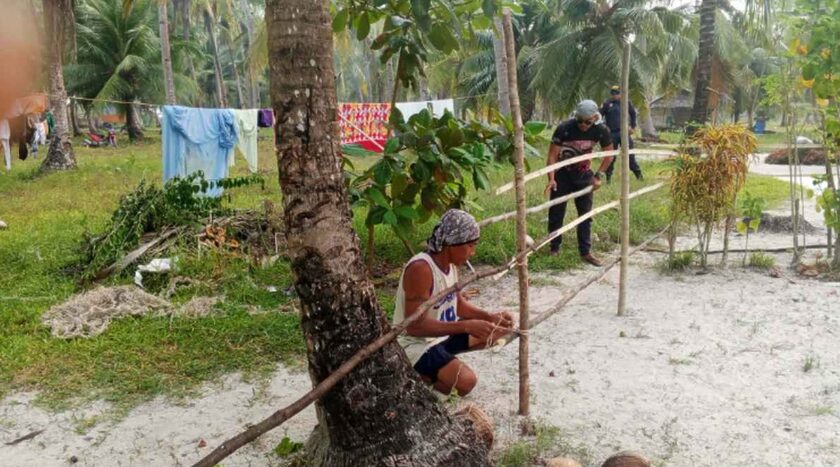
Lab Security Agency guards, accompanied by a DENR personnel, the Barangay Captain of Sebaring, and his secretary at Gabong’s home on August 29. | Contributed Video
Before this incident, the guards already entered Gabong’s home three times on August 8, and once more on August 10. The guards stopped all his repairs since it was “their boss’s orders,” Hannah said.
On August 30, the day after the viral video, a local police officer checked on Gabong’s home. The visit offered no protection because the guards returned anyway.
They destroyed a small bamboo fence Gabong built to keep them away from his family whenever he leaves to work as a fisherman.
Fencing
The islanders are not the only ones who erect fences. Normal Holdings and Development Corporation and its affiliates do too—and theirs are made of barbed wire that stretches to the sea.

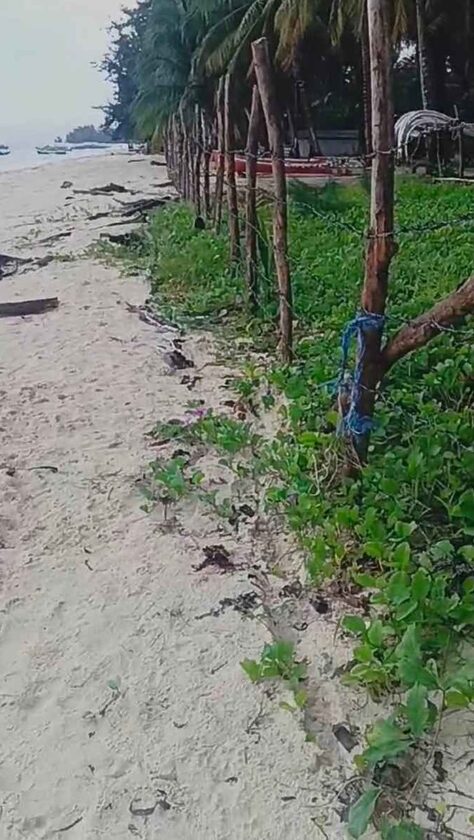
Two separate pictures of the barbed wire fence erected by Normal Holdings and Development Corporation around Barangay Sebaring. | Contributed Photographs
Their fence was constructed despite ongoing DENR negotiations. It blocks routine pathways in the middle of the island so Barangay Sebaring residents cannot avoid the water and beachfront.
Now, the only way past the metal strands are a small door or the sandy shore near a mangrove swamp—the territory of saltwater crocodiles.
The size of the door prevents resident Pastor Apolinario Panolino, who Hannah says is also fighting the company’s land claims, from doing his job.
He usually makes regular trips on a topdown motorcycle to purchase and deliver goods for local stores. However, all his excursions are halted because his delivery vehicle cannot fit the gate’s entrance.

Meanwhile, in Sitio Binasag, a sub-village of Barangay Sebaring, the fencing forces residents to walk along the beach. There is no path during high tide as the seawater rises to waist-level so they wade through the sea.
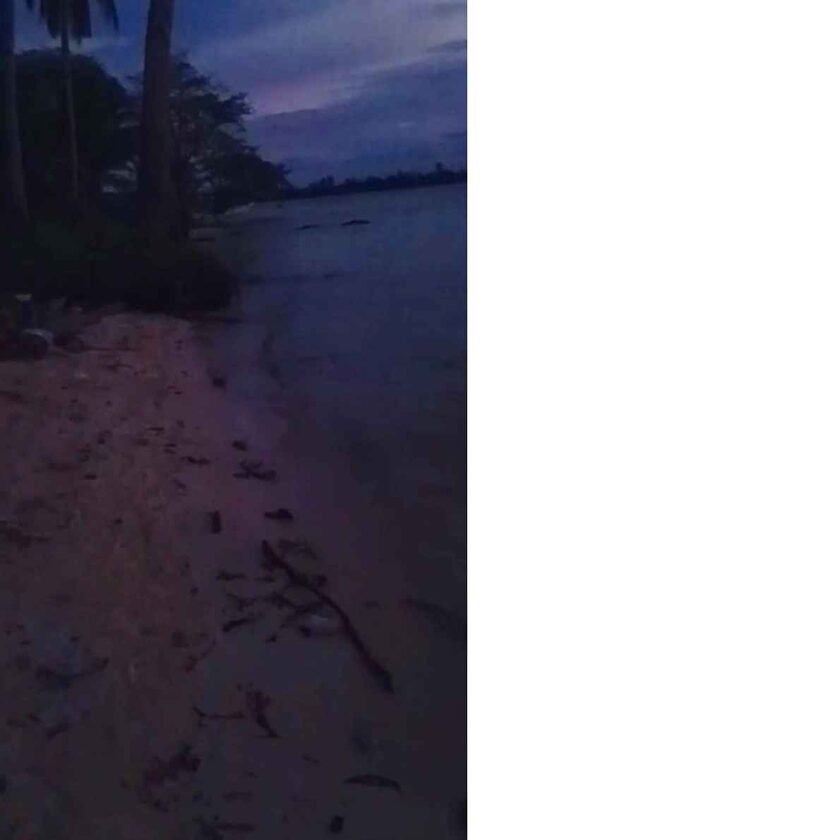
A fatal crocodile attack reported on January 14 happened along the shore. The victim was Hannah’s cousin who was walking home with her sibling through the water.
Her sibling made it home but her cousin did not.
“The next day, our nephew arrived and asked my sibling if his father had slept here. My sibling said no. That was when they started searching, and the next day, my cousin was found. His internal organs were gone. His body was mangled, with his hands and head missing—only his pharynx was still attached,” she said.
Cannot be bought
As of this writing, the administrative toll has begun to intensify.
According to Calo, following the failure of the Brooke’s Point compromise agreement, the community’s case has been elevated to the DENR–Provincial Environment and Natural Resources Office. “The reality is that we go unnoticed because we are located in such a distant area. The government remains unaware of what is happening to us Indigenous Peoples… Here in Palawan, when we seek help, it feels like we have no hope. I am appealing for someone from the national government to come down and inspect the area so they can see the actual situation of the tribes,” Hannah asserted on behalf of her community.
The community is still waiting for a responses to their protest in the DENR and appeal for government visibility.
For now, Normal Holdings and Development Corporation carries on with its business while Barangay Sebaring’s residents feel their lives are being swept away by institutions that cannot (or refuse) to help. (AMU, DAA)
 Save as PDF
0 Comments