
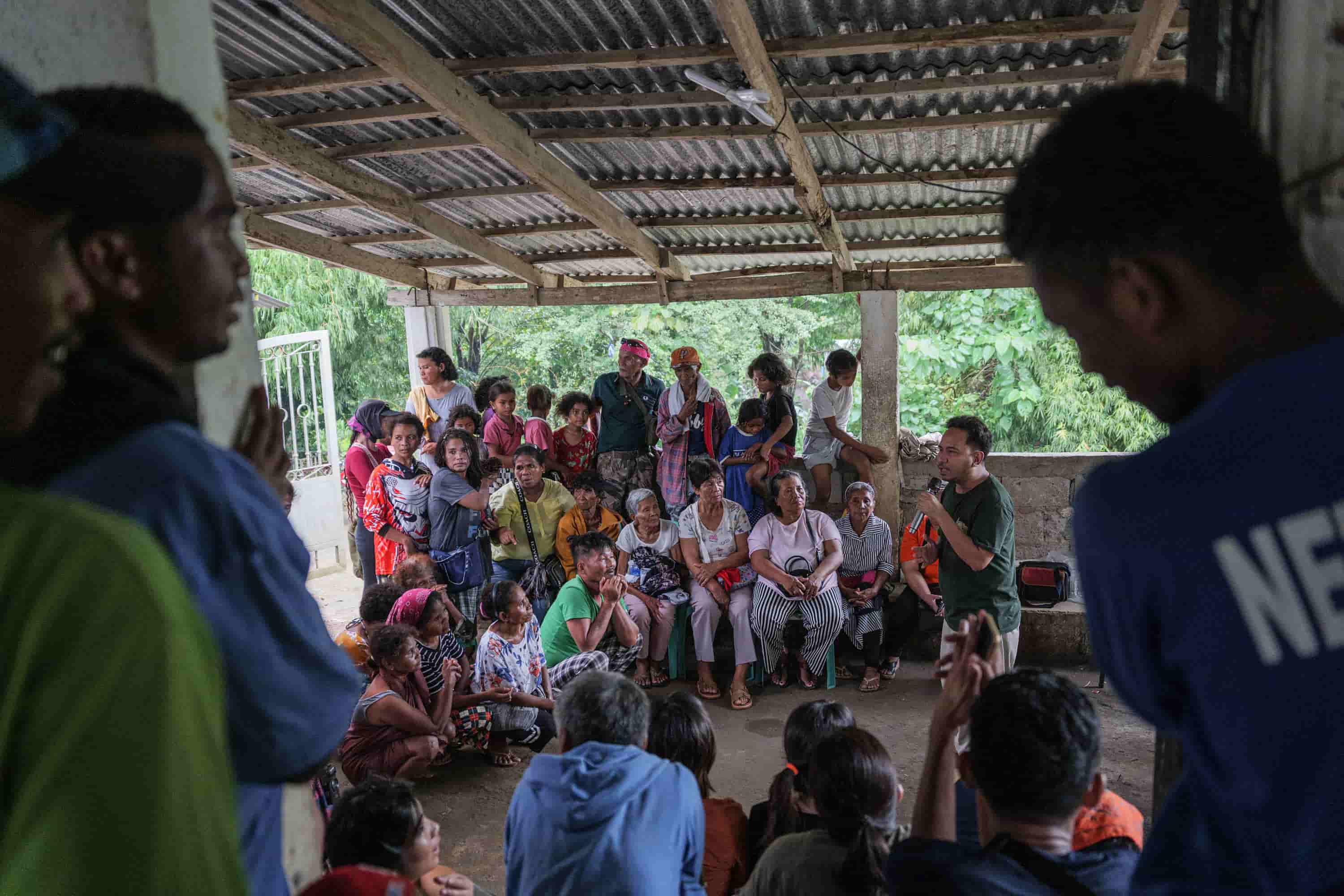
“It was really built to cater to corporations. Any semblance that it protects IP rights and allows Indigenous peoples to say no is gone.”
Mandor Matias, 45, has lived all his life on his family’s land in Sitio Binyayan in Capas, Tarlac. He and his relatives plant rice and vegetables on about three hectares of land. But on July 15, employees from the Bases Conversion and Development Authority (BCDA) came to his house. They pointed to the planted land in front of it, handed him a paper to sign and offered P30 (USD 0.47) per square meter, or about P900,000 (US$ 14,100) for all three hectares.
“They gave me a paper and asked me to sign it. I said I didn’t need to sign it. If I signed it, it would be as if I had accepted payment,” Matias told Bulatlat in Filipino.
He was not told why they were being pushed to sell their land. He later learned through social media and then confirmed by their village head, that the Pax Silica hub, a U.S.-backed hub for artificial intelligence and semiconductor manufacturing, will be built on their land.
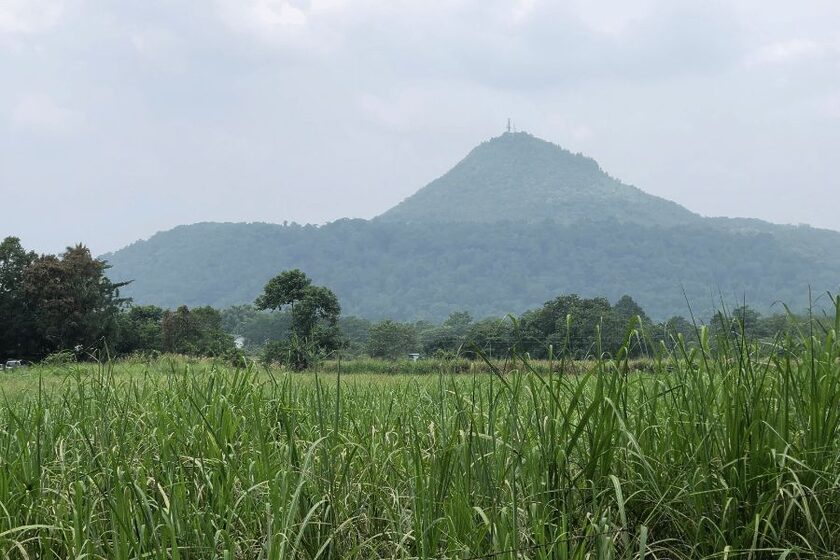
Matias is an indigenous Ayta. His home and farm now lie within the area of the proposed Clark Advanced Manufacturing Park, a 1,620-hectare hub in New Clark City that the BCDA is developing with the United States under the Pax Silica framework. Their fate may now be decided under new consent rules. In May, the National Commission on Indigenous Peoples (NCIP) approved the contentious amendments to the guidelines on free, prior and informed consent (FPIC), and a copy was only released publicly in September. The 2026 guidelines shorten deadlines, approve permits automatically when officials fail to act on time, and let some government projects pass with a document review instead of a full community vote. Indigenous groups warn the rules could clear the way for Pax Silica and other “development projects” on ancestral lands.
Fast-tracked FPIC process
The FPIC process could take months to years, especially when a project could greatly affect the ancestral land and the community is divided. The new FPIC guidelines run on tight deadlines: seven working days for the NCIP’s field investigation, 10 days for community assemblies on large projects and up to 60 days for the community to decide. If NCIP officials fail to act on time on a completed consent report, the certificate is issued automatically.
Government-funded projects need only a document review if they are “non-commercial.” Those with private partners or long-term impacts go to Category A or B, as the regional director decides. Projects that displace residents fall under Category A, the strictest track. But a project can get its certificate even before it is clear which households will be affected. Protections for those families can be settled later. Meanwhile, even after a community says no, the applicant keeps the right to refile.
Built for corporations?
Funa-ay Claver, an Indigenous youth leader and spokesperson of Katribu, said the BCDA may avoid FPIC altogether by insisting that no Indigenous people live on the site.
“It was really built to cater to corporations. Any semblance that it protects IP rights and allows Indigenous peoples to say no is gone,” Claver explained in Filipino.
She said the categories depend on a project’s scale, not on how many people it affects, and that manufacturing hubs are not mentioned anywhere. She added that the NCIP never released a draft for public comment.
Katribu said it is wary of even calling on the BCDA to “uphold FPIC.” Under the new rules, Claver said, consent risks becoming a checklist that only clears the way for the project.
BCDA consulted IPs?
At a media forum of the Foreign Correspondents Association of the Philippines (FOCAP) in September, BCDA President Joshua Bingcang claimed that they have always consulted communities whenever there’s a project or development within New Clark City. While showing pictures of what he described as consultations, he did not specifically say that they have already consulted, much less secured the consent of the Aytas living in the area where the Pax Silica hub will be built.
He called the hub site “already BCDA property” and promised, “We will not just kick them out… there will be consultations.”
Trade Undersecretary Ceferino Rodolfo, who was on the panel, said the site’s irregular boundary was drawn so the land is “already free of any communities.”
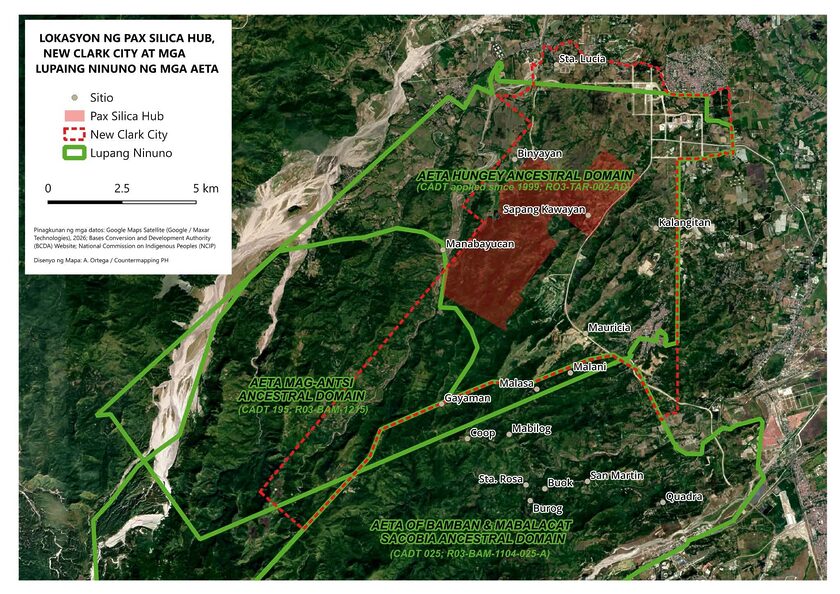
An overlay of the BCDA site on NCIP ancestral domain maps done by Countermapping PH, a group of geographers, shows that part of the site lies within an existing titled ancestral domain and that the entire hub falls inside the Aeta Hungey ancestral domain claim, which has been pending since 1999.
No consultation of Aytas in Pax Silica hub site
Petronila Muñoz, an Ayta leader, said no one talked to them before the hub was announced.
“No one. They just showed up there. They handed out letters,” she said.
Just two years after the NCIP was created, the Ayta Hungey first filed their ancestral domain claim in 1999, which is now under Certificate of Ancestral Domain Title (CADT) Application No. R03-TAR-002-A. Their ancestral land has yet to be formally recognized.
“What will become of us if we lose our ancestral land?” she asked, naming what is at stake: their church, their burial ground and their livelihood.
The Aytas will stand their ground
Matias say they will not leave their home and their lives and livelihood are rooted in their land.
“How can we leave if we don’t know of any relocation site to move to?” Matias asked.
Muñoz said that their opposition to Pax Silica is not only for them Aytas but for every Filipino because the project will destroy the environment.
“Our love for our ancestral land is equal to our very lives,” Muñoz said.
Matias said he tells his neighbors the same thing. “We just keep fighting. As long as we stay united. Let’s not allow Pax Silica to be built.” (RVO)
 Save as PDF


0 Comments