
The united voice of the indigenous peoples swept from continent to continent in 37 countries calling their respective governments to stop large-scale mining and other extractive activities (oil and gas projects) in their indigenous lands until effective measures to safeguard their rights and the environment are in place.
BY JO VILLANUEVA
INDIGENOUS PEOPLE’S WATCH
Northern Dispatch
Posted by Bulatlat
The united voice of the indigenous peoples swept from continent to continent in 37 countries calling their respective governments to stop large-scale mining and other extractive activities (oil and gas projects) in their indigenous lands until effective measures to safeguard their rights and the environment are in place.
The call for a global moratorium on extractive projects for oil, gold, gas and other mineral resources also include a demand that the World Bank must stop funding transnational mining companies in their effort to exploit the world’s natural resources.
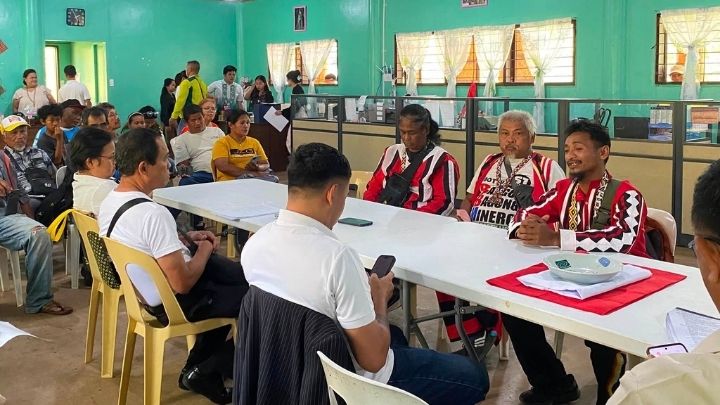
This is among their collective calls contained in the final Declaration that is set to be submitted to the United Nations, multilateral banks and government officials attending the International Expert Workshop on Indigenous Peoples Rights, Corporate Accountability and Extractive Industry held March 26-27 at the Legend Villas in Mandaluyong City.
Victoria Tauli-Corpuz, chair of the UN Permanent Forum on Indigenous Issues (UNPFII), said that following the growing and alarming reports by indigenous peoples against extractive industries, a recommendation was adopted during the 7th Session UNPFII, which authorized a three-day international expert group workshop on indigenous peoples’ rights, corporate accountability and the extractive industries.
The UNPFII is an advisory body to the Economic and Social Council, with a mandate to discuss indigenous issues related to economic and social development, culture, the environment, education, health and human rights.
Corpuz, a Kankana-ey from Besao, Mt. Province, Cordillera, said the results of the meeting will be part of reports that will be submitted to the Permanent Forum on its 8th Session, on 18-29 May 2009.
“We call for a moratorium on extractive industry projects that may affect us, until structures and processes are in place that will ensure respect for our human rights. The determination of when this can be realized and can only be made by those communities whose lives, livelihoods and environment are affected by extractive activities,” they said.
Further, they called for stronger mechanisms that should be enforced to fight the indiscriminate practices of extractive industries, which they said are often ignored or intentionally allowed by their respective governments.
They also want the World Bank to immediately stop financing transnational mining companies and commence phasing out its funding, promotion and support for fossil fuel- related projects, including large-scale mining projects.
“The World Bank must provide a timeline to end such funding,” the declaration said.
One provision in the United Nations Declaration on the Rights of Indigenous Peoples — the free, prior, and informed consent (FPIC) — poses serious disagreement with the World Bank, as the latter has not accepted such and instead coined and followed its own words to read: “free, prior and informed consultation.”
This, the IPs said, has been used by the World Bank and the transnational mining companies to skirt the law and push through with the extractive activities. They said that “consent and consultation” are two different words and each has distinct meaning.
“We want to request that UN to establish procedures which provide indigenous communities with the opportunity to request the relevant UN agencies to assist them in the monitoring and provision of independent information on FPIC processes,” they said.
In the Philippines,” free, prior and informed consent” is also embodied in the Indigenous Peoples’ Rights Act of 1997.
They added that World Bank group must update its operational directives and safeguard policies with regard to indigenous peoples and adopt the UNDRIP provision of free, prior and informed consent in all the WB assisted mining projects.
Indigenous lands around the world are facing massive threats from the influx of extractive industries, which the indigenous delegates to this second international conference claimed have appalling records of environmental destruction and widespread violation of the human rights of indigenous peoples.
The 85 delegates from 37 countries said they demand compensation for damages inflicted upon their lands and lives, and the rehabilitation of their degraded environment caused by extractive industries.
The delegates also proposed the creation of an international indigenous criminal court that would address the ill effects of extractive industries on the lives of indigenous peoples, including the loss of lives as a result of indiscriminate mining committed by transnational mining firms. The court, they said, must issue decisions based on the indigenous peoples’ customary laws. (Posted by Bulatlat)
 Save as PDF

I read this article and see why the poor in the Philippines get poorer. For god sake allow mining under a centrally controlled system that is able to keep the greedy at bay and put some wealth into the country, especially the deserving indiginious people. The above article is not set out or even look to to be in support of these desperate people. Please take their welfare into consideration before you go along the almighty global who har line.
Dear Sir
I being an indigenous cultural anthropologist, writer, poet, and human rights worker of the indigenous peoples in India, appreciate very much your initiatives. I shall be very happy to participate in your seminars and consultations.
M Bhuriya