
Humanitarian mission
In a statement released to the media in an Oct. 24 press conference in Cotabato City, the NIHM participants described the evacuees’ situation thus:
In the evacuation centers, the displaced persons suffer from inadequate facilities. Most of them have set up tents in whatever public place available. With heavy rains and flooding now common at this time of year, many child evacuees are sick with cough, cold, fever, and diarrhea. A number of evacuees have died of disease. There is also the trauma experienced by the evacuees, particularly the children.
Composed of human rights groups, relief workers, church-based groups, doctors, nurses, students, business groups, human rights advocates, peace advocates and various cause-oriented groups, the NIHM conducted human rights documentation, psycho-social and medical treatment, and relief operations for evacuees in Pikit and Datu Piang.
The NIHM documented various human rights abuses by the military in the two provinces. Violations included a raid in an evacuation center in Aleosan, North Cotabato. Evacuees interviewed by the NIHM in Pikit and Datu Piang narrated accounts of deaths due to strafing and aerial bombing, as well as threats and intimidation, torture, abductions, illegal searches and arrests, as well as divestment and destruction of property.
Among the prominent human rights violations documented by the NIHM was an Oct. 15 raid on a house, which had served as an evacuation center in Aleosan. The occupants were beaten up by the raiders, who were identified as elements of the Philippine Army’s 40th Infantry Battalion. Two of the occupants, Rakman Suleik and his son Samsudin, were taken away and brought to the Aleosan Municipal Police Office, where Rakman learned that there was a case against him. Samsudin, who delivered a testimony before the entire NIHM on Oct. 23, insisted that the soldiers who took his father did not show any warrant of arrest. Rakman is still in detention and there is no clear information on whether or not he has been charged with any offense.
“They had already evacuated (to escape the military’s atrocities), but even the evacuation center was not spared,” said Karapatan (Alliance for the Advancement of People’s Rights) secretary-general Marie Hilao-Enriquez.
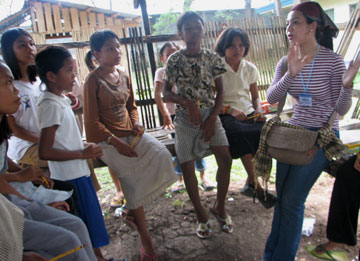
Meanwhile, the NIHM also assigned teams to conduct psycho-social treatment for the child evacuees. The psycho-social teams served a total of 214 children, and found manifestations of trauma in them, including restlessness and disruption of sleeping patterns. In the psycho-social activities, the children were asked to relate their experience regarding the conflict through sharing, drawings, and role-playing. The psycho-social teams noted that in their sessions, the children commonly expressed either fear or hatred of soldiers. Their drawings usually showed fighter planes dropping bombs on houses, the psycho-social teams disclosed.
The medical teams, who served a total of 192 patients, for its part noted that many of the patients were complaining of ailments that could be attributed to the conditions in the evacuation centers, such as ever, dizziness, headaches, skin and respiratory infections, and diarrhea.
The NIHM also conducted relief operations on Oct. 22, benefiting some 766 evacuees in Brgy. Batulawan, Pikit and Brgys. Tee and Poblacion in Datu Piang.
 Save as PDF


0 Comments
Trackbacks/Pingbacks