
Writ of amparo
While the AHRC welcomed the Supreme Court’s adoption of the writ of amparo and the writ of habeas data, the group noted that there have been strong reservations as to how judges are dealing with petitions. The group said, “…They [judges] are ignoring the fact that these writs are designed to provide urgent relief and not lead to exhaustive and lengthy procedures before decisions are issued. These are tools designed to protect the lives and security of persons.
The AHRC lamented that five petitions for writs have been rejected on the premise that the petitioners have failed to produce clear evidence of apparent or visible threats to their lives in recent times. “The courts’ decisions have run contrary to the writ’s intent as they cast the burden of proof concerning threats on the complainants,” it said.
Arming civilians
The AHRC also expressed alarm over the ‘re-emergence and strengthening of the government’s long-standing policy of arming civilians.’ The group cited the creation of the Police Auxiliaries (PAX) by the Philippine National Police (PNP).
The AHRC said, “The policy to arm civilians has given legitimacy to vigilantism and exposed civilians to greater risk of being caught in the armed conflict.” It said that vigilante groups reign in General Santos and Davao in Mindanao and Cebu in Visayas.

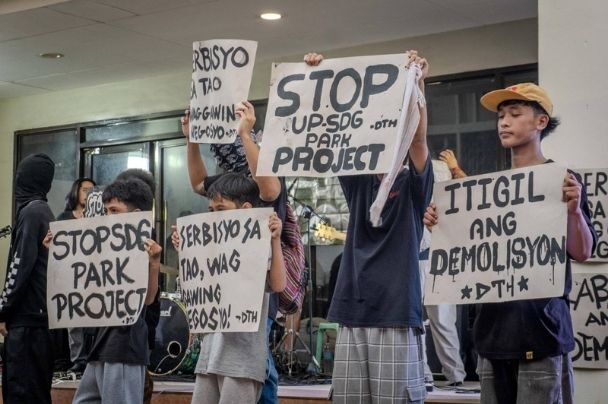
A protesters holds a placard during a rally marking the International Human Rights Day. (Photo by Ronalyn Olea)
The group called on the government to abandon its policy of arming civilians and to disband the Citizens Armed Force Geographical Unit (CAFGU), Civilian Volunteer Organization (CVO) and the Police Auxiliaries (PAX). “The continued existence and operations of these armed militias have already obscured the notion of state responsibility, permitting abuses of authority and rights while enabling impunity,” the AHRC deemed.
Domestic laws
The AHRC also called for the enactment of proposed laws regarding the criminalization of torture and enforced disappearance.
The group also said that no legislation concerning the principle of command responsibility with respect to extrajudicial killings has been enacted. The principle of command responsibility holds the higher ranking government official, military or otherwise, liable if he or she encourages, incites, tolerates or ignores any extrajudicial killing committed by a subordinate.
 Save as PDF





0 Comments
Trackbacks/Pingbacks