
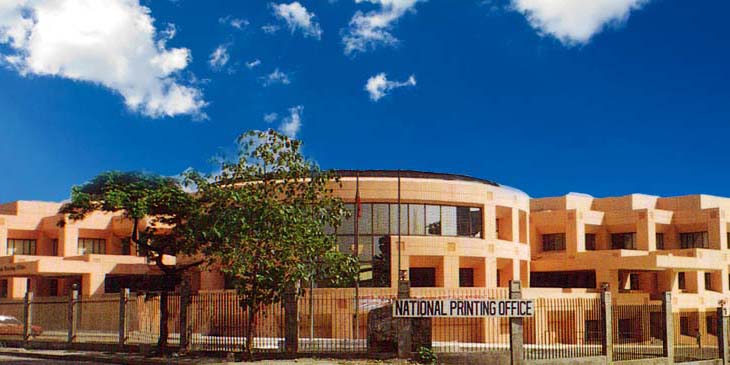
“They really want to abolish the NPO because of the kickbacks they would get when working with private companies.” — Teresita Crisostomo, employee, National Printing Office
By JANESS ANN J. ELLAO
Bulatlat.com
MANILA — Teresita Crisostomo has spent the past 37 years working for the National Printing Office. She receives a relatively high salary of P31,636 ($710) but only takes home around P6,000 ($136) due to her loan deductions.
The amount barely keeps her family afloat for a month, and so Crisostomo could not imagine how and why the government is allotting only a total of P6,000, not just for one person’s salary but – believe it or not – for all the 441 employees of NPO for the whole of 2015.
During the congressional budget deliberations, the Presidential Communications Operations Office, which heads the NPO, however, did not come out with an explanation for the amount.
“This is a big insult to us,” Crisostomo told Bulatlat.com in an interview. “They really want to abolish the NPO because of the kickbacks they would get when working with private companies.”
The NPO is tasked with the printing of government accountable forms, official election ballots, and other public documents. They ensure that these comply with standards set by the government.
Recognizing the importance of having a printing arm for government publications, a Bureau of Printing was established in 1901 under the Philippine Commission Act of 296. The government agency was renamed twice, as the Government Printing Office in 1972 and, as the National Printing Office in 1987 under Executive Order No. 285.
The NPO was placed under the Office of the Press Secretary (OPS). Under Aquino, however, it was placed under the Presidential Communications Operations Office (PCOO), the reorganized OPS.
Not the first time
NPO workers believe that the cut in their budget would lead to the eventual abolition of the said government agency. This, however, is not the first time that the NPO was rumored to be abolished.
Back in 2002, under then President Gloria Macapagal Arroyo, the government included the NPO in the 14 agencies it planned to abolish to streamline government operations and save public funds.
Her critics, however, said it might be a ploy to breach the security of the ballots for the 2004 election.
Then Press Secretary Ignacio Bunye later on clarified in media reports that the Arroyo government would only streamline its services, not abolish it. He also belied statements of then Budget Secretary Emilia Boncodin that the NPO would be put under the jurisdiction of the Bangko Sentral ng Pilipinas.
Compete with private corporations
Ferdinand Gaite, president of the government employees union Courage, said the $136 budget for the salary of the NPO personnel is similar to the zero budget mechanism implemented under Arroyo.
This time, however, the PCOO and the DBM could not account how they came up with the $136 budget figure. They could not, Gaite said, offer any other explanation yet workers are seemingly expected to accept it as it is.
Gaite said part of the proposed 2015 NPO budget was a P100 million ($2.24 million) “revolving fund” to be used for its production and printing activities, and the profits from these would fund salaries of its employees and Maintenance and Other Operating Expenses (MOOE).
But such mechanism, he added, is only implemented in government-owned and -controlled corporations and not government offices such as the NPO.
Profit of the likes of the National Food Authority (NFA), a “self-sufficient” government office, goes to the national treasury, and not to the salaries of their employees as this is allocated under the General Appropriations Act (GAA).
The NPO, he said, could never compete with private printing companies, and this would most likely lead to its bankruptcy as “the cost of printing in the NPO is more expensive than private companies as they are left behind, technology-wise.”
Violation of salary standardization law
During the budget deliberation in August, ACT Teachers partylist Rep. Antonio Tinio questioned the proposed $136 annual budget for the salary of its 441 personnel in 2015.
“These are all regular national government employees. Obviously, their salaries and benefits for one whole year cannot possibly be paid for by a budget of $136? So why ask for a mere $136?” Tinio said.
Communications secretary Herminio Coloma said the Department of Budget and Management sealed an arrangement with the NPO, which allows them to use the income they generated to pay for the salaries of their personnel.
Tinio, however, said it is a violation of the Salary Standardization Law.
“In fact, the Salary Standardization Law mandates that all national government plantilla positions are to be funded from the General Appropriations. In the absence of any other legal ground, this arrangement is unlawful,” he said.
He added that such arrangement would put the workers welfare at stake and would betray the purpose of the General Appropriations Act, which, among others, ensure that workers would paid “no matter what.”
“Paying their compensation from income exposes the employees and their families to unnecessary risk,” Tinio said, “This is unacceptable.”
Based on its previous budgets, the NPO needs at least $3.4 million to pay the salary for all its employees.
Implications of possible abolition
Austerity measures, according to Gaite, are being taken by the government not just at the expense of its workers but also of the general public.
The NPO, one of the three government-recognized printers, is mandated to print election ballots and accountable forms such as birth certificates and official receipts.
How will the public be assured that the ballots are not tampered, if its printing is done by private companies without the NPO’s supervision and ensuring its quality? Gaite asked.
It also goes against the Aquino government’s supposed fight against corrupt practices in the government if the integrity of its official receipts becomes questionable.
“Is it going to be as easy as going to Recto?” he said, referring to Recto Avenue in Manila, where the underground business of printing of fake certificates still thrives. 
 Save as PDF





0 Comments