
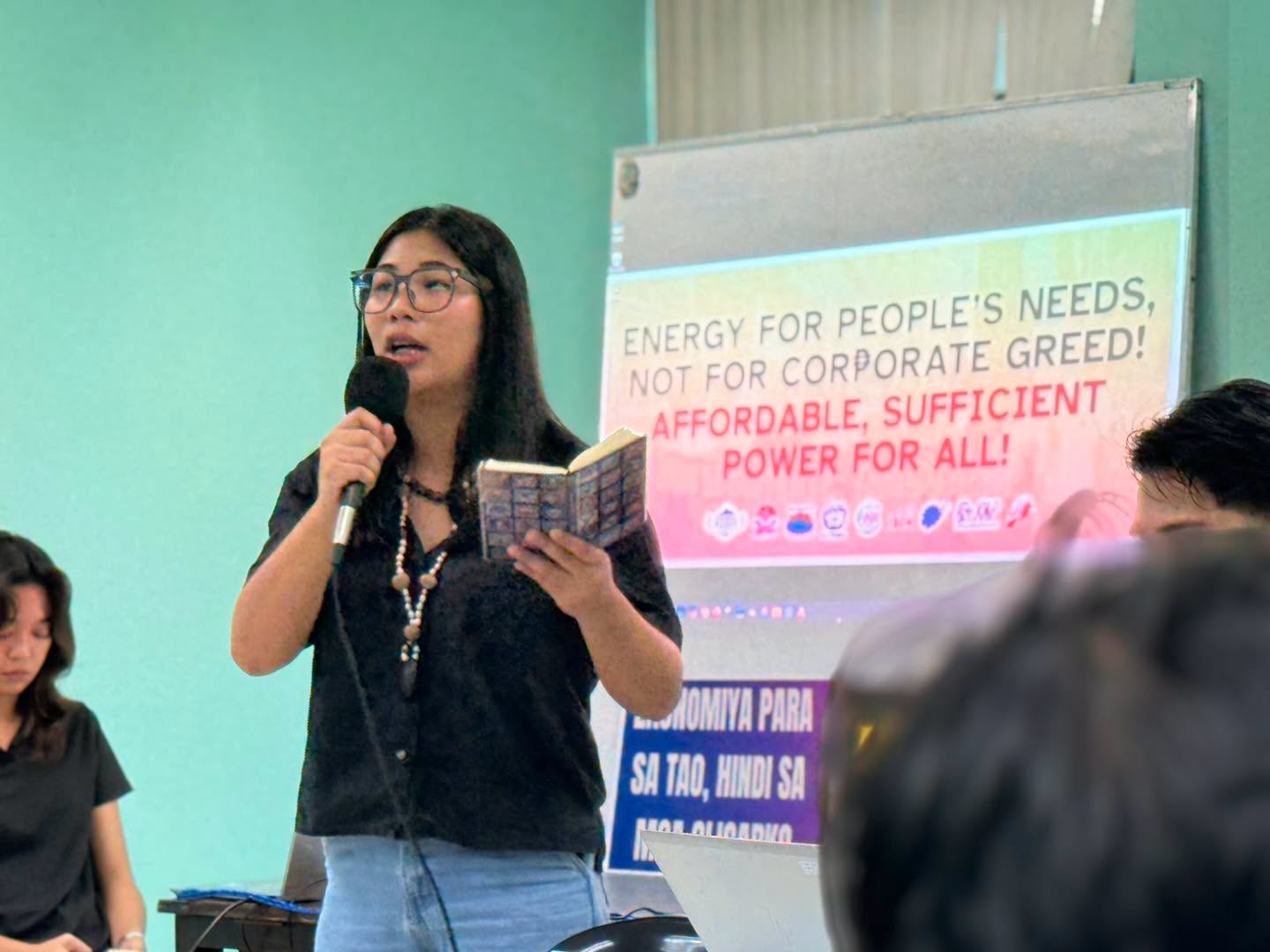
“Energy transition should be an opportunity to develop our self-sufficiency in manufacturing, engineering, and research.”
(Part 1 of 2 reports)
ASEAN’s energy future is being planned at a forum filled with representatives from corporations, government, banks, and international institutions. Those from grassroots communities are nowhere to be found.
The ASEAN Energy Business Forum was held in Manila from October 5 to 9, bringing more than 1,500 high-level delegates and officials.
“The forum speaks sweetly about innovation, investment, sustainable energy future: identifying projects to fund and profit from,” said Sonny Africa, executive director of think-tank Ibon Foundation, during a parallel conference. “For ordinary people, the essence is not defined by the amount of investments, bankable projects, public-private partnerships, energy companies, and financing but the simplest questions: is the electricity cost lower? Is it more efficient and more accessible?”
The Philippines is assuming the ASEAN chairpersonship this year. Energy Secretary Sharon Garin said that the government will use the opportunity to champion “immediate energy security with long-term resilience.”
“Energy security is a shared challenge. What happens in global energy markets can quickly reach our shores, affecting the cost and availability of fuel, disrupting industries, and putting pressure on households,” Garin said in a report by Philippine Information Agency.
This year, the Department of Energy (DOE) reported that the Philippines has the most expensive residential electricity cost in the Southeast Asia region. In June 2026, it reached an average of P12.43 per kilowatt-hour, surpassing Singapore’s average rate by P0.09 per kWh.
“We have the most expensive electricity rate in the region even if our minimum wage is not at par with our counterpart in Singapore,” said Julius Roa of Pro-People Engineers and Leaders during the parallel conference.
Roa said that the cost of electricity is due to the 2001 Electric Power Industry Reform Act (EPIRA) which implemented privatization.
The country’s state-run think-tank Philippine Institute for Development Studies recorded that the five largest conglomerates control 85 percent of the nationwide power grid.
“In the whole Visayas region, we are experiencing rotational brownouts. These are not isolated power interruptions, this is a result of a power system that failed to ensure reliable generation, adequate reserves, and sufficient transmission capacity,” Irma Espinosa, convenor of Panay Consumers Alliance, said in a video statement.
Visayas is also the highest residential electricity rate recorded by the DOE in June 2026, which is at P16.57 per kWH.
Espinosa said that they experienced consecutive yellow and red alerts in the electricity because of the insufficient power capacity during peak hours. In August 2026, the available capacity was at 2,059 megawatts but the demand during peak hours reached 2,305 megawatts. “The electric supply remains insufficient: out of 47 power plants, 9 are no longer functioning, 16 are partially functioning, while 22 are no longer used since 2021.”
The Philippines is still reliant on fossil fuels like coal (56.4%) and gas (17.9%) for its energy supply. Roa emphasized that the insufficiency of energy supply is often linked to these fossil fuel sources.
The ASEAN Energy Business Forum has Asian Development Bank, World Bank Group, LNGPH, Aboitiz Power, and Meralco Terra Solar as major strategic partners.
Meralco Terra (MTerra) Solar Project which spans approximately 3,500 hectares across Bulacan and Nueva Ecija is the Philippines’ largest integrated solar photovoltaic and battery energy storage system facility. But there were residents in affected communities who said that this project is destructive, especially for farmers in the area, and ancestral lands and waters.
“Phase 1 of the project is already done in our community. My crops have dried up, especially vegetables and bananas,” said long-time farmer Marvin Resilva from Nueva Ecija in the vernacular. “There is no public consultation for the construction of the solar project. The majority of the farmers have been forced to sell their lands.”
MTerra Solar Project is already integrated into the Luzon grid after the National Grid Corp. of the Philippines (NGCP) cleared an initial 750 megawatts (MW) of capacity for testing and commissioning. The second phase of the project is scheduled for completion in 2027.
Meanwhile, Aboitiz Power, another strategic partner of the ASEAN Energy Business Forum, is also developing the Olongapo Solar Power Plant, a 221-megawatt peak (MWp) renewable energy facility in Zambales.
“This project does not undergo the right free prior, and informed consent (FPIC) process needed for its establishment,” said Aeta indigenous resident Rica Torres, stressing that they were not consulted. Torres added that there are 150 renewable energy projects in Central Luzon that affect other indigenous communities in the region.
“Can we really call this development if farmers and Aetas are being displaced?” she asked. “To deforest our mountains is to strip us of our livelihood and our sacred culture.”
Marilou Dabon, another farmer leader from Olongapo, said that the project caused division in their farming community. “Since the Aboitiz came, our community was divided into two: those who agreed to sell their lands and those who remained firm in opposing the project.”
In December 2025, a resolution was passed by the barangay council rejecting the expansion of Olongapo Solar Power Project on Mount Balimpuyo. Dabon said that among their identified risks with the project is the possible environmental degradation and increased flooding.
“Entire communities residing in Mount Balimpuyo will be affected. Just last month, we recorded fifteen landslides. We are also witnessing neck-deep flooding,” she said.
The Olongapo Solar Power Plant is the largest solar project in the Philippines. Earlier this year, Bulatlat reported that four barangays with IP communities and farmers were affected by the ongoing operations of the solar power plant.
An independent environmental impact mission commenced in May 2026 to probe the project. In July 2026, the mission report was publicized, identifying the project as a threat to biodiversity, further linked to increasing risk to Olongapo’s water supply, soil erosion, and violation of indigenous peoples’ collective right to ancestral lands.
Read: ‘Government, businesses use renewable energy projects to exploit resources’
“The farmers are not against clean or renewable energy,” peasant leader Rafael Mariano of Kilusang Magbubukid ng Pilipinas (KMP) said. “But it should not be developed at the expense of our fundamental rights to adequate food, livelihood, land, and development.”
He said that under the Local Government Code of 1991, the city or municipal council should conduct mandatory public hearings and consultations for the projects and reclassification of agricultural lands.
“We should always link these to the land question, a genuine land reform and the establishment of national industrialization in our country,” Mariano said.
For these grassroots leaders, welcoming more foreign investments for the energy projects is an irony and not a solution to long-standing energy problems of the country.
“Energy transition should be an opportunity to develop our self-sufficiency in manufacturing, engineering, and research,” Africa said. “Energy is a strategic public utility and an instrument for genuine development. Our energy policy should not lean on ensuring profit of foreign investors, but how we can make electricity more efficient, accessible, and sustainable.” (DAA)
 Save as PDF






0 Comments