
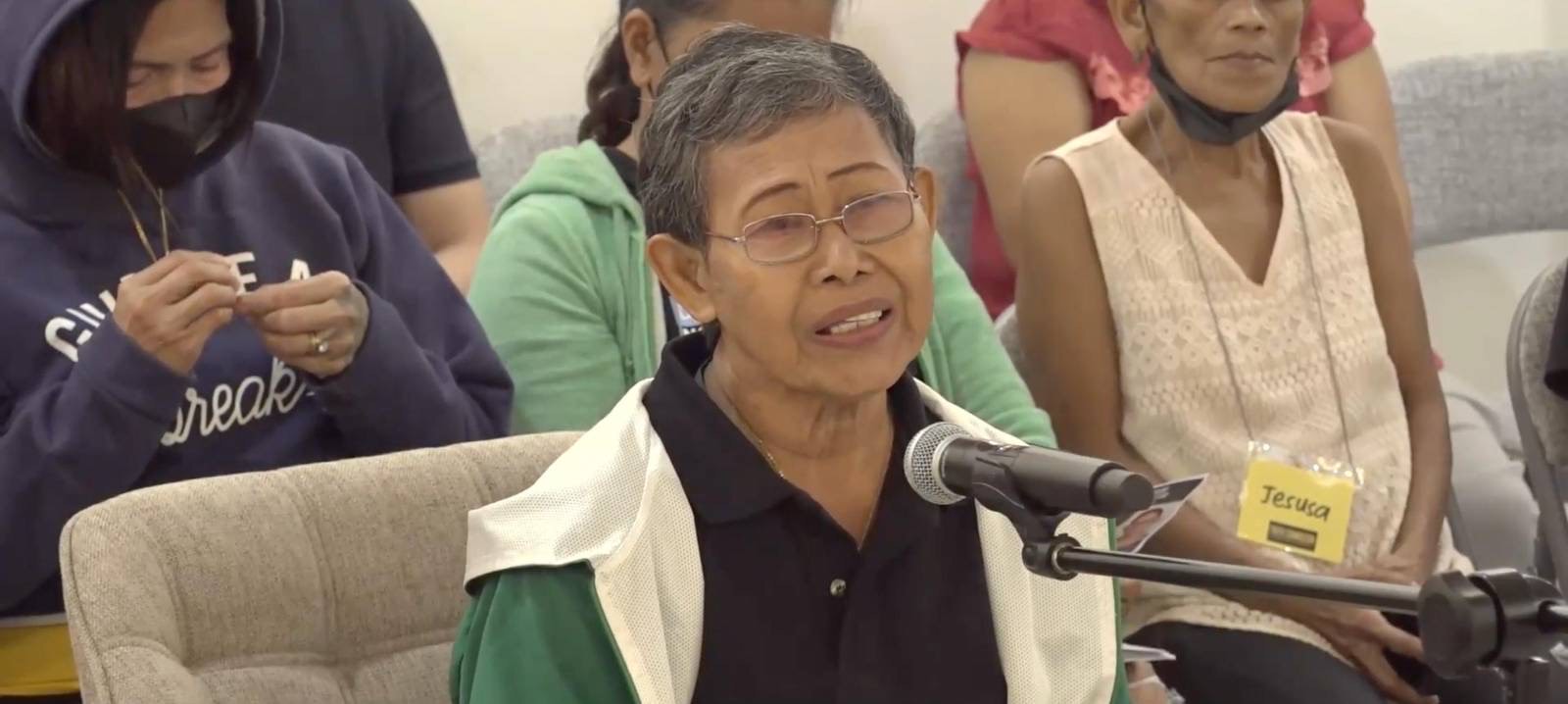
“For me, justice and healing mean holding accountable those who carried out the killings, the perpetrators, those who gave the orders, and the highest-ranking officials behind the killings.”
Trigger warning: details of violence and death
Seeing her son’s body, his blood spilling in the streets, Lorna Carina Pepaño could not cry. That day, on May 18, 2020, her son Christian was shot dead by two unidentified men while buying medicines and coffee for Pepaño.
On the day of the incident, Pepaño ran to the scene of the crime without slippers. Many of the witnesses she talked to said that Christian was begging for his life, telling the perpetrators that he was not the person they were after. The witnesses also heard one of the gunmen saying that Christian was not the target.
Six years later, Pepaño mustered the courage to tell the story of her son during the fourth public truth-telling session organized by the independent Philippine Truth Commission on October 9, 2026.
“All I feel until now is anger,” Pepaño said in Filipino. “Back then, I was shouting, saying words I never thought I could say. Never did I think that my son would be killed that day. I have so many questions but not a single answer.”
The police medico-legal report revealed that Christian died of four gunshot wounds in the head and trunk. The manner of death was also specified as homicide. All four gunshot wounds were fatal, causing immediate death.
“I could not sleep (properly) for five months. I was only drinking coffee. My grandson was also deeply affected by the incident. He would wake up shouting in the middle of the night,” Pepaño added.
Pepaño deeply misses his son. Christian only finished primary school because he took care of his grandmother in the province in the early years of his life, while Pepaño was a security guard in Manila.
The year Christian was killed was supposed to be his 40th year. On his 39th birthday, Pepaño prepared a small feast and a gift – a smartphone – for Christian. It was the first birthday celebration they organized as a family because that was the only time Pepaño could afford it.
“It was his happiest birthday. We rented a videoke and he sang his heart out. He hugged me and thanked me for the celebration,” Lorna said. “I never thought that it would be his last birthday celebration.”
Forensic pathologist Raquel Fortun, who is also a Commissioner of the Philippine Truth Commission, conducted an autopsy of Christian’s body on February 15, 2024, almost four years after he was summarily killed. She confirmed the two gunshot wounds in the head, but could not confirm the two gunshot wounds in the trunk since the body was already in advanced decomposition and they could only recover bones.
“Christian was in a really bad shape with the fatal shots in the head alone,” said Fortun, noting that all wounds were sutured based on the police medico-legal report. “There is no full homicide investigation. We do not have scene documentation.”
The bottom line, she emphasized, is that killings continue during the administration of Rodrigo Duterte, because there is no proper investigation.
More than 30,000 were extrajudicially-killed during the Duterte administration, according to the report of independent human rights groups. Only five cases resulted in conviction, as monitored by the Philippine Truth Commission, while some remain on appeal.
The fourth truth-telling session happened a day after the International Criminal Court (ICC) released the public redacted version of the decision, declaring that Duterte is fit to stand trial based on the assessment of independent medical experts. The ICC also adopted measures for his participation in his trial, which is slated to start on November 30 this year.
“Christian’s case was not part of the ICC. We call that temporal jurisdiction. The ICC is limited to the crimes committed from 2011 to 2019, the temporal limitation does not apply to the Truth Commission,” former ICC Judge Raul Pangalangan, chairperson of the Philippine Truth Commission, said in a press conference.
He emphasizes that there are differences in the mandate of the Philippine Truth Commission and the ICC. The former is not limited to temporal jurisdiction or the timeframe when the Philippine government was a member-state of the ICC. But their main objective was to provide a platform for the victims to share their stories.
“The ICC and the Truth Commission are separate but working on the same ideals: to give justice to the victims,” human rights researcher Carlos Conde, commissioner of the Truth Commission. “Whatever sprouts from us – testimonies, data, information – can be used both by the ICC and the Philippine government. At the end of the day, we wish that justice will not only come from the ICC but also in our own government.”
The ICC Pre-Trial Chamber I confirmed the charges against Duterte and found reasonable grounds to believe he is individually responsible as an indirect co-perpetrator for the crimes against humanity of murder. While the ICC Appeals Chamber ruled in finality that the court has jurisdiction over Duterte’s case.
Read: It’s final: Rodrigo Duterte to face ICC trial for crimes against humanity
“We would be left helpless without the ICC,” Pepaño said. “To kill and kill is an injustice. They are human beings, too. Our children had dreams. What we want is justice, peace of mind, and compensation for what happened to our loved one.”
After her son’s killing, she said that there has been no proper investigation. She was visited only once by the barangay to ask some questions. She could not pursue a case because of the money needed for the lawyer, the legal documents, and the logistics needed for possible witnesses.
“For me, justice and healing mean holding accountable those who carried out the killings, the perpetrators, those who gave the orders, and the highest-ranking officials behind the killings,” she added. (RTS, RVO)
 Save as PDF

0 Comments