
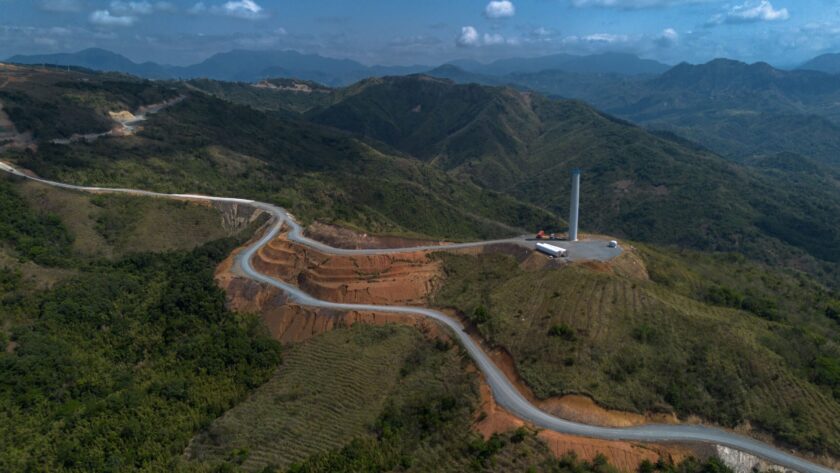
Marcelo Itaas, chief of operations of the Community Environment and Tourism Office in Guiuan, told Bulatlat that HRMC’s mining is destructive. “Even though no chemical flows out of the tailing ponds of the mine, since the soil flows out with the water into the sea, it results in siltation or the covering up of the weeds, which eventually leads to their death. The fishes are deprived of their shelter and source of food,” he said.
Moreover, a forest fire had earlier destroyed more than 2,000 hectares of forest in the area and subsequently affected the residents’ water supply.
“The mining operation does extensive damage to Cagusuan and to the nearby barangays (villages) for a number of reasons. First, we have lost our water supply. During El Nino, the water supply ran short for after about seven months, but now, only two months has passed, and we no longer have water,” said Caberio Vencion, a village councilor and Hero’s vice-president.
Vencion believed the fire was deliberate. “I cannot pinpoint the exact perpetrator but this is a result of the mining operations since our forests were once filled with trees,” he said. The HRMC is now mining in these former forests.
According to the Rev. Fr. Alejandro Galo, a parish priest of the nearby Manicani island who did a study on the forest fire, there are different versions of fire that razed the mountains of Homonhon in the 1980s and that HRMC had denied the allegation that it started the fire. The mountains, according to HRMC, burned 10 years before the firm began operations and that residents who gathered honey were the ones responsible for the fire. The government never identified the culprits.
Divide and rule
Norman Bocar, the Provincial Environment and Tourism Officer (Penro) of Eastern Samar, revealed that HRMC uses “divide and rule” tactic against the people of Homonhon. He said the company provides superficial benefits to the village in order to obtain their sympathy and, thus, enable the company to continue its operations despite the opposition of the other residents.
“Aside from environmental destruction, the other negative effect of mining on our island is the disunity of the people. Even siblings fight among themselves due to different perceptions regarding the mining operations,” said Hero’s Montes.
Some residents extol HRMC for sending their children to school and for giving them galvanized iron sheets to replace their nipa (grass) roofs. They said their lives have gotten better and those opposed to the mining are disturbing them.
“All I can say to those opposed to the mining operations is that we should unite in persuading the government to provide us with employment opportunities in our area. We do not intend to fight with them. It is difficult to unite a barangay whose residents fight among themselves,” Roberto Lagamina, president of the Cagusuan Wage-Earners Association, told Bulatlat.
Rosario Abueme, a resident against the mining, said fishing alone can sustain the community. “We are able to survive even if our husbands rely on fishing alone. The problem with them is that they are selfish and only think of themselves, they do not think of the future.”
Montes accused the HRMC of using its livelihood and support program to quell resistance to the mining operation. “While is true that HRMC does provide benefits to the residents such as a school bus for the children, free rides aboard their motorboat, and providing a generator to the barangay, these are all meant for those who do not oppose their operations,” he said.
Vencion, the councilor, said he has not lost hope that the majority of the residents will join Hero’s call to stop the mining operations. Hero has gotten support from such groups as the Regional Peasant Alliance in Eastern Visayas (Sagupa), a group that campaigns against mining.
“We do not oppose mining operations per se, since it forms the backbone of an industrialized nation. But at present, it is untimely to conduct such since it does not respond to the need for the sustainable development of our economy and livelihood of the people,” said Diana Ragub, campaign officer of Sagupa. “While it is true that it provides immediate relief, minerals — unlike a plant that can be harvested and replanted — are slowly being used up with only the foreign capitalists enjoying the benefits, since they have the technology and capital to process them.”
Ragub explained that the environment is not the only victim of HRMC’s operations but also the sustainable livelihood of the people.
She predicts that, because of the mining operations and the residents’ opposition, the area will be militarized. “The strong opposition of the people is always met with state fascism,” Ragub said. She also pointed out that there have been cases where the residents’ opposition stopped mining operations in several places in the region.
“I am calling on the members of Hero to be with us in the steps we will undertake in the future to protect not only the island of Homonhon but the whole region of Eastern Visayas,” Ragub said. 
 Save as PDF





0 Comments