
While attending the Permanent People’s Tribunal Session 2 on the Philippines last March at The Hague, Netherlands, I had the privilege of meeting Senator Madrigal. She was one of the witnesses in the trial against the anti-people crimes of Arroyo and Bush. Her testimony centered on the continuing displacement of indigenous communities and the plunder of the environment. Senator Madrigal criticized Executive Order No. 364 which subordinated the National Commission on Indigenous Peoples to the Department of Land Reform, thus rendering it inutile in its task of protecting and promoting the rights of indigenous peoples. She also condemned various multinational corporations for the devastation of our natural resources (for example, mining company Toronto Ventures, Inc. in Zamboanga del Norte; Lafayette Mining Corporation in Rapu-Rapu Island, Sorsogon, Marcopper Mining Company). She concluded her speech before the Tribunal with these words: “As a Filipino, I accuse and seek a guilty verdict for the regime of Gloria Macapagal Arroyo for the violations of the economic, social and cultural rights of the people, including the violation of economic sovereignty and the national patrimony through iniquitous agreements and economic plunder by foreign and local exploiters.”
Devil’s Wager: Exchanging Security for State Terror
Concerning the Anti-Terrorism Bill (ATB), Senator Madrigal called my attention to her joint statement with Sen. Aquilino Pimentel, Jr. at the Legend Restaurant, Oct. 9, 2006. In that statement, she charged that the bill (Senate Bill No. 2137, sponsored by Sen. Juan Ponce Enrile) “legislates martial law.” She asserted that the bill “will create a shadow criminal justice system that in turn will be used as an instrument of a greater terror perpetrated by people in power against their critics and political opponents.” Sacrificing human rights for an alleged guarantee of security, ATB contains vague and sweeping provisions that practically abolish “the rights to freedom of expression and association, the liberty of movement, the prohibition against arbitrary detention, and the rights to the presumption of innocence and fair trial.” Exactly what thousands of demonstrators in Washington, DC last June 26 were saying about the MCA and the U.S. Patriot Act.
Senator Madrigal also recounted to me her trip to Europe in October 2006, specifically to the World Council of Churches (WCC) in Geneva, and the International Parliamentary Union (IPU), the International Federation of Journalists (IFJ), the Belgian and Flemish parliaments, the House of Lords in UK, and Amnesty International. She focused on the “repressive provisions of the proposed ATB,” intent on broadcasting to the international community that “Mrs. Arroyo is bent on adopting policies and measures that will only further strengthen her control over Filipinos and encourage widespread human rights abuses” (Press Statement, 17 October; from Senator Madrigal’s Official Website).
Senator Madrigal finally referred me to her presentation titled “Legislating Insecurity through State Terrorism” to the Eminent Jurists Panel on Terrrorism, Counter-Terrorism and Human Rights at the conference of the International Commission of Jurists in Jakarta, Indonesia, on 5 December 2006. In this extremely valuable speech, Senator Madrigal reiterated her principled stand against the ATB, an “oppressive” law that would legitimize Arroyo’s “state terrorism” because of its “terrifying provisions.” I have already cited some: the likelihood that persons may be labelled terrorist “by reason solely of his religious or political beliefs,” which is already the practice of the AFP, their paramilitary death squads, and Arroyo’s security council. As illustration, Senator Madrigal cited the case of six progressive parliamentarians (Satur Ocampo, Crispin Beltran and colleagues) “who were accused of participating in a rebellion against the current regime,” as well as the case of the Tagaytay 5 who were arrested and tortured without any warrant. One of the provisions of the ATB (on detention of suspects for five days or more) has already been judged by the International Commission of Jurists (ICJ) as violating Article 9, paragraph 3, of the UN International Covenant on Civil and Political Rights (ICCPR), which requires that a person arrested be brought “promptly [not exceeding 48 hours] before a judicial authority.”
Last March 12, the UN Special Rapporteur for promotion and protection of human rights, Martin Scheinin, issued a statement that the overly broad definition of terrorist acts contradicts “the principle of legality and [is] thus incompatible with Article 15 of the ICCPR.” Moreover, Scheinin noted other defective features, such as the 40-year imprisonment for suspects which “undermines judicial discretion in individual cases” and results in disproportionate punishment, and the questionable competence of various bodies authorized to review detention, as well as the restrictions on movement, including the imposition of house arrest—all amount to the conclusion that many provisions of the ATB “are not in accordance with international human rights standards” (see his website: http://www.ohchr.org/english/issues/terrorism/rapporteur/srchr.htm).
Senator Madrigal also warns of other extreme provisions of the ATB which are tantamount to disregarding “with impunity constitutional guarantees” and therefore sanctioning State terrorism. In her press statement dated March 11, 2007, supporting Rep. Satur Ocampo’s defense, Senator Madrigal described the current dispensation as “martial law with a de facto civilian and military junta in control.”
What is to be Done?
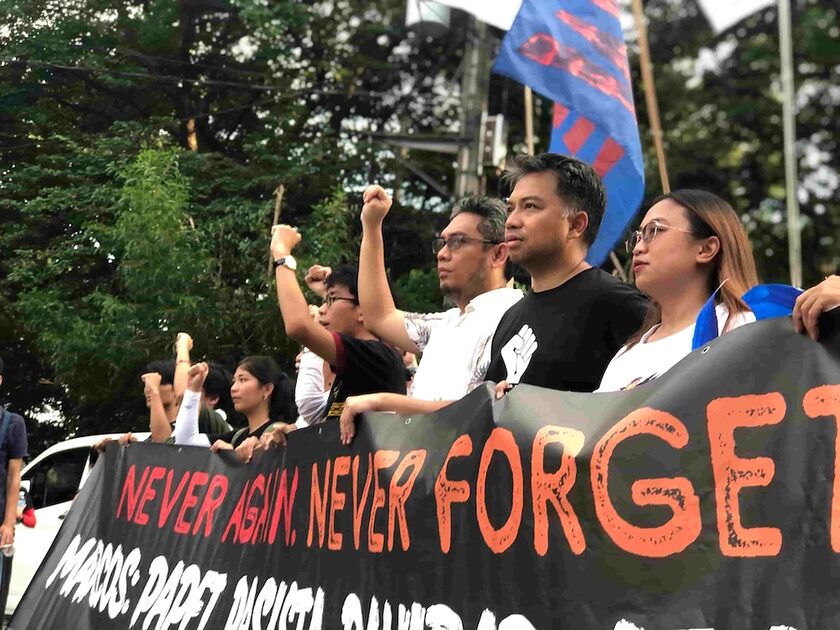
At this juncture, I call the readers of this news-zine to the substantial and thorough critique of the ATB by the militant organization Bayan titled “The Anti-Terrorism Act: Recipe for Undeclared Martial Law (June 13, 2007), accessible in Bayan Website; and also to a recent letter of Amie Dural, secretary general of the Promotion of Church People’s Response, posted in Inquirer’s Opinion Section (June 27). Dural stressed the points raised by Senator Madrigal, Bayan and others: the ATB will embolden the abductors and torturers of activists like Pastor Berlin Guerrero and “multiply the number of unjustified arrests, forced disappearances and extrajudicial killings in the name of the Arroyo administration’s ‘war on terror…. The full implementation of the anti-terrorism law threatens to arrest progressive parliamentarians and anyone who will participate in protest actions, such as nationally coordinated rallies, during the State of the Nation Address (SONA),” as well as legalize “the unconstitutional deployment of military troops in urban communities,” a step which proved useful for the regime in terrorizing citizen-voters during the May electoral campaigns and depriving citizens of their democratic rights.
Senator Madrigal articulates with great eloquence her nationalist and libertarian convictions in the following exchange with my colleague Dr. Rainer Werning (RW), lecturer at the Internationale Weiterbildung und Entwicklung of Bad Honef, Germany. He has asked me to edit (for style and readability) the transcript of this taped interview of Senator Madrigal during the session of the Permanent People’s Tribunal [words in brackets are the editor’s].
DR. RAINER WERNING INTERVIEWS SENATOR MADRIGAL
Madam Senator, you listened to the presentation of Prof. Roland Simbulan on U.S.-Philippines relations. What is your response to that?
 Save as PDF


0 Comments