
Oil
Based on various government data, millions of poor people who directly consume petroleum products pay millions of VAT daily.
Daily, hundreds of thousands of jeepney drivers pay P67.95 million ($1,536,527 at an exchange rate of $1=P44.225) in VAT and tricycle drivers, P14.12 million ($319,292), for the fuel they consume. Thousands of fishermen using motorized bancas pay a total of P8.85 million ($200,113) in VAT per fishing trip.
More than nine million kerosene users pay P218.32 million ($4,936,673) for VAT per month. Kerosene is used primarily by the poor for cooking and lighting.
Estimated VAT Paid Daily/Monthly by Consumers of Petroleum Products
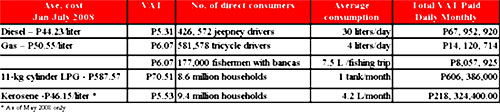
Source of basic data: Oil Price Watch Department of Energy , Land Transportation Office 2007 report, National Statistics Office 2004 Household Energy Consumption Survey, Piston, Pamalakaya
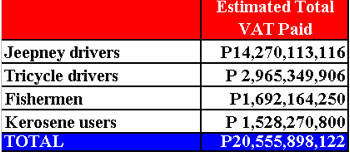
Based on the above data covering the period January to July 2008, the poor directly paid around P20.55 billion ($464,669,304) in VAT.
Estimated VAT Paid Directly by Poor Consumers, January to July 2008
Added to this, taxpayers, including minimum wage earners, also pay for the oil consumption of government offices and government-owned and-controlled corporations (GOCCs).
Data from the Commission on Audit’s (COA) 2006 Annual Financial Report of the National Government shows that the government spent P2.82 billion ($63,764,838) for gasoline, oil and other lubricants expenses.
The COA report shows that the top spenders of gasoline, oil and lubricants were the Department of National Defense and the Department of Interior and Local Government with P83 million ($3,670,675,000) and P63 million ($2,786,175,000), respectively.
The average retail price of gasoline then was P39.41 ($0.89) per liter and diesel, P34.46 ($0.779) per liter. Assuming that the consumption is constant, the 28 percent increase in the prices of petroleum products from 2006 to 2008 would mean that the government would spend P3.61 billion ($81,628,038) for the same items this year. From this amount, the 12 percent VAT shouldered by the taxpayers would be P379 million ($8,569,813).
Based on the Projected Oil Demand by Sector taken from the Philippine Energy Plan of 2006, below is the projected oil consumption in 2007:
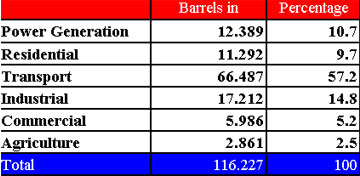
Based on the above data, Ramirez noted that excluding the transport sector, the public pays 42.8 percent of the VAT on oil. He explained that the VAT on power generation is passed on to consumers as part of the generation charge. Ramirez said that factory owners and businessmen who comprise the industrial and commercial sectors also pass on the VAT to consumers. Oil consumption by residential and agriculture sectors is also paid for by the public.
 Save as PDF







0 Comments