

The lesson left behind by Isty and the 11 others remains clear: liberation and safety will never be granted voluntarily by the bosses or the state. This is why emulating diligent organizers like Isty is no longer just an option—but a necessity.
MANILA — To many, the business process outsourcing (BPO) sector is the ultimate economic escape hatch in a country where wages remain at an all-time low and decent job opportunities are scarce.
Beneath the bright lights of corporate tech hubs, however, is a reality that is very different from what most assumed. On the production floors and in every cubicle, exploitation of BPO workers is rampant.
Multinational corporations treat them like modern-day robots – machines expected to type and talk non-stop, even during disasters.
It was this reality, the dehumanizing system of most BPOs, that drove Mary Grace “Isty” Petrolla to resist.
Living the Isty way
The fight against corporate giants did not start with a grand assembly. It began out of survival.
In 2012, eleven BPO workers started gathering in a fastfood branch where they vented out everyday dehumanization they experienced in the industry. This is how the BPO Industry Employees Network (BIEN) was conceived.
In an interview with Bulatlat, BIEN Secretary General Renso Bajala, recalled, “It was literally just a small group of workers who would vent about their conditions inside the workplace, about their BPO work. Back then, they came from different companies in BGC and Makati.”
Among them was Isty, who refused to let their post-shift complaints end at the coffee shop table. Isty took on the daunting task of unionizing workers in an industry notorious for its anti-union policies. When BIEN was formally established, she served as its very first vice president, while maintaining her career before eventually retiring to focus on her family.
Bajala said that colleagues remember Isty as an organizer who gave everything to the movement, navigating the grueling demands of the graveyard shift without losing sight of the struggle.
“Well, the shift of a BPO worker is at night. We turn night into day,” Bajala said. “At the same time, she was balancing that with her advocacy. So the free time that a BPO industry organizer should typically use to rest or sleep, she instead used as time to organize and to raise the consciousness of BPO workers—showing them that these kinds of workplace conditions shouldn’t be normalized. She helped explain why these things happen and why the working conditions are this bad.”
On June 2, 2026, Isty passed away due to complications from breast cancer. Yet, her death comes at a time when her defiance is needed more than ever.
As labor and health violations across the industry peak, the call to live life the way Isty did, grows heavier.
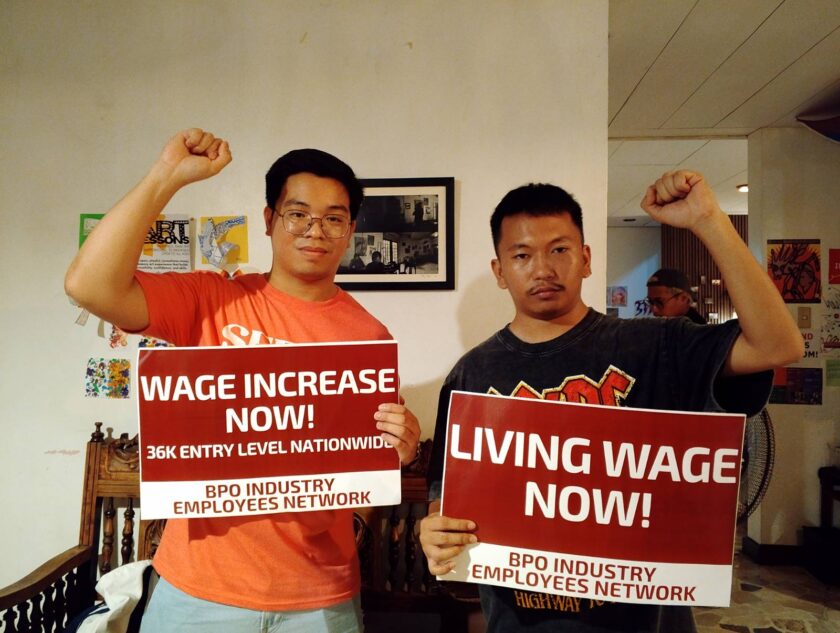
‘Do not be afraid, join the struggle’
The systemic danger facing BPO workers is not a matter of hyperbole, but of record.
A recent structural fire at Cyberpark Tower 2 in Cubao serves as a fresh reminder of how fragile safety nets are for BPO workers. According to an open letter by BIEN, several BPO firms—specifically R1 RCM, Alorica, and Ibex—subjected employees to extreme safety hazards and corporate intimidation during a recent building fire. Workers reportedly experienced management threats and coercion, and delay or absence of evacuation despite active fire and smoke exposure–putting not only their work but more importantly their welfare in danger.
According to Ron Carlo Zarate, the Occupational Safety and Health (OSH) Head of BIEN Philippines, the state of workplace safety has stagnated over the years, as laws like the RA No. 11058, supposedly in existence to protect workers, remain toothless.
“Well, truth be told, nothing has changed with the system when it comes to OSH—from the very beginning up until now,” Zarate told Bulatlat. “To this day, we continue to fight for the health and safety rights of BPO workers.”
Zarate also pointed to the 2025 earthquake in Cebu as glaring proof of the industry’s priorities. BIEN documented gross OSH violations across more than 30 companies in the incident.
“There were also so many companies that locked emergency exits and wouldn’t let employees step outside. On top of that, workers were essentially forced to work under the threat of termination if they didn’t. Those are just some of the violations that employees experience,” he said.
For BIEN, the culprit behind this persistent corporate impunity is a system that favors big business over human life. The lesson left behind by Isty and the 11 others remains clear: liberation and safety will never be granted voluntarily by the bosses or the state. This is why emulating diligent organizers like Isty is no longer just an option—but a necessity.
Bajala encouraged BPO workers to join the struggle. “Do not be afraid to join organizations whose goal is to push for change—like BIEN, which aims to advance workers’ rights and welfare.” He also highlighted that true change will only come, not from organizations like BIEN but from the workers themselves.
“BPO workers shouldn’t just wait for conditions to change, because that won’t just be handed down by the state, the government, by Ferdinand Marcos Jr., or anyone else. Even the companies will not just give it freely. Demand and fight for your rights—because this is the only way the system changes, and this is the only way our demands for better wages and OSH are met,” Renso concluded. (RTS, RVO)
 Save as PDF





0 Comments