

U.S. President Donald Trump’s upcoming visit to Manila for the ASEAN Summit happens in the wake of intensifying struggle between the U.S. and China for economic, technological, political, and military dominance in Asia. Washington aims to consolidate its strategic position in Southeast Asia, with the Philippines under Ferdinand Marcos Jr. playing an increasingly important role in advancing U.S. imperialist interests.
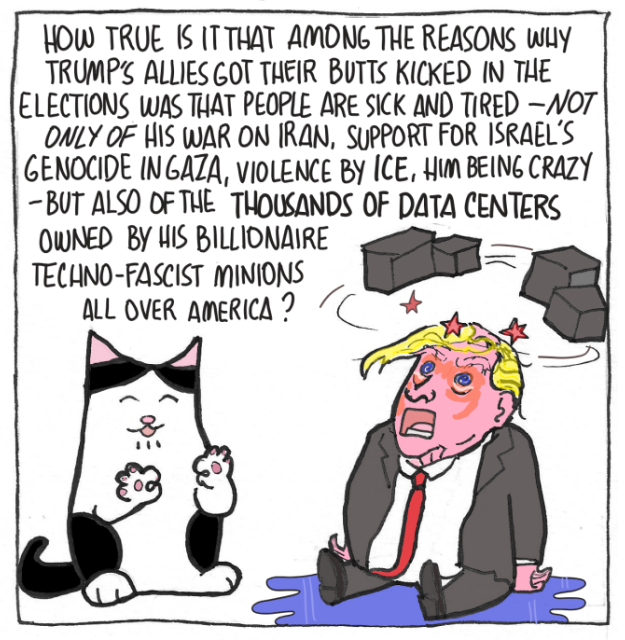
Trump arrives politically battered. The sweeping Republican defeat in the November 3 midterm elections, which handed both houses of Congress to the Democrats, represents a powerful repudiation of his administration’s policies. Trump’s unpopular U.S. war against Iran and his aggressive tariff policies and their disastrous economic consequences, such as rising living costs, contributed to widespread dissatisfaction among American voters.
The defeat further exposes the political crisis confronting U.S. imperialism. It reflects growing domestic opposition to policies that impose enormous economic and social costs on the American people while sustaining Washington’s aggressive military interventions and global ambitions.
But Trump’s weakened domestic position does not mean that the White House will abandon its imperialist agenda abroad. On the contrary, the administration may seek to demonstrate U.S. power through new military, economic, and diplomatic agreements. Trump could use his visit to Manila to project strength and secure strategic commitments to counter the political setback at home.
The central objective of Washington’s ASEAN agenda is to preserve U.S. supremacy in the face of China’s expanding economic and military power. Southeast Asia occupies a crucial place in this rivalry. It sits astride strategic maritime routes and contains vital manufacturing centers, mineral resources, emerging digital markets, and production networks essential to the world economy.
For U.S. imperialism, maintaining influence over ASEAN means safeguarding its military reach while securing access to markets, technology infrastructure, critical minerals, and industrial supply chains. The U.S. seeks to organize these strategic assets around its own economic and national-security priorities, particularly by reducing dependence on Chinese-controlled production networks.
At the same time, China is expanding its own economic and strategic influence through trade, investment, infrastructure, and military power. This competition between rival great powers seeks to expand their influence over the region’s resources, markets, territory, and political decisions.
Militarizing Southeast Asia
Washington’s military agenda was made explicit during the ASEAN defense ministers’ meetings in Cebu in October, when Pete Hegseth, Trump’s so-called Secretary of War, proposed a new framework for U.S.–ASEAN defense cooperation.
Under the language of maritime security and interoperability, Washington seeks to deepen military coordination, intelligence sharing, joint exercises, and naval cooperation with Southeast Asian governments. The proposal complements the expanding network of U.S. military alliances and access arrangements across the Indo-Pacific. It aims to strengthen its First Island Chain strategy to encircle and contain China. On the sidelines of the Cebu meeting, U.S. and Japanese defense officials discussed implementing a more effective denial-defense posture along this chain.
With its geographical location, the Philippines has become a crucial platform for this strategy. Under Marcos Jr., U.S. military access under the Enhanced Defense Cooperation Agreement (EDCA) has expanded from five to nine designated Philippine facilities. Washington and Manila are also increasing joint military exercises and deployments of advanced missile and unmanned systems. These arrangements strengthen the capacity of U.S. forces to operate in the South China Sea and potentially respond to a Taiwan Strait conflict.
So far, only two ASEAN countries have formal defense treaties with the U.S., namely the Philippines and Thailand. But all the other members, except for Myanmar, have various forms of extensive defense or military cooperation arrangements with the U.S. However, unlike its Mutual Defense Treaty (MDT) and related pacts with the Philippines, not all agreements with other ASEAN countries grant U.S. troops access to military installations, allow combat deployments, or entail an obligation to support U.S. military operations.
Hegseth’s proposal aims to move beyond separate military arrangements with individual ASEAN countries toward a more coordinated, ASEAN-wide structure for defense cooperation. Such a framework could strengthen the U.S. military’s regional presence and operational coordination without necessarily creating a formal military alliance. It will build on existing regional initiatives such as the ASEAN-U.S. Maritime Exercise (AUMX), the Southeast Asia Cooperation and Training (SEACAT), and other military exercises between ASEAN and the U.S. and American allies in the Indo-Pacific like Japan, Australia, and South Korea, focusing on naval coordination, maritime security and surveillance, and military interoperability.
Unlike the U.S., China lacks formal military treaties with any ASEAN member. However, it maintains defense cooperation memoranda of understanding with all of them except Myanmar, with which it nevertheless sustains substantial military equipment supplies, training, and defense ties. It also participates in the ASEAN-China Maritime Exercise (ACMX) as a regional initiative and maintains several bilateral and multilateral exercises with ASEAN members.
In terms of forward bases and military presence, the U.S. has several naval and air facilities in Thailand (U-Tapao airfield and Sattahip Naval Base) and Singapore (Changi Naval Base, Sembawang facilities and Paya Lebar Air Base), in addition to the nine EDCA sites in the Philippines, that allow the deployment of troops, prepositioning of supplies, and logistical support. China counters this with military infrastructure recently built in mainland Southeast Asia, specifically the Ream Naval Base in Cambodia and the Ban Keun aviation facility in Laos. Aside from the EDCA sites, the U.S. is also reinforcing its presence in the Philippines by deploying advanced weapons systems in strategic areas facing Taiwan and the South China Sea, while building defense-industrial infrastructure to support its military logistics and mobility through the Luzon Economic Corridor (LEC). In response, China has fortified its position in the disputed maritime features of the South China Sea, establishing a military presence in the Spratly Islands with long airstrips, hangars, naval support facilities, and reportedly even air-defense and anti-ship missile systems.
The increasing militarization of Southeast Asia amid intensifying U.S.-China competition is exposing the people of the region to massive death and destruction. Such danger is aggravated by the political crisis the Trump regime faces following the midterm elections. It could further escalate regional tensions as Trump becomes more desperate and aggressive in projecting U.S. power abroad and asserting its control over territories it deems part of its spheres of influence to consolidate domestic support. To be sure, U.S. long-term strategic objectives in the Indo-Pacific have continued across successive Republican and Democratic regimes, but Trump’s post-midterm political calculations could further accelerate the region’s militarization and escalate tensions.
Battleground for strategic industries and supply chains
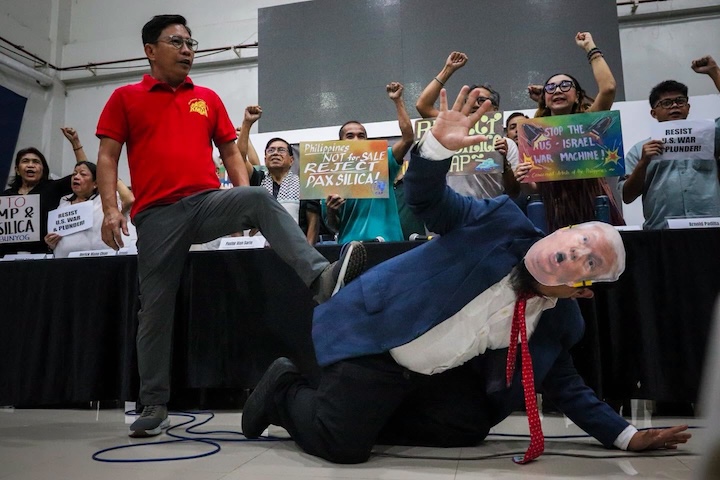
Another achievement Trump would likely seek during his Manila visit is finalizing an agreement with the Philippines to build an advanced manufacturing park within the Luzon Economic Corridor (LEC). The 1,620-hectare Clark Advanced Manufacturing Park is a vital project for the Trump regime, as its success bolsters the feasibility of its Pax Silica initiative to counter China’s control over chokepoints of artificial intelligence (A.I.) supply chains, which have become a key arena of inter-imperialist competition for economic and military supremacy. Pax Silica is part of the broader U.S. strategic agenda to contain China and its rapid expansion.
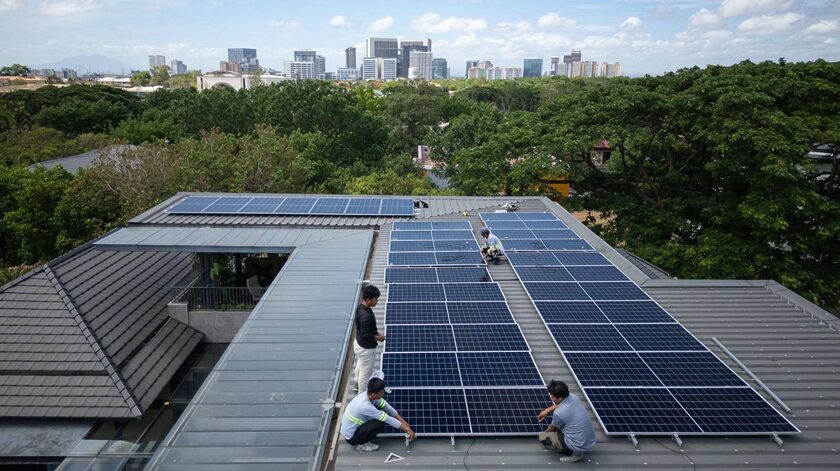
Launched in December 2025, Pax Silica seeks to establish secure supply chains involving critical minerals, semiconductors, advanced manufacturing, energy infrastructure, and A.I. technologies among the U.S. and its trusted allies. It aims to strengthen American influence over the technologies and industrial inputs increasingly regarded as essential to economic and military power. Southeast Asia plays an important role in this strategy because of its substantial mineral resources, established electronics manufacturing industries, growing digital markets, and its location along crucial international trade routes.
A major challenge for the U.S. is how to break China’s grip on the region’s critical mineral resources, the most important raw materials to build A.I. and its infrastructure. China has overwhelming dominance in Southeast Asia’s mining investments, mineral processing, exports, and purchases. Indonesia, for instance, holds the world’s largest nickel reserves, accounting for 44% of the total, and China accounts for around 75% of Indonesia’s nickel refining capacity. The Philippines ranks sixth, and almost 72% of its nickel ore and concentrate exports go to China, while 28% go to Indonesia, with the former likely processed by Chinese refineries. Dismantling such monopoly control makes Pax Silica’s success in the Philippines high on Trump’s agenda for his visit to Manila.
China, meanwhile, is pursuing its own strategy to consolidate and expand its influence over the international A.I. supply chains and digital economy. A significant development was the establishment of the World Artificial Intelligence Cooperation Organization (WAICO) in July 2026, which presents itself as an inclusive intergovernmental institution that promotes cooperation, AI capacity building, and more equitable international governance.
Aside from the Philippines, Singapore is the only other ASEAN member among the 26 Pax Silica signatories. On the other hand, WAICO includes seven ASEAN countries among its 38 members: Brunei, Cambodia, Indonesia, Laos, Myanmar, Malaysia, and Vietnam.
The ASEAN Digital Economy Framework Agreement (DEFA), scheduled to be signed at the Manila Summit, provides a potentially far-reaching framework through which the U.S.-China competition over A.I. supply chains could unfold.
Although negotiated by ASEAN member states, DEFA is being developed in an environment dominated by American and Chinese technology corporations. Its provisions on digital trade, cross-border data flows, electronic commerce, digital payments, and A.I. cooperation could profoundly influence who controls the region’s emerging digital economy. For the U.S., expanded ASEAN digital integration offers opportunities to consolidate its dominance in cloud computing, digital platforms, A.I. systems, financial technologies, and data infrastructure.
Resist imperialist domination and war in Southeast Asia
Trump’s upcoming Manila visit underscores how Southeast Asia is increasingly becoming a major theater for the competing economic, geopolitical, and military ambitions of the U.S. and China. Whether through military alliances and forward deployments, control over critical minerals and advanced technologies, or the reorganization of regional production networks, the two rival powers are seeking to secure their respective spheres of influence at the expense of the region’s sovereignty and the interests of its peoples.
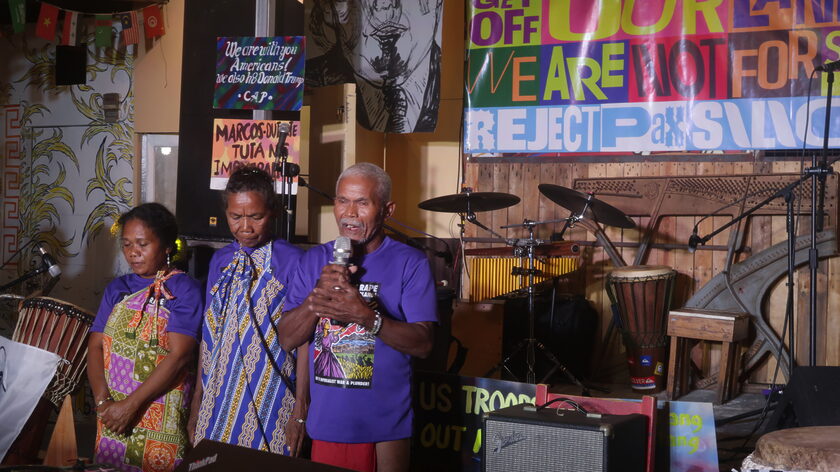
For the Philippines, the stakes are particularly high. The Marcos regime is allowing Washington to use the country as a frontline military platform against China while facilitating greater U.S. control over strategic infrastructure, industries, and resources. Under the guise of strengthening national security and attracting investments, these arrangements threaten to deepen the country’s economic dependence, undermine its sovereignty, and expose the Filipino people to the catastrophic consequences of a possible regional war.
Trump’s visit must therefore be met with determined opposition to U.S. imperialist intervention, militarization, and economic domination. The Filipino people must join hands with the peoples of Southeast Asia to resist foreign domination, oppose preparations for war, and assert their right to determine their own political and economic future.
The peoples of Southeast Asia have nothing to gain from being drawn into an escalating confrontation between rival powers. What the region needs is not deeper subordination to competing imperialist agendas, but genuine cooperation based on mutual benefit and respect for national sovereignty and the democratic rights and aspirations of its peoples. (DAA)
 Save as PDF





0 Comments