
There have been 1,240 documented cases of red-tagging in 2025 which is double the amount of red-tagging incidents in 2024.
By Elisha Beatrice Umali
LAGUNA – A system of repression against human rights defenders (HRDs).
The 2026 report of the Observatory for the Protection of Human Rights Defenders showed that the Marcos Jr. administration continues the violence of previous administrations like the ones perpetrated by the dictator Ferdinand Marcos Sr., and Rodrigo Duterte.
The study confirmed that land and environmental rights defenders, human rights lawyers, journalists, women human rights defenders, trade unionists, and LGBTQIA+ rights activists are among those who experience harassment and threats from government agents.
The Marcos Jr. administration “has been associated with the ongoing extrajudicial killings, red-tagging, and arbitrary arrests and detentions of members of civil society, including human rights defenders,” the report read. The Supreme Court in 2023 declared red-tagging as a threat to life, liberty or security.
As cited in the report, there have been 1,240 documented cases of red-tagging in 2025 which is double the amount of red-tagging incidents in 2024.
The group said that perpetrators include “national and local authorities, the Armed Forces of the Philippines, the Philippine National Police, private security firms under extractive companies, and conservative religious groups.”
Marcos Jr. was reported to have failed to dismantle the National Task Force to End Local Communist Armed Conflict (NTF-ELCAC), a Duterte-established government task force. The 2026 General Appropriations Act allocated P8.08 billion (approximately over $131 million) for it.
EJKs, war on drugs continues
The war on drugs continues under Marcos Jr., the report noted. While the anti-drug campaign scale and extrajudicial killings (EJKs) have been reduced compared to the Duterte administration, there were killings that targeted HRDs.
Notable cases of EJKs under the Marcos Jr. administration include the 2025 killing of radio journalist Noel Bellen Samar and the 2022 killing of radio journalist Percy Lapid.
As of June 7, research group DAHAS reported 1,267 drug-related killings under the current administration.
Despite the victory of Rodrigo Duterte’s arrest by the International Criminal Court (ICC) in 2025, families of Duterte’s drug war victims face threats and harassment online. Disinformation is prevalent in and out of the country, as well as discrediting the victims’ families and lawyers, an unnamed lawyer was pointed out in the report.
Laws against civil society
The Terrorism Financing Prevention and Suppression Act (TFPSA) of 2012 and the Anti-Terrorism Act of 2020 have been used against HRDs.
In January 2026, journalist Frenchie Mae Cumpio and rights defender Marielle Domequil were convicted of violating the TFPSA after allegedly funding “terrorist organizations”. Photojournalist Deo Montescarlos was also charged with terrorism financing.
Criminal libel under the Revised Penal Code and cyberlibel under the Cybercrime Prevention Act of 2012 have been used to persecute journalists. The report said that criminal libel has been used against journalists in the regions while cyberlibel cases can be filed anywhere in the country.
“We have documented a case, for example, of a journalist who is based in a southern Tagalog province, but the cyber libel was ?led in Pasay– that’s a ?ve-hour travel by land. So, they do that just to harass you,” an activist said in the report.
The Human Rights Defenders Protection Bill has been refiled in the 20th Congress. During the 19th Congress, the bill was initially approved for third and final reading at the House of Representatives, but it remained pending in the Senate.
At the same time the Sexual Orientation, Gender Identity & Expression, and Sex Characteristics (SOGIESC) Equality Bill has remained in Congress for more than two decades. It has since been refiled in the 20th Congress.
Calls for change
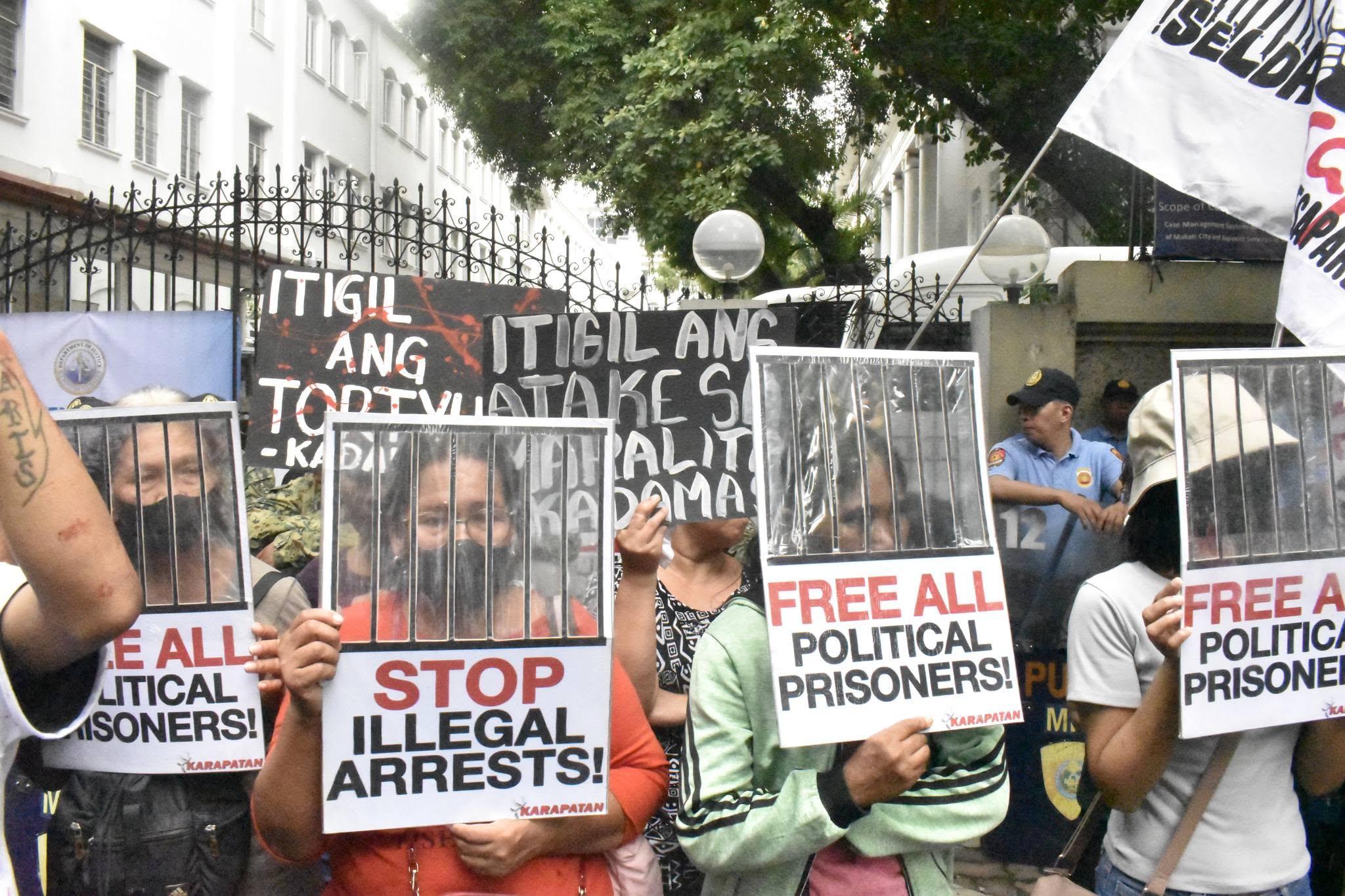
On the International Day in Support of Victims of Torture on June 26, people’s rights group Karapatan called for the release of all political prisoners subjected to “torture, prolonged and arbitrary detention, trumped-up charges and criminalization of dissent.”
Karapatan also called for the abolition of NTF-ELCAC, saying, “it has become one of the government’s most reliable [ways] for terrorizing individuals and communities.”
Gerald Staberock, secretary-general of the World Organization Against Torture, said that authorities should prioritize ending impunity, protecting civic spaces and holding perpetrators accountable.
The Commission on Human Rights (CHR) echoed calls against torture. “Torture is never acceptable and that every person, including those deprived of liberty, deserves dignity and humane treatment.”
“Being deprived of liberty should never mean losing one’s humanity,” CHR said. (RTS, DAA)
Access the full report of the Observatory for the Protection of Human Rights Defenders entitled “Same-same but different: Repression of human rights defenders in the Philippines under President Marcos Jr.” here.
 Save as PDF

0 Comments