

The conviction went against a previous decision in October 2025 by the Court of Appeals which voided the civil forfeiture case against Cumpio and Domequil.
MANILA — While she is acquitted of illegal possession of firearms and explosives, kin and groups denounced the guilty verdict on the case on terrorism financing against detained journalist Frenchie Mae Cumpio, calling it a dangerous precedent in journalism practice.
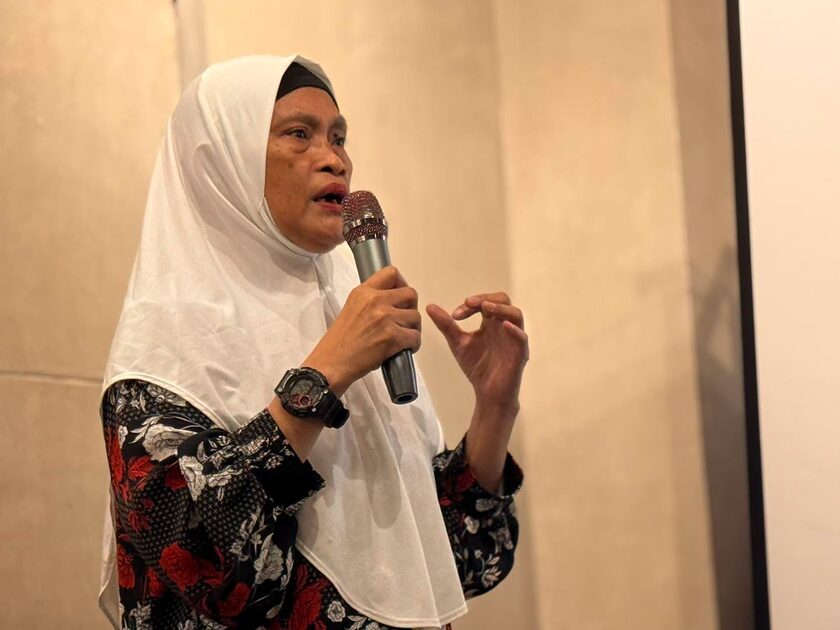
“If only the judge granted Frenchie her freedom, we would have celebrated her 27th birthday,” Lala Cumpio, mother of Frenchie, said in a press conference. “It could have been a birthday gift and a celebration for us.”
It was frustrating for her as a mother, she said, as she was expecting the acquittal of all charges against Frenchie who has been detained for almost six years.
Judge Georgina Uy Perez of Tacloban Regional Trial Court Branch 45 found Cumpio and Marielle Domequil guilty of financing terrorism beyond reasonable doubt. Lawyers will file for bail and a motion for reconsideration for the terrorism financing case.
Four of Cumpio’s other charges of murder and illegal possession of firearms and explosives were dismissed.
“This is so difficult and heavy on us. I still could not find the right words to say,” Lala told the media.
Aleksandra Beilakowska, advocacy manager of press freedom watchdog Reporters Without Borders (RSF) Asia-Pacific Bureau, said that Cumpio’s conviction would set a dangerous precedent for journalists speaking truth to power.
It would also not help, she said, improve the Philippines’ ranking in the Press Freedom Index, which still has a “difficult” situation.
“We would like to express our profound outrage and deep concern over how this unfolded, which seemed quite inconsistent with international human rights norms. We were hoping for a better result today,” said Akriti Saraswat of international watchdog Free Press Unlimited (FPU).
Questionable arrest, dubious witness
Noberto Robel Jr., part of Cumpio’s legal team, maintained their client’s innocence. He said that the financing terrorism case has complicated issues that involve the constitutionality of the law and the integrity of the evidence.
“Most of the evidence of the prosecution is based on testimony only. We should not lose hope about the freedom of Frenchie Mae Cumpio,” he said.
The witnesses claimed to be former rebels whose credibility rests on implicating human rights defenders.
Extensive RSF investigation last year found that no other witness or documents support their claims. The key prosecution witness also made incoherent and clearly false statements.
“The central role of these two women in the criminal case is even more troubling considering their backgrounds. Alma G. admitted to RSF that she was facing 17 court cases—mainly for murder—at the time of her arrest in June 2020. After a quick “repentance,” all those cases were dropped, and she became an active witness in several similar cases targeting civilians,” RSF investigation reads.
Beilakowska also cannot fathom the judge’s decision to convict Cumpio and Domequill since there is no physical evidence against them but only testimonial narratives from the former rebels.
Julianne Agpalo of National Union of Peoples’ Lawyers and part of Cumpio’s legal team said that the camp will not stop from pursuing justice. “We’ll continue to fight for the immediate release of Frenchie and Marielle, for the motion that we will be filing to be granted. Another is that we will continue to challenge the decision itself.”
She said that Presidential Proclamation No. 374 from the previous administration of Rodrigo Duterte is not a valid form of terrorist designation.
“Nowhere in RA 11068 (Terrorism Financing Prevention and Suppression Act) states that a president can designate an individual or organization by a mere executive order. We will continue to challenge the constitutionality of such executive orders,” Agpalo added.
The National Union of Journalists of the Philippines (NUJP) decried the conviction notwithstanding the reversal of the Court of Appeals on the civil forfeiture petition against Cumpio and lay worker Marielle Domequil related to the cash seized during a police raid in Tacloban City in February 2020.
“We have held from the start that both charges are trumped up and are products of a questionable arrest and testimony from dubious witnesses,” the group said in a statement.
Empty talks
Last year, the administration of Ferdinand Marcos Jr. said that there is press freedom in the country. He added that his administration is doubling down on its commitment to protect journalists and uphold press freedom.
However, these words meant nothing with the recent conviction of Cumpio, according to Beh Lih Yi of the international organization Committee to Protect Journalists (CPJ).
“Today’s decision is absurd, appalling, and nothing but injustice,” Yi said. “The decision today also shows that the different pledges and commitments made by the administration are nothing but empty talks.”
International press freedom watchdogs CPJ, RSF, and FPU sent delegates to the Philippines to monitor the case of Cumpio and to campaign for her release.
Ronalyn Olea*, secretary-general of the National Union of Journalists of the Philippines, said that Cumpio’s case is part of the pattern of repression – “factory warrants” against activists – during the Duterte administration.
“President Marcos Jr., when he assumed the presidency, had the power to reverse that kind of trend and decision. But still, here we are,” Olea said.
This pattern of repression is largely attributed to the Philippine government’s counterinsurgency policy across administrations. Two United Nations Special Rapporteur – Irene Khan and Ian Fry – recommended the abolition of the National Task Force to End Local Communist Armed Conflict (NTF-ELCAC), supported by various human rights organizations and defenders in the country. But Marcos has refused to do so.
Many of the dubious former rebels presented by the NTF-ELCAC also act as key witnesses of the prosecution in the cases against human rights defenders.
“The decision today by the court actually sets a precedent and it has far-reaching implications. The trend of using terrorism-related charges to go after journalists is a trend that we see in autocratic regimes (worldwide),” Yi said.
Far-reaching consequences
Cumpio is the first journalist in the Philippines to be prosecuted and convicted of financing terrorism charges. Another is Deo Montesclaros, a community journalist from Pinoy Weekly, although he remains free at the moment.
Prior to her detention, Cumpio managed a woman-led radio program and was the executive director of Tacloban-based alternative media outfit Eastern Vista, reporting human rights and land rights violations in the province. She was also a victim of red-tagging and surveillance.
The People’s Alternative Media Network (AlterMidya) expressed outrage with the court decision, emphasizing that this conviction has consequences beyond the accused.
“It deepens the climate of impunity in the country and sends a chilling message to journalists, activists, and ordinary citizens that free expression comes at a heavy cost,” it said in a statement.
Cumpio and Domequil, who were detained for nearly six years, were part of the “Tacloban 5” nabbed during a police raid in Tacloban City in February 2020. Alexander Philip Abinguna is still also detained for pending charges, while the other two were released on bail.
Abinguna is a national council member of human rights group Karapatan. The group also released a statement denouncing the court conviction of Cumpio and Domequill, holding it accountable for the sustained weaponization of anti-terror laws. They recorded at least 227 individuals charged with trumped-up terrorism cases. (With reports of Franck Dick Rosete) (RTS, DAA)
Disclosure: Ronalyn V. Olea is the editor-in-chief of Bulatlat.
 Save as PDF

0 Comments