
News in Pictures: Parade of Coffins




By ARNOLD PADILLA
Consumers face continuing injustice as they shoulder additional power costs (on top of possible rotating brownouts) while Meralco delays accounting for its over-collections that could reach more than P7 billion. Thus, it is very reasonable for consumers to demand that whatever planned rate increases by Meralco must be disallowed by the ERC.

By ARNOLD PADILLA
In a poor country where one out of two people dies without receiving any medical attention, where more than half of the population do not have access to basic health care, community-based health workers who provide needed services to fill this health-care gap should be heralded as heroes, not thrown to jail and tortured.
Related blog post: The AFP is telling us we need more NPA guerrillas

By ARNOLD PADILLA
There is no justifiable reason for local sugar prices to increase due to increasing global prices. The Philippines is not dependent on imported sugar and, in fact, is a net sugar exporter.

By ARNOLD PADILLA
Whoever becomes the next president will have to run a government that is almost P5 trillion deep in debt and with a budget deficit of P300 billion or more. Thus, whatever promises about providing for the basic needs of the people especially the poor are empty rhetoric unless candidates disclose how they intend to address the worsening fiscal situation.

By ARNOLD PADILLA
There’s good news for its close to five million customers to start the New Year, said utility giant Manila Electric Power Co. (Meralco). It claimed that its January billing will go down by 30.5 centavos per kilowatt-hour (kWh) due to lower generation and transmission charges. But Meralco did not say that the said reduction is just one side of the story.

By ARNOLD PADILLA
Malacañang is threatening to reimpose an oil price control if oil companies will not follow the conditions outlined by Mrs. Arroyo. Government, however, has given up the high ground with its lifting of EO 839 and continued adherence to the discredited deregulation policy.
Ni ARNOLD PADILLA Bulatlat.com tulad mo rin, noynoy, ang dambuhalang pabrika sa inyong azucarera na walang imik nang dumating ang sandaang sasakyan ng protesta patuloy lamang sa pagbuga ng usok ng mga makinang lumalamon sa tubô at tubo, at tulad ng mga armadong...

By ARNOLD PADILLA
To a certain degree, Executive Order 839 questioned the lies long peddled by the oil companies and staunch defenders of neoliberalism about neoliberal free market economics. If left unchallenged, EO 839 could become a precedent in policy making: that the government, in the name of public good and welfare, could take decisive action against abusive corporations.
By ARNOLD PADILLA
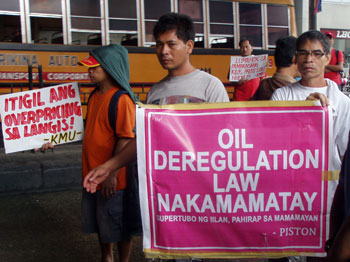
While it is supposed to be based on the Oil Deregulation Law, the executive order mandating the recent price rollback in effect puts into question the wisdom of oil deregulation. Moreover, the oil companies have found a way to offset whatever “losses” they would incur in Luzon due to the EO: by overpricing in the Visayas and Mindanao.
By ARNOLD PADILLA
The challenge that policy makers now face is how to raise the needed resources to fund in a sustainable manner and without placing additional burden on Filipinos the requirements of relief and rehabilitation.
By ARNOLD PADILLA MANILA -- “A President must be on the job 24/7, ready for any contingency, any crisis, anywhere, anytime." "As a country in the path of typhoons… we must be as prepared as the latest technology permits to anticipate natural calamities when that is...

By ARNOLD PADILLA
The latest incarnation of the text tax comes in the context of an administration under pressure from the International Monetary Fund (IMF) to widen its revenue base. It was the IMF that first openly pushed the text tax idea in 2002 to address the government’s burgeoning budget deficit.

By ARNOLD PADILLA
No matter how oil firms deny the allegations that they are overcharging the consumers, the widespread public perception that oil companies are abusive and profit-hungry will remain. This will be the case as long as the oil industry is deregulated and oil companies are allowed to automatically increase their prices and at the same time not compelled to publicly divulge how they compute their price adjustments.

In her recent State of the Nation Address, President Arroyo claimed to have created eight million jobs, or an average of a million jobs per year in the past eight years. But where exactly did this figure come from? A closer look at the government’s own data yields a statistical distortion.

The Americans, like the Europeans, have an inventory of what they call “barriers” in the Philippine Constitution that they want the Arroyo regime to remove through constitutional amendments. Meanwhile, the Constitution will have to conform with the Jpepa, the Philippine-Japan agreement, not the other way around. (Second of two parts)

The political dimension of charter change has dominated the national agenda. But the constant driving force behind all the attempts since the last decade to modify the Constitution has been the external pressure coming mainly from the WTO, the US, the EU and Japan to create the sort of policy environment that will allow globalization to fully thrive in the Philippines. (First of two parts)
One of Ibon’s proposals is a system of centralized procurement of imported crude oil and refined oil products, a necessary step to ensure the steady supply of reasonably priced petroleum in the country. By Arnold Padilla Ibon Features It has now become obvious that...
Looking at Service Contract 38 and its implementation, government has practically become 'powerless' over Malampaya, and is therefore not in the position to ensure that Malampaya serves the national interest. By Arnold Padilla IBON FEATURES The US$4.5-billion...
A community of readers and supporters that help us sustain our operations through microdonations for as low as $1.