

“Art belongs to the people and it is part of holding those in power accountable.”
By Pajo Albano
Bulatlat.com
MANILA – Concerned artists, workers, and farmers gathered at the University of the Philippines Fine Arts Gallery on July 16 for the opening of Managinip Na(ng) Gising: Visions of National Democracy, an exhibition by the Surian ng Sining (SUSI) that calls on Filipinos to dream of a just and liberated future.
Now in its sixth year, SUSI’s anniversary exhibit brings together paintings, sculptures, installations, and performance pieces that portray mass struggles and collective aspirations for land, livelihood, sovereignty, and genuine democracy.
“This is not just art for art’s sake,” said JL Burgos, chairperson of SUSI. “Sining ito na may layunin na humarap sa umiiral na sistema at sabihing sapat na.” (This is art with a purpose to confront the prevailing system and say enough is enough.)
According to Burgos, Managinip Na(ng) Gising offers a cultural counterforce to dominant, commercialized narratives that often erase the demands and conditions of the working class.
“Mainstream culture masks suffering and glorifies the status quo,” he said. “We put forward a counterculture that does not only reflect our conditions but demands that they change.”
The exhibit is part of SUSI’s broader campaign Bantay Salakay: Cultural Movement Against Imperialism which positions art as a tool to expose exploitation, resist foreign domination, and organize sectors into action.
A centerpiece of the gallery is a makeshift kampuhan (protest encampment) flanked by imagined scenes of a democratic society, visualizing both the ongoing struggle and the aspired future.
For labor leader Jerome Adonis, chairperson of Kilusang Mayo Uno (KMU) who delivered a solidarity message at the event, the works present a vivid political truth often absent in official accounts.
“It doesn’t just depict the conditions of the masses,” he said in Filipino. “It also shows the need to fight back, that resisting an oppressive and exploitative society is just and rightful.”
Adonis pointed to worsening economic conditions under the Marcos Jr. administration, particularly high inflation, stagnant wages, widespread contractualization, and a surge in privatization of public services like water, energy, transportation, and education.
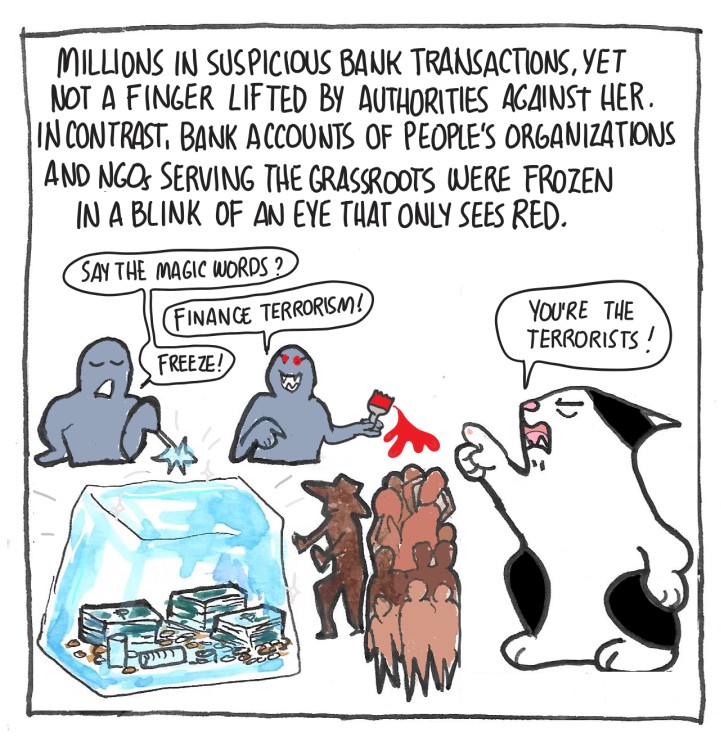
He also criticized the Marcos Jr. administration’s tolerance of impunity, including its refusal to hold Vice President Sara Duterte accountable for the PhP125 million (US$2.1 million) confidential funds and its silence on human rights abuses during the previous administration.
“Silence is a form of consent,” Adonis said in Filipino. “And art has a role in breaking that silence.”

Ronnie Manalo of Kilusang Magbubukid ng Pilipinas (KMP) stressed the importance of art in reaching sectors often excluded from policy discourse, including illiterate and geographically isolated farmers.
“Even if many farmers can’t read, they understand the message of art,” he said in Filipino. “In a single visual work, you can immediately see the oppressive system and the dreams being fought for through resistance.”
Manalo praised the exhibit for portraying not just rural poverty and landlessness, but also the collective resistance of peasant communities. “This kind of exhibit is not just an eye-opener. It is also a call for artists to serve the people.”.
Burgos said that this year’s anniversary marks a turning point for SUSI, citing clearer direction and stronger political grounding after six years of grassroots collaborations. “We will be among those taking to the streets during the State of the Nation Address (SONA), because what we are fighting for is not just art—but the future of the nation.”
Protest art meets people’s demands
With Ferdinand Marcos Jr. set to deliver his third SONA on July 28, groups behind the exhibit said that the works serve as a visual state of the people that counters official spin with grassroots truths.
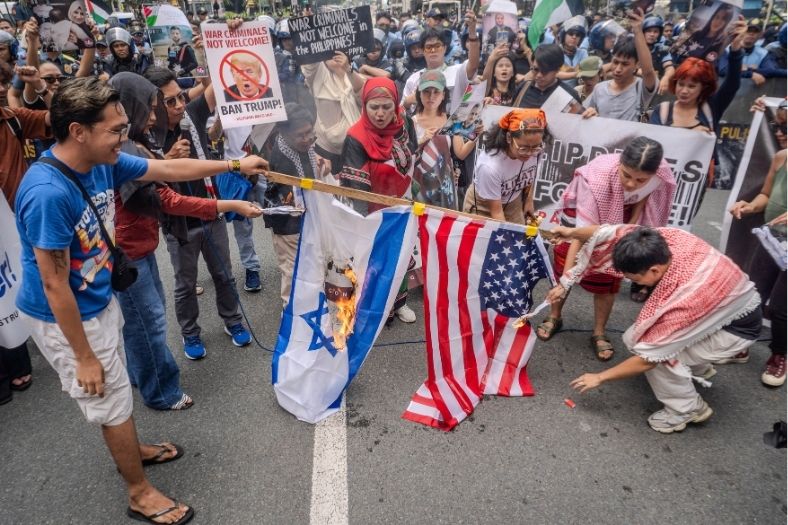
“We will greet him with protest, not applause,” Adonis said, referring to the planned People’s SONA mobilization that will culminate on Commonwealth Avenue.“We will answer his lies with our demands.”
Included in the demands are immediate wage increases, rollback of privatized public services, justice for victims of red-tagging and state violence, and a decisive end to foreign control, particularly by the United States and multinational corporations.
These concerns are echoed in civil society and labor reports ahead of the SONA, with a March 2025 briefing by Ibon Foundation reporting that millions of Filipinos remain in low-quality, part-time, or informal work despite government claims of economic growth, highlighting persistent issues in job creation and wage stagnation.
Meanwhile, the 2024 Human Rights Watch report raised alarms over continued red-tagging, enforced disappearances, and impunity for past atrocities under Rodrigo Duterte’s administration.
Adonis said that the Marcos administration’s rejection of the proposed P150 legislated wage hike was a “betrayal of the working class,” noting that the bill passed the House of Representatives but was blocked in the Senate with no support from the executive.
For SUSI, the ongoing repression of artists also underscores the urgent need to protect freedom of expression and resist creeping censorship.
In January, Film Development Council of the Philippines (FDCP) Chair Jose Javier Reyes confirmed that the agency could no longer fund the Cinemalaya Independent Film Festival due to budget constraints, sparking concern among artists about the state’s commitment to independent and regional cinema.
“This is why we’re in the streets,” Burgos said. “Culture is not a plaything of the state. Art belongs to the people and it is part of holding those in power accountable,” he said in Filipino. (AMU, DAA)
 Save as PDF


0 Comments