
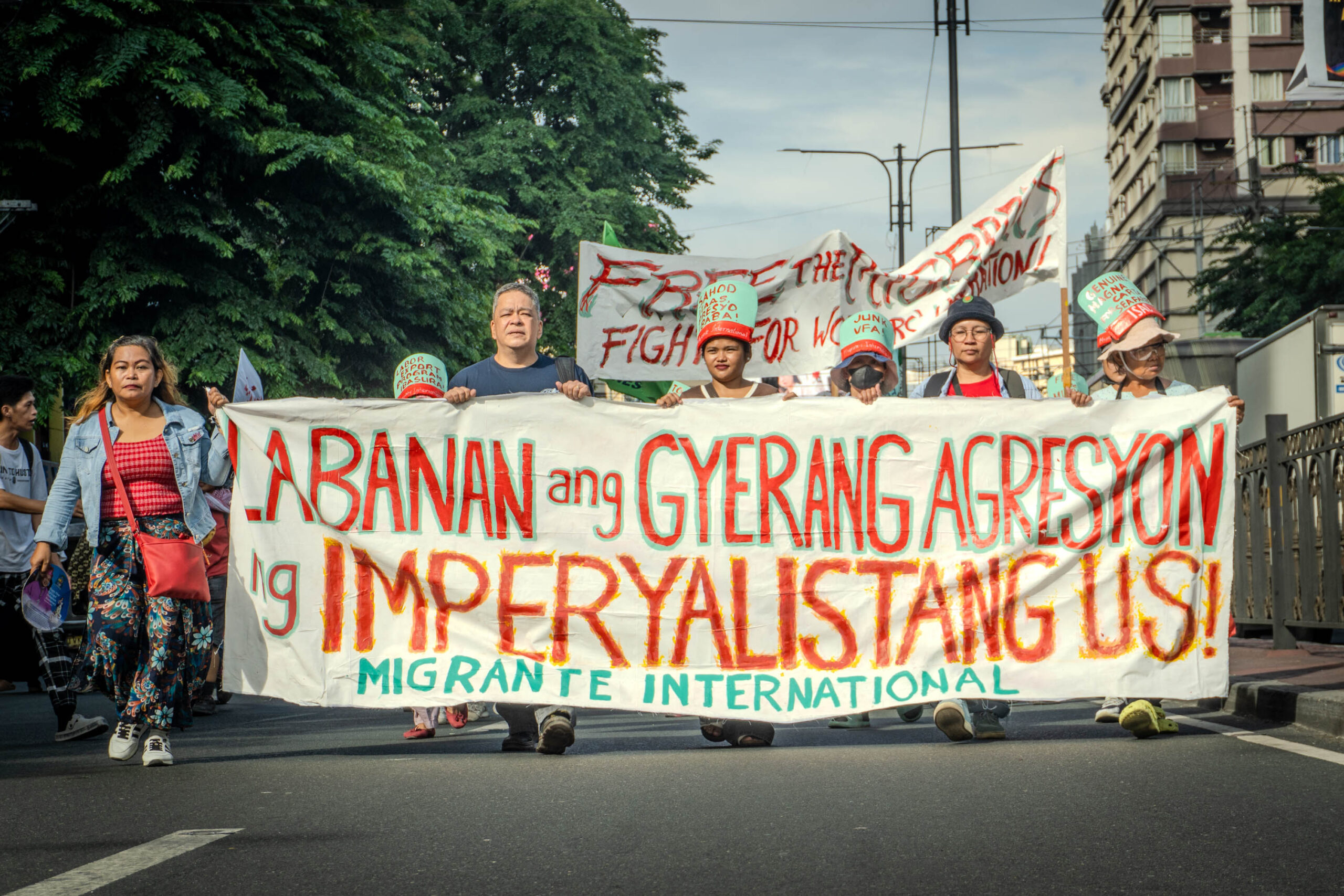
First of three parts
Part 1: From unbridled globalization to controlling supply chains
Part 2: Unprecedented deepening of US military intervention
Part 3: Luzon Economic Corridor and Pax Silica: Defense-industrial imperialist project
For almost half a century, US imperialism relied on unbridled neoliberal globalization to assert and maintain its global hegemony. Trade and investment liberalization, privatization of public services and government functions, and deregulation of state control over key industries, sectors, and activities of the economy were promoted to facilitate the monopoly capitalist accumulation of U.S. financial oligarchs. U.S. imperialism also maintained a vast network of foreign military bases and a massive deployment of its troops to project its might and safeguard U.S. monopoly capital around the world.
Under this model, the integration of economies into a U.S.-led global order enabled American corporations and financial institutions to dominate markets, plunder resources, and exploit labor while maintaining geopolitical influence. Its financial oligarchy increasingly turned to financialization and speculation to quickly and massively generate profits while focusing on the production of high technology and expanding the U.S. military-industrial complex for corporate profit-making and global power projection. It outsourced most of its industrial production to take advantage of cheap labor and raw materials in poor countries and to meet the needs of its industries.
Controlling strategic supply chains
However, the rise of China exposed vulnerabilities in this strategy. As the US outsourced industrial production and relied on financialization and war for profits and domination, China has become central to global manufacturing, using concentrated state intervention and an enormous army of cheap labor to steadily build its industrial base, acquire technology, and accumulate capital. China’s economy has expanded to become the world’s largest today in terms of the absolute volume of physical goods and services produced. The U.S. holds the top position in nominal gross domestic product (GDP) primarily because of its tech industry (software development) and financial sector, but China trumps it in actual manufacturing capacity and commodity exports.
China’s manufacturing dominance means it has asserted control over global supply chains for the production and distribution of many goods and services, including sectors that American strategic thinkers deem a threat to U.S. hegemony. Globally integrated supply chains, which the US promoted through neoliberal globalization that culminated in China’s accession to the World Trade Organization (WTO) in 2001, are now seen by U.S. imperialism as a national security risk amid China’s rise. The reason is that these supply chains include sectors that could ultimately undermine the supremacy of US imperialism in one field that allows it to keep its global hegemonic position—the military.
In the context of its strategic competition with China, U.S. imperialism considers certain sectors to be “national power industries” or “force multiplier fields” because they dictate not just economic dominance but also military superiority. These include advanced computing and semiconductors, artificial intelligence (AI) and autonomous systems, clean energy and advanced mobility, critical minerals and materials processing, biotechnology and biomanufacturing, and defense, aerospace, and telecommunications. Control over the supply chains of these dual-use sectors (i.e., sectors with commercial and military uses) explains recent major U.S. imperialist projects, namely the Pax Silica initiative and the Critical Minerals Ministerial.
Consequently, Washington began recalibrating neoliberalism within the framework of its national security strategy. The emphasis shifted from maximizing efficiency through unrestricted globalization toward securing strategic supply chains and maintaining technological superiority. Concepts such as “economic security,” “friend-shoring,” “ally-shoring,” industrial policy, and state intervention emerged as key pillars of U.S. strategy. While wielding various protectionist measures for its economy and key industries, U.S. imperialism continues to impose neoliberal policies on its semi-colonies to facilitate the plunder of resources and assert control over supply chains.
Economic-military strategic framework
The Philippines occupies a crucial position in Washington’s effort to contain China. Geographically, it lies within the so-called First Island Chain, a strategic arc stretching from Japan through Taiwan and the Philippines down to Indonesia. Control over this chain is viewed by U.S. strategists as essential for limiting China’s maritime expansion and military mobility.
As a result, the Philippines has become a key platform for U.S. power projection. The expansion of the Enhanced Defense Cooperation Agreement (EDCA), the exponential growth of large-scale military exercises such as Balikatan, record-high increases in military financing, unprecedented deployment of advanced missile systems and drones, and enhanced interoperability between the Armed Forces of the Philippines (AFP) and the U.S. military under the command of U.S. imperialism all reflect this strategic objective.
US imperialist machinations in the Philippines in the current period are characterized by the ever-deepening integration of U.S. military and economic agenda into a single strategic framework. So-called development initiatives, infrastructure projects, industrial zones, and digital connectivity programs are specifically designed to support U.S. military and strategic objectives. Economic projects such as the Luzon Economic Corridor and Pax Silica’s Economic Security Zone facilitate economic penetration, enable the plunder and exploitation of resources, and generate profits for American financial oligarchs while simultaneously strengthening U.S. military logistics, mobility, and operational capacity. This necessitates the exceptional puppetry and subservience to U.S. imperialism of the local elite’s ruling clique, represented by the regime of Ferdinand Marcos Jr. and the bourgeois compradors who benefit from these plunderous projects.
 Save as PDF






0 Comments