
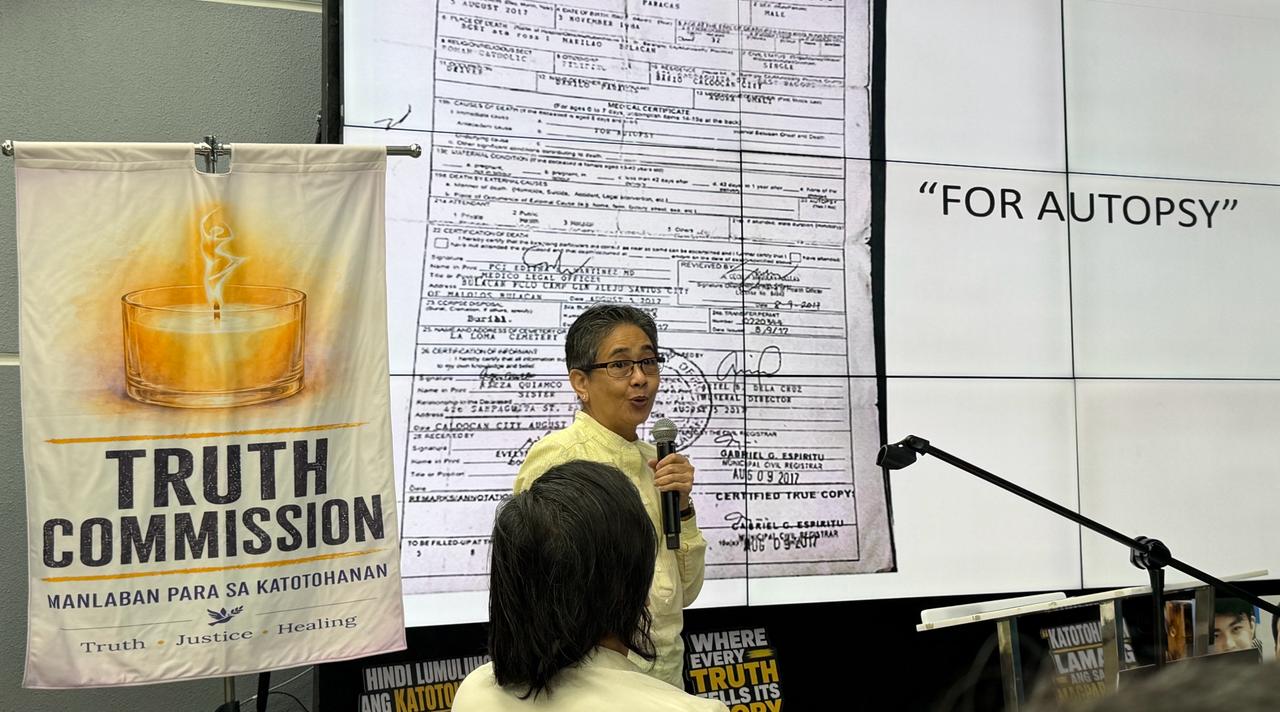
The Truth Commission has called on the Philippine government to investigate the police officers’ misconduct and promotion and the doctors’ questionable death certificates in the course of the “drug war” campaign of former President Rodrigo Duterte.
“My son was alive when they arrested him, but they killed him. They could’ve let him live. They did not show mercy, they planted drugs and guns,” Marissa Lazaro, mother of extrajudicial killing victim Cristopher Lazaro, said in Tagalog during the commission’s truth-telling session.
The Truth Commission pointed to a failed system for investigating deaths, marked by careless police and forensic work, and little concern for victims’ families. Lazaro’s account also showed that the police officers were asking money from her, indicating a potential trail of corruption.
Cristopher, 20, and Alberto Paragas, 32, died in police operations on August 5, 2017 in Marilao, Bulacan. Police reported that the two resisted (nanlaban) after an alleged attempted holdup. Cristopher’s friends also died hours earlier in Bocaue, a separate town in Bulacan.
Lazaro added, “They asked me to sign a waiver, indicating that I consented to their illegal operation. I did not sign it. They told me: the day will come that I will seek their help. I told them, what help could you give my son? You killed him. He’s already dead.”
A similar incident happened to Marissa Quiamco, sister of Alberto, after she paid the P10,000 fee to release the cadaver of her brother. A police officer asked her and Alberto’s partner to sign a document, indicating consent for the operation but they refused to sign.
“I wish I could fight for my brother. Even my neighbors asked me to file a complaint. But I told them: we don’t have money. We don’t have the capacity or resources to get a lawyer,” Quiamco said during the truth-telling session. “I’m only earning enough to help my mother and father.”
Promotion, reassignment
In October, an analysis of public records by the Truth Commission recorded a pattern that commanding police officers were promoted and reassigned, instead of being subjected to criminal and administrative sanctions.
Lito Patay, who commanded Batasan police station that killed 108 people in drug operations during his term, was named chief of the Criminal Investigation and Detection Group (CIDG) in Central Luzon.
In Caloocan, the commission’s own records documented 284 killings in 2016, before the leadership of Chito Bersaluno in the City Police. During his watch, 105 more deaths were recorded from February to August 2017. He was removed from his post after the killing of Kian delos Santos. However, he was made police director of Bulacan Province in 2018 and promoted to the rank of brigadier general in 2022.
In 2020, human rights organizations flagged the reassignment of Debold Sinas, former chief of the Central Visayas Police Regional Office, to the National Capital Region. The Commission on Human Rights (CHR) Regional Office said back then that Sinas’ watch in Central Visayas was marred by unresolved killings linked to the illegal drugs trade and the anti-insurgency campaign “Oplan Sauron.” Duterte appointed him as the Philippine National Police Chief on November 9, 2020, serving a six-month term. A year after, he was appointed as an undersecretary of the Office of the President.
Read: [LIST] Gross human rights violations under Debold Sinas
“Any inquiry must look at promotions as closely as it looks at cash payments,” said Christopher Magno, the commission’s executive director and an expert on state violence in the Philippines. “No police officer should gain in any way from the blood of people killed outside the law.”
Former Philippine Charity Sweepstakes Office (PCSO) General Manager Royina Garma, who also served as Cebu City police chief under the Duterte administration, revealed the incentivization of police officers through the “Davao Model” in a quad committee hearing of the House of Representatives in 2024.
“First is the reward if the suspect is killed. Second is the funding of planned operations. Third is the refund of operational expenses,” Garma said, stressing that the rewards started from P20,000 ($343.95) to P1 million ($17,197.50), depending on the profile of the suspects. She said that the rewards were only meant for killings, not for the arrest of the drug suspects.
During the quad committee hearing, it was also revealed that rewards for anti-drug operations by the police involved several key figures, including then-Special Assistant to the President Bong Go, an individual known as “Muking” from the Presidential Management Staff, a “Pedro” from the Criminal Investigation and Detection Group, and former National Police Commission (Napolcom) Commissioner Edilberto Leonardo, who handled the distribution of the payments.
Questionable death certification
The Truth Commission also called on the Professional Regulation Commission (PRC) to investigate the medical doctors behind the questionable death certificates of extrajudicial killing victims.
A letter submitted by the Truth Commission on November 9 reads: “Accurate death certification is essential to establishing the truth about the circumstances of a person’s death. Where death certificates contain inaccurate, incomplete, or potentially misleading information, families may be deprived of an accurate official record of what happened to their loved ones.”
In the 150 extrajudicial killing victims examined by forensic pathologist Raquel Fortun, who is also a commissioner of the Truth Commission, at least 13 death certificates listed causes of death that did not match her findings. Among these were the cases of Alberto and Cristopher.
Fortun’s findings on Alberto’s forensic examination indicated that the manner of death was homicide. His death certificate stated no clear reason and labeled “for autopsy.” Fortun’s team tried to ask for an autopsy report but to no avail.
Christopher’s death certificate and medico-legal report issued by the Philippine National Police also did not match. The former document indicates that the cause of death was a “gunshot wound (to the trunk) and left lower extremity”, while the medico-legal stated “gunshot wound (of the) head and left lower extremity.”
She also questioned whether the doctor who documented ligature marks on Christopher’s wrists had been free to challenge the police. “This is very glaring. The pictures of the crime scene were also very limited and messy. The documentation of the scene is so wrong.”
The letter requested the PRC, through the Board of Medicine, not only to investigate the doctors and the death certification process, but also to determine professional accountability, help protect and preserve the evidence of “drug war”, and examine whether similar practices occurred in other cases.
They also asked the PRC to work with the Philippine Statistics Authority, local civil registrars, and relevant health authorities in correcting the death certificates. The Philippine Medical Association (PMA)’s Ethics Committee will also be helpful in examining possible violations of the professional ethics.
“We emphasize that the purpose of this request is not to prejudge the responsibility of any physician, but to ensure that questionable death certifications are properly investigated, that relevant evidence is protected, and that accountability is pursued where warranted and in accordance with due process,” the letter added.
“They already killed our loved ones, now, they’re vilifying them. I will persevere in speaking up to let the public know the true circumstances of my son’s death. Not all victims of the war on drugs are drug addicts. And even if they’re addicts, it is not a justified reason to kill them,” Lazaro said. (RTS, DAA)
 Save as PDF



0 Comments