
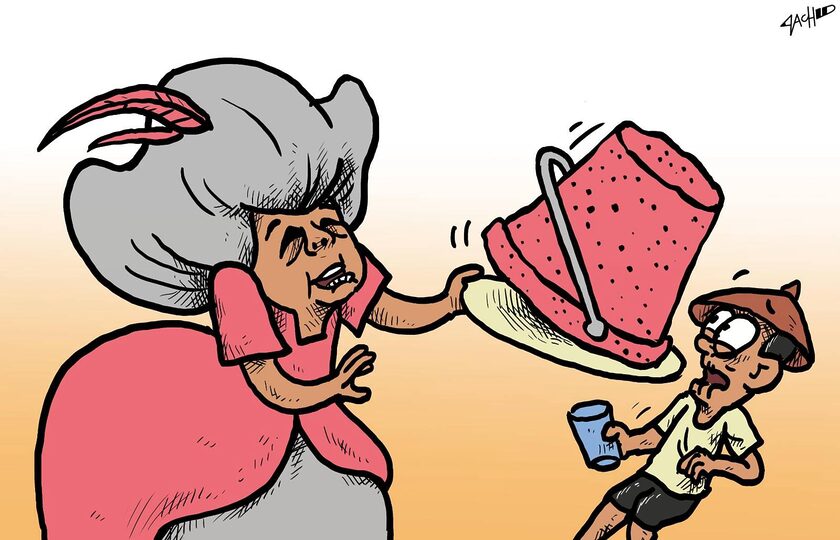
The health sector was not spared from the crisis that envelops the country. Health as a fundamental requisite for development is continuously being neglected by a government keen only in seeking profit. Health workers continue to suffer from the lack in government budget resulting from the flawed privatization and market-driven policies of the Arroyo government, and made worse by corruption. The few idealistic and patriotic health workers and professionals who have decided not to leave had to work amid the crumbling public health system.
BY PHILIP PARAAN
Contributed to Bulatlat
The year 2006 was tumultuous for the country – politically and economically. The health sector was not spared from the crisis. Health as a fundamental requisite for development is continuously being neglected by a government keen only in seeking profit. Health workers continue to suffer from the lack in government budget resulting from the flawed privatization and market-driven policies of the Arroyo government, and made worse by corruption. Having to endure low wages and unbearable working conditions, more and more health professionals leave the country in search of gainful employment abroad.
The few idealistic and patriotic health workers and professionals who have decided not to leave had to work amid the crumbling public health system.
Health hazards
Administrative Order no. 2006-0011 issued May 16 and effective July 1, 2006 was meant to provide for a standardized hazard pay of P 4,989.7 ($101.83 at an exchange rate of $1=P49) per month. But the hazard pay did not benefit all health workers. This is merely a repetition of an earlier order that benefited only a few in the health department. Only Department of Health (DoH) officials and employees within Salary Grades 20 and up or those in the top management, would again benefit from it. While those severely affected by the crisis, those within Salary Grades 9 and below or the rank and file employees did not have any increase in their pay or their benefits.
Although health workers, well understand that health hazards do not distinguish between salary grades, those in the frontlines namely, doctors, nurses, midwives and attendants who are most exposed would not benefit from the proposed increase. Emma Manuel, president of the Alliance of Health Workers (AHW), an alliance of unions and associations of health workers, said, “Hindi dapat dependent ang hazard pay sa salary grade, di mo naman alam kung sino ang unang dadapuan ng bacteria.” (The hazard pay should not be dependent on the salary grade since you could not predict who would be the first to be infected by bacteria.)
But the most vulnerable to infections are the rank and file who are directly involved in patient care and other services. They work more than eight hours and usually takes care of 60-80 patients per shift.
Health workers protested against the discriminatory order prompting the DoH to consider a resolution fixing the hazard pay of all health workers. The resolution is being studied by the National Health Workers Management Consultative Council under Health Undersecretary Nemesio Gako.
Their long fought battle for unpaid hazard pay dates back since the term of former Health Secretary Manuel Dayrit, and with its earlier precedents of a series of contradicting administrative orders. Administrative Order no.17, dated February 10, 2003, ordered an increase in the hazard pay of Salary Grade 20 from five percent of basic pay to 25 percent, using Salary Grade 19 as benchmark. Salary Grade 20 and above employees have been enjoying this benefit from 2003 to present, without the knowledge of rank and file employees.
Later that year, health workers, through their protests, managed to lobby for a hazard pay increase for all. Under AO 125, dated December 15, 2003, Salary Grade 1 employees were granted hazard pay amounting to 43 percent of their basic pay while those in Salary Grade 20 were suppose to receive hazard pay equal to 24 percent of their basic pay. This proposal would have been favorable according to AHW because of its proximity to the provisions set by the RA 7305 or Magna Carta for Health Workers. But it was never implemented.
The AHW is demanding for a uniform rate for hazard pay, which is 25 percent of basic pay with Salary Grade 19 as benchmark. Only the Philippine General Hospital implemented a uniform hazard pay citing an implementing guideline of RA 7305 issued by then Health Secretary Juan Flavier.
.In a dialogue last Oct.2, 2006 between the DoH and officers of various hospital unions under AHW, Health Secretary Francisco Duque claimed that he was unaware of previous administrative orders regarding hazard pay, which were never implemented. Duque said that he was amenable to the proposal for a hazard pay increase. But nothing has come out of it yet.
Reversing the gains of concerted action
Instead of addressing the legitimate demands of the government service sector, the Arroyo government introduced the Government Compensation and Classification Act of 2006 (GCCA). The bill which is pending in Congress is being proposed jointly by the Civil Service Commission (CSC) and the Department of Budget and Management (DBM). Under the GCCA, Salary Grades 1-5 will get a minimal increase even if their basic salaries are still below poverty line. The basic pay of Salary Grade 1 amounts to only P 5, 082 ($103.71).
 Save as PDF



0 Comments