
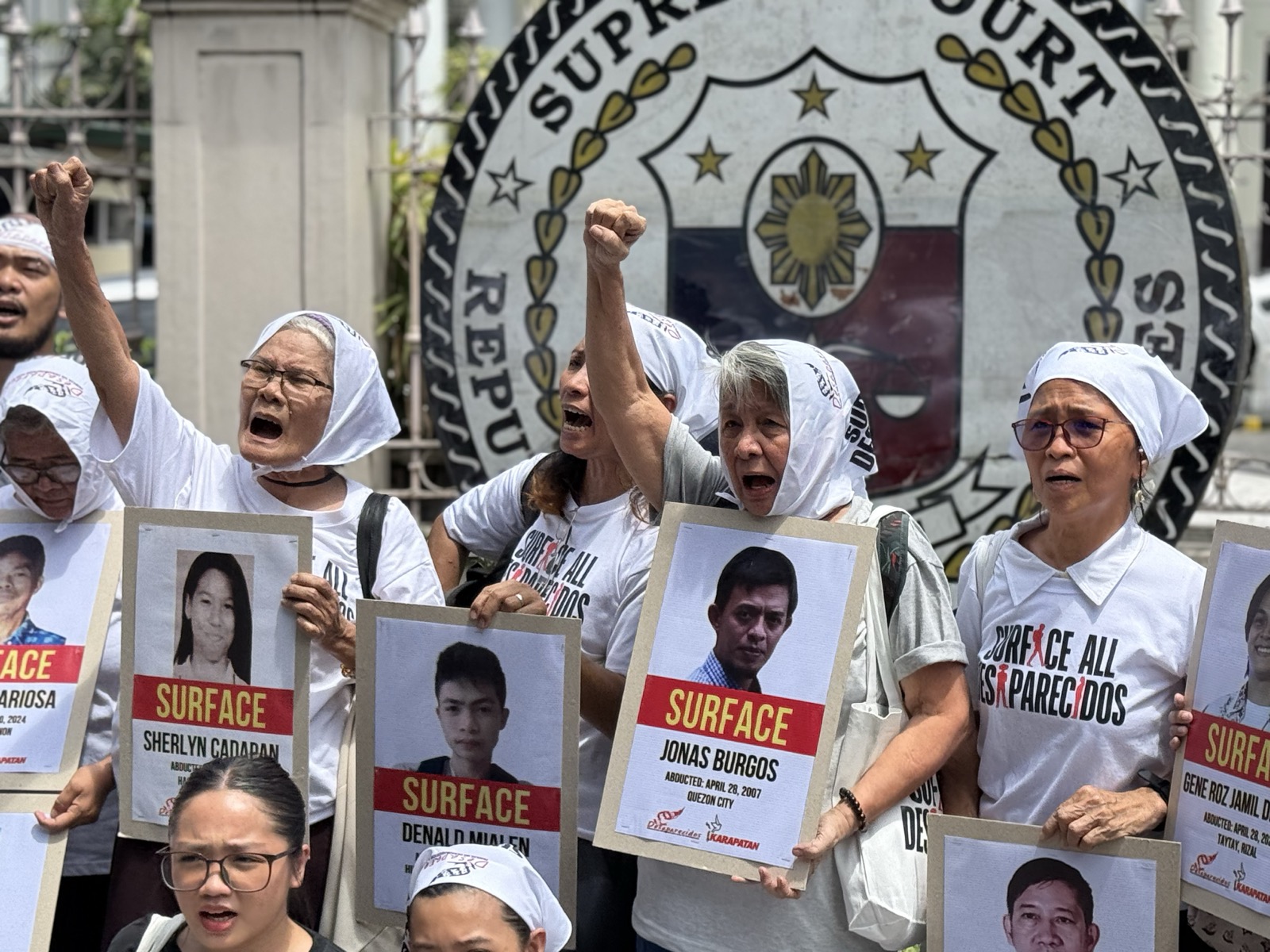
MANILA – The military camps remain closed and the government has failed to surface the desaparecidos (victims of enforced disappearance).
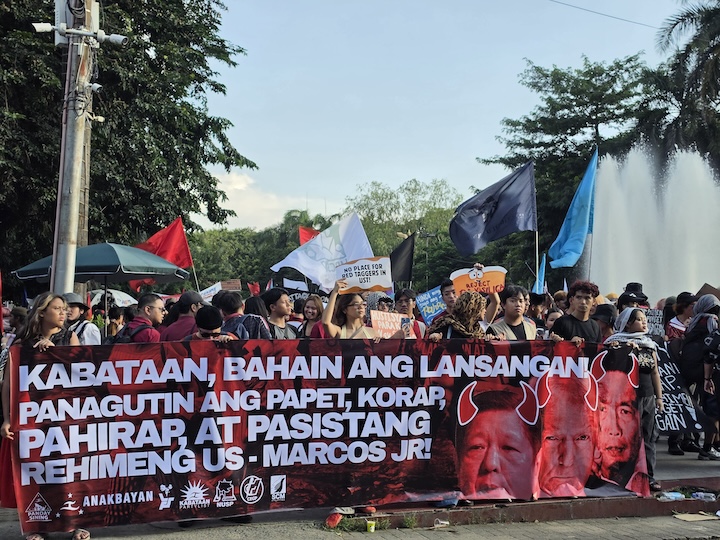
Families of the disappeared held a protest in front of the Supreme Court (SC) on April 28, marking the 19th year of Jonas Burgos’ disappearance and the third year that Dexter Capuyan and Gene Roz Jamil “Bazoo” De Jesus have been missing.
“After my son Jonas was abducted and disappeared, we spent nearly six years bringing our case before the Supreme Court. That is why we are here—because the Court issued a ruling affirming that Jonas was indeed a victim of enforced disappearance, ordering the Armed Forces of the Philippines to surface my son,” said Edith Burgos in a protest in front of the SC.
In an en banc resolution dated July 5, 2011, the SC upheld the findings of the Commission on Human Rights (CHR) affirming Jonas’ disappearance and directed the Armed Forces of the Philippines (AFP) to produce him.
The Court of Appeals (CA) also identified then-Major Harry Baliaga Jr. responsible for the disappearance, along with high-ranking officials of the Philippine Army.
Burgos was abducted on April 28, 2007 by four armed men and a woman at Hapag Kainan restaurant in Ever Gotesco Mall in Quezon City.
“They should open their camps to our family so we can search for him, and they must provide all documents related to his abduction. But not a single one of those responsible has done anything,” Edith added.
The same brutal practice of enforced disappearance continues until the current administration.
There have been over 2,000 victims of enforced disappearance since Martial Law, according to data from Desaparecidos Philippines.
“Even protective writs issued to the victims by the courts and orders to the police and military to exercise extraordinary diligence in looking for the disappeared persons have not resulted in the surfacing of any of the victims,” human rights groups Karapatan and Desaparecidos Philippines said in a joint statement.
The cases of Jonas, Dexter, and Bazoo also trace a pattern: The Court affirms their enforced disappearance, issues the protection orders, orders due diligence of investigating authorities, but none have resulted in their actual surfacing. Below are the similar enforced disappearance cases:
Below are the following cases that the groups cited:
- Karen Empeño, Sherlyn Cadapan, and Manuel Merino (Disappeared June 26, 2006, Hagonoy, Bulacan): The writ of amparo was filed on October 24, 2007, with the Supreme Court issuing the writ on October 25, 2007. Despite the Court of Appeals ordering their immediate release on September 17, 2008, the victims remain missing.
- Romulas Robiños (Disappeared November 17, 2006, City of San Fernando, Pampanga): The Supreme Court issued a writ of amparo on November 8, 2007, but the Court of Appeals later dismissed the petition citing “lack of evidence.” He remains missing.
- Nilo Arado and Maria Luisa Posa-Dominado (Disappeared April 12, 2007, Oton, Iloilo): A writ of amparo was granted by the Iloilo Regional Trial Court on December 17, 2007, ordering their release. They remain missing.
- Jonas Burgos (Disappeared April 28, 2007, Quezon City): The writ of amparo was issued by the Supreme Court on December 24, 2007. The Court of Appeals partially granted the writ on July 17, 2008, ordering investigations. He remains missing.
- James Balao (Disappeared September 17, 2008, La Trinidad, Benguet): The writ of amparo was partly issued on October 9, 2008, but later reversed on January 19, 2009. He remains missing.
- Elizabeth “Loi” Magbanua (Disappeared May 3, 2022, Valenzuela City, Metro Manila): The Supreme Court issued the writ of amparo on August 23, 2022, and the Court of Appeals held the military accountable on September 9, 2022. Magbanua remains missing.
- Maria Elena Pampoza and Elgene Mungcal (Disappeared July 3, 2022, Moncada, Tarlac): The writ of amparo was granted by the Supreme Court on November 29, 2022. They remain missing.
- William Lariosa (Disappeared April 10, 2024, Quezon, Bukidnon): After dismissal of habeas corpus and amparo petitions, the Supreme Court ruled in favor of the family in August 2026 and directed military respondents to respond. He remains missing.
- Dexter Capuyan and Gene Roz Jamil de Jesus: Petitions were filed in August 2024 for writs of amparo and habeas data. On August 12, 2025, the Court of Appeals declared the Capuyan and de Jesus as victims of enforced disappearance, contrary to the outcome of the police investigation which concluded that the two were merely in hiding. The CA granted the writ of amparo.They remain missing.
- James Jazmines (Disappeared August 23, 2024, Tabaco City, Albay): The writ of amparo was issued on May 6, 2025, with the Court of Appeals granting the writ on January 14, 2026. He remains missing.
- Felix Salaveria, Jr. (Disappeared August 28, 2024, Tabaco City, Albay): The writ of amparo was issued on February 5, 2025, and the Court of Appeals granted the writ on July 21, 2025. He remains missing.
“Since the ruling of the Court of Appeals last year, there has been no follow-up investigation nor has my father been surfaced,” Gabrielle “Chuwaley” Capuyan told Bulatlat.
Dexter and Bazoo were abducted in Taytay, Rizal by armed men who identified themselves to be with the Philippine National Police (PNP) – Criminal Investigation and Detection Group (CIDG) on April 28, 2023.
The CA granted the privilege of writ of amparo to Dexter, Bazoo, and their families. The decision affirmed that the two activists were forcibly disappeared and that state actors had shortcomings in investigating and observing due diligence through subpar investigations.
Read: Families hope court ruling can help find Dexter and Bazoo
“After the hearings and the ruling, we are still awaiting documents submission from them. Their paper trail is incomplete—there are requirements from the Court of Appeals that they need to submit and follow up,” Bazoo’s sister, Idda, told Bulatlat.
Enforced disappearance — the illegal arrest, detention, abduction, or any other form of deprivation of liberty by state agents — is a grave human rights violation.
The United Nations (UN) Working Group on Enforced or Involuntary Disappearances stated that it has frequently been used as a strategy to spread terror within societies– affecting not only the disappeared but also their relatives and communities.
The International Coalition Against Enforced Disappearances (ICAED), chaired by Edith, submitted the cases of Jonas, Dexter, and Bazoo to the UN Working Group, together with the hundreds of cases they documented across administrations.
This particular human rights violation is criminalized under the Anti-Enforced or Involuntary Disappearance Act of 2012 or Republic Act 10353.
However, no one has been successfully prosecuted for it.
Despite the presence of this law, the Philippines also refused to ratify the International Convention for the Protection of All Persons from Enforced Disappearance.
“This is not surprising, given that enforced disappearance has long been one of the means resorted to by despotic Philippine regimes to silence dissent and instill fear among the populace,” human rights group Karapatan and Desaparecidos Philippines said in a joint statement.
Honoring the disappeared
“Sometimes, I just find myself staring blankly, realizing it has already been three years. We missed another birthday. The last time we celebrated, he was so happy,” Idda said.
“He could have already accomplished so much, he could have experienced and helped more people.”
At home, the loss is hardest to explain to a child.
Idda’s son often asks about his missing uncle, remembering him as the one who never got angry.
“Every time we go to church, he copies the way I pray. A child expresses loss differently, especially at such a young age. He doesn’t fully understand, but he feels it, and he keeps waiting.”
A mother’s worry takes on a life of its own in the absence of answers.
For Edith, each day begins and ends with questions no one can resolve: What is Jonas eating? Where is he sleeping? Does he have a blanket?
Their stories weigh as heavily as the lives of their loved ones.
Chuwaley shares that her way of honoring her father is taking on the work he did for indigenous peoples communities. “I like to continue the work of my father in serving the communities, especially the people of Cordillera.”
She is currently a coordinator of TAKDER, a mass organization of indigenous Kaigorotan and its advocates based in the National Capital Region.
She took part in the People’s Cordillera Day celebrations in Metro Manila.
“Jonas, Bazoo, Dexter—wherever you are now, we hope you know that we have never stopped searching. We have never stopped fighting,” says Mary Ann, wife of Jonas. “Your lives continue to inspire all of us who refuse to be silenced.”
Mary Ann described the pain as a deep wound that never heals. For her, speaking Jonas’ name is a form of defiance for a system that allows such grave human rights violations to thrive unpunished. The protest closed with a resolute gesture: Families tied white ribbons on the bars of the gate of the SC as a symbol of the lives still unaccounted for and a search that refuses to end. (RTS, JDS)
 Save as PDF



0 Comments