Students in public school unsatisfied with state of schools
According to the survey, students complain about uncomfortable and overcrowded classrooms, insufficient textbooks and unsanitary comfort rooms.

ADVERTISEMENT

According to the survey, students complain about uncomfortable and overcrowded classrooms, insufficient textbooks and unsanitary comfort rooms.

“The burden is on us. The Department of Education wants the teachers to be more creative and innovative in teaching. But we only had five days of training. Teaching materials and guidelines were not even provided.” Luisa Ramirez, grade 9 teacher

Teachers are very disappointed with DepED; they say its officials have focused more on hiding the problems under conjured illusions to make it seem everything is well in public schools, instead of addressing the problems head on.

Kabataan Partylist Rep. Terry Ridon filed House Resolution No. 1160 calling on the House Committee on Higher and Technical Education to investigate the incident and hold the Earist administration accountable for “repressing students whose sole crime is to practice their constitutionally-guaranteed rights to free expression, speech, and peaceable assembly.”

“Unfortunately, both CHED [Commission on Higher Education] and the Department of Education (DepEd) have miserably failed to curb the meteoric rise in tuition and other school fees. Their issuances and memorandum orders are inherently full of loopholes and appear merely to give the illusion that these agencies are actually doing something about the problem when the opposite is true.”
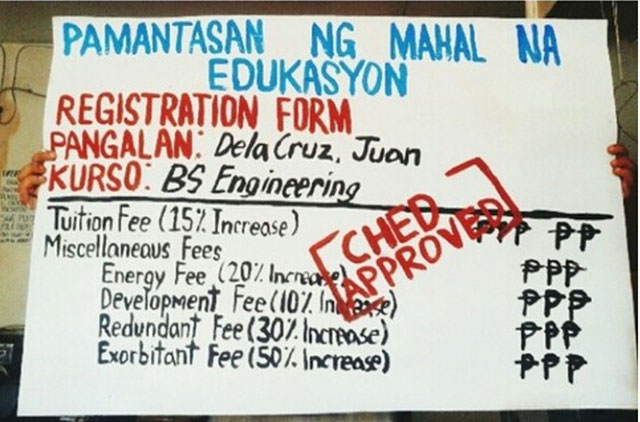
The average tuition in the National Capital Region (NCR) ranges from P20,600 ($472) to P36,650 ($841) for 21 units. The rates of increase are 3.5 to 10 percent in tuition and 300-percent in miscellaneous fees.
RELATED STORY | Uncertain future await youth due to incessant tuition hikes
The Philippines has the highest drop out rate in Southeast Asia.
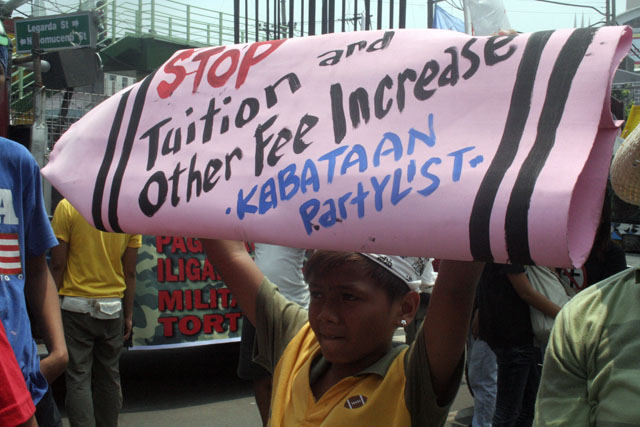
Youth and students showed their disgust over tuition hikes not only in the streets but also on social media.

“We are aghast with Aquino’s statement that there is no budget to cover the salary increase knowing that a lot of government money was just used for ghost, anomalous and corrupt projects through the Priority Development Assistance Fund, Presidential Social Fund and other lump sum allocations.” – Alliance of Concerned Teachers

“The peace negotiations are important and it concerns every Filipino. Its result will directly affect our country and its immediate future.” – Act for Peace
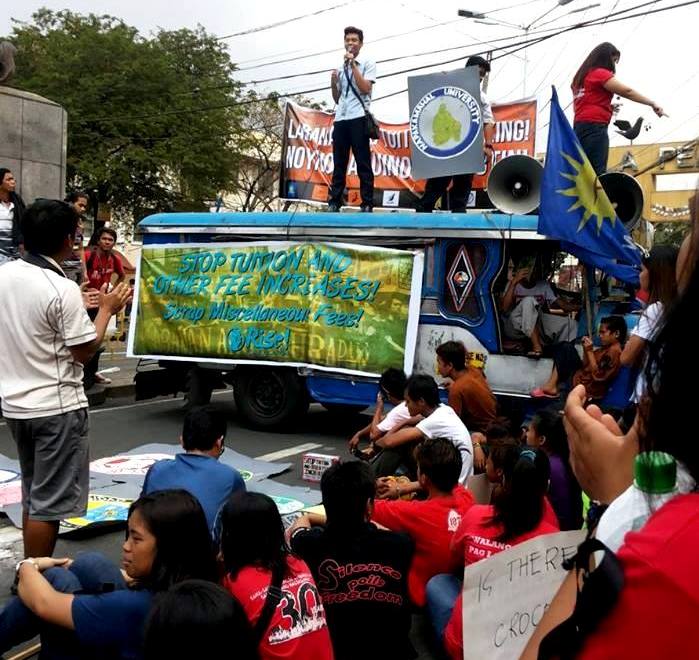
“I am prepared for the consequences in defending students’ rights. As long as what you are fighting for is right, we should never give up the fight.” – James Bryan Deang, president of the NU Supreme Student Council

“Every year, skyrocketing tuition and miscellaneous fees have always been a burden to students of SUCs and private HEIs. Although there is an existing Ched guideline regarding tuition and school fee increases, the said memo is a toothless regulatory paper. Not only does it fail to genuinely regulate tuition and other school fees increases, it also allows automatic tuition increases for incoming freshmen students.” – National Union of Students of the Philippines
RELATED STORY | Student leaders lose scholarships for protesting tuition increases

The controversial ‘no late payment policy’ has not yet been rescinded by the administration of the University of the Philippines despite the criticisms the policy generated after the suicide of student Kristel Tejada last year.

Since the tuition in UP increased by 300 percent in 2007, the number of students applying for student loans have also dramatically increased. Recent data from the Office of Scholarships and Student Services (OSSS) showed that 5,391 students applied for loans in UP Diliman alone during the second semester of school year 2013-2014.
RELATED STORY | Almost another blot in UP’s record as a state university

The only way [to improve the education system] is to have a higher budgetary allocation to education to solve shortages in classrooms, equipment and facilities and to increase the salaries of teachers. There is a need for a comprehensive professional development program for teachers to continuously equip them and further their knowledge and capacity to teach. “ – France Castro, Alliance of Concerned Teachers

“The rationalization that we need is a program that regularizes employees and hires more non-teaching personnel as support staff in schools.” – Manila Public School Teachers Association
Citing data from the Office of Scholarships and Student Services (OSSS), the Office of the Student Regent revealed that 5,391 students applied for student loans in UP Diliman alone. As of last semester, the OSR said, 1,218 students were not able to pay their loans before the scheduled release of grades.

“While it is good that the bicameral committee averted the heftier cut earlier passed by the Lower House and was able to bring down the number of SUCs that will incur budget cuts for 2014 from 79 to the current 26, it is still deplorable to know that there are still schools that will suffer large cuts.” – Kabataan Party Rep. Terry Ridon

At a time when the Aquino government is claiming to be instituting reforms in the education system, mainly through its K to 12 program for basic education, why is it that tertiary education seems to be getting farther from the reach of the poor majority?

Despite getting the largest share of funds from the national budget of 2014, teachers say the budget for basic education in the Philippines is not even enough to supply a class with chalk that would last a school year.
A community of readers and supporters that help us sustain our operations through microdonations for as low as $1.