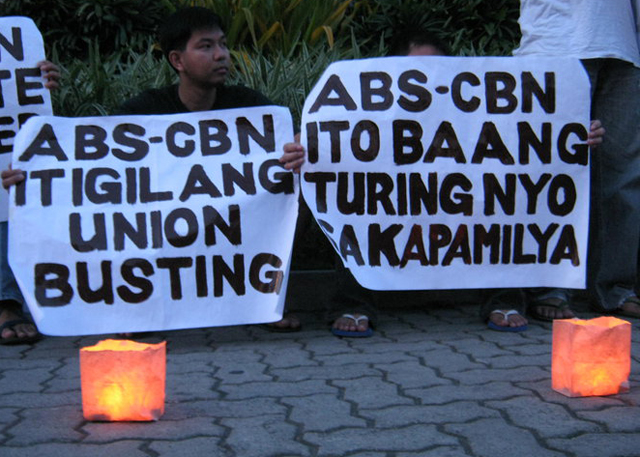
Friday the 13th ‘Massacre’ at ABS-CBN as Media Giant Axes 37 More Workers
By MARYA SALAMAT
The ABS-CBN IJM Workers Union asks President Aquino to stop the illegal dismissals, contractualization and union-busting at his “favorite” media network.

ADVERTISEMENT
By MARYA SALAMAT
The ABS-CBN IJM Workers Union asks President Aquino to stop the illegal dismissals, contractualization and union-busting at his “favorite” media network.

That the plight of farm workers at Hacienda Luisita in Tarlac has already faded from the mainstream media limelight does not mean that there is now peace in the area. Last April 22, some 1,500 farm workers agreed to withdraw their shares in Hacienda Luisita, Inc. (HLI), demand that stock distribution option (SDO) be revoked and opt for land distribution instead.

A former member of the Yellow Army and supervisor of Hacienda Luisita who admitted to being one of campaigners for the Stock Distribution Option in 1989 tell how he did so -- and why they are going against it today.

Before the coffin bearing the remains of Tarlac City Councilor Abel Ladera, the ninth Hacienda Luisita martyr, was buried, it was opened for his family and barriomates one last time. It took however almost an hour before the people could finish their goodbye: young ones took pictures of him with their cellular phones; the older ones patted the coffin, with whispers of “Salamat po, salamat po” (thank you, thank you) while a woman asked with a break in her voice, “Bakit ka nila pinatay, wala na kaming kasama.” (Why did they kill you, we no longer have someone to help us.)

Holding a multi-colored bayong (plastic market bag), Mang Pering, a retired sugar farm worker, looked half-scared and half-exited. Inside his bayong was a panti (fish net made of nylon) and some dry clothes. He is on his way to the nearby river where he hopes to get some fish so his family would have something to eat for the day. But before he left, he said he only had one wish: “Sana hindi ako mahuli ng gwardya” (I hope the guard won’t catch me).
The Department of Agrarian Reform (DAR) has set June 10 as the date for initial land distribution in Hacienda Luisita but the parties to the dispute, including DAR, appear to be getting deeply embroiled in a tug-of-war.
Sa Ngalan ng Tubo is action-packed and is never dragging. The music is at one time stirring and at another, solemn. Truly, the film portrays a history unfolding – and the strikers as the makers of history.
The labor secretary’s “assumption of jurisdiction” power is being used to ban all strikes and has caused bloodshed in the workers front. This is like reliving martial law, militant labor unions say.

From his humble beginnings as a sugar worker, City Councilor Abelardo R. Ladera emerged as one of the few successful local political figures who openly stood against the Cojuangco-Aquino dynasty in Tarlac. Ladera was gunned down at high noon of March 3 making him Tarlac’s first local official assassinated in the post-dictator era.
After several minutes of searching in the shadows, we finally find them, with lights from their gas lamps flickering through sack-covered bunkhouses. They stay by the edge of the Cojuangcos’ sprawling sugar plantation in Tarlac, far from the estate’s factories and barrios.

Shots shattered the evening calm as a peasant leader, Marcelino Beltran, went out of his house to greet some “visitors.” The visitors pumped bullets into his body and he died two hours later – the eighth to fall following the Nov. 16 massacre of seven farmers at Hacienda Luisita.

The violence that marred the strike of plantation and milling workers of the Cojuangco-owned Hacienda Luisita on Nov. 16 was bound to happen and government authorities may have to account for it.

 'Bungkalan' Improved Lives of Farmers

After the Presidential Agrarian Reform Council ordered the revocation of the SDO in Hacienda Luisita, the farmer beneficiaries launched what they call a "bungkalan" or the cultivation of idle Luisita land. It was both a political statement and a matter of survival for the farm workers who were facing extreme poverty in the hacienda owned by President Benigno S. Aquino III and his family. Farmers who participated swear that their lives improved after the "bungkalan."  View related slideshow
By RONALYN V. OLEA
Ulwu chairman Lito Bais said the financial package from Hacienda Luisita management was meant to lure farm workers into the compromise-agreement bait. “They exploited the poverty of the farm workers and used money to deceive them,” he said. Bais also accused the Cojuangco-Aquinos of "hoodwinking" farm workers of hundreds of millions from earlier land deals.

By RONALYN V. OLEA
Kicked out of farmers' groups and the workers’ union in Hacienda Luisita, the two key signatories in the compromise agreement supposedly representing the farmer beneficiaries have a history of betrayal against the farm workers and collaboration with the Cojuangco-Aquinos.


By MARYA SALAMAT
“If you can tie our hands with an AJ (assumption of jurisdiction), please tie the hands, too, of the PAL management with regard to their discrimination and violations of the Labor Code,” Robert Anduiza, FASAP president, appealed to the Department of Labor.

In this webcast, Lito Bais, president of the United Luisita Workers Union, Felix Nakpil and Federico Laza of Ambala, and Atty. Jobert Pahilga, lawyer for the farm workers, talk about the compromise agreement wangled by Hacienda Luisita management. They enumerate the alleged deception by the Cojuangco-Aquinos.  Watch the webcast
A community of readers and supporters that help us sustain our operations through microdonations for as low as $1.
 Save as PDF