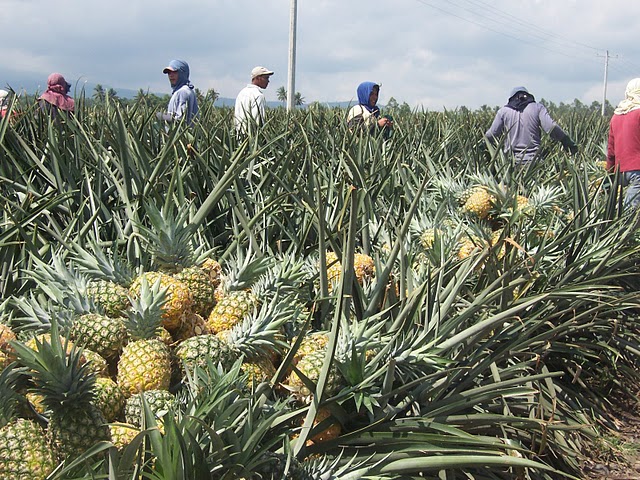
Farm workers decry plantation expansions
 Save as PDF
ADVERTISEMENT

“What we have seen so far is that the government is not serious in improving the agricultural industry in the country."

In This Week on People's History, Bulatlat remembers the gruesome massacre of 13 protesting farmers on Jan. 22, 1987. The killed farmers were among the more than 20,000 who marched to the historic bridge of Mendiola, a stone's throw away from Malacanang, to press for a genuine agrarian reform program.

“Ang pagsasaka ay marangal na gawain, hindi po ito terorismo. Hindi po kami terorista."

“The Rice Industry Development Act (RIDA) bill seeks to lift our rice industry from a multi-dimensional crisis that wasted away its productive capability, stunted its development and forestalled the country’s attainment of food security."

“We need to show them that we are not buying their story line-- the victims are the ones being blamed and a child survivor is being forced to pin down innocent persons for the crime.”

"The deployment of more state security forces in the province and in the whole Negros Island would not lead to the so-called peace and order. They are there primarily to protect the interests of big landlords who still lord over the Island.”

Fourteen years after the Hacienda Luisita massacre, farmers still fight for their land. The Cojuangco-Aquinos have regained control of the vast sugar plantation with the aid of the Department of Agrarian Reform, military and police.

What often gets left out of the frame are images of farmer and fisherfolk households forcibly evicted from their homes, divested of livelihood, security, and property. What never make the headlines are these stories of poor families excluded from their own community due to land grabs, which remain doubly driven by private property and wanton state complicity.


'The manner by which the killing was committed points to impunity on the part of the perpetrators.'

Nine farmers were killed and three wounded in a massacre in Hacienda Nene in Purok Pine Tree Barangay Bulanon in Sagay City, where farmers are staging “bungkalan” or land cultivation of idle farm lands.

“Not one area of any successful bungkalan did not go through harassment from soldiers, goons, policemen.”


If the government is looking for someone to blame for the inflation and increasing prices of basic commodities as rice and fish, it is its own neglect to subsidize agricultural producers when other countries have been actively doing so, and its tax and investment policies that hit the agricultural producers and consumers hard.

"The SC decision lacks any sense of social justice."

“Two years of the Duterte regime is two years of non-agrarian reform agenda, as it has yet to pass a new law to replace the expired and failed CARP.”

“Two years of the Duterte regime is two years of non-agrarian reform agenda, as it has yet to pass a new law to replace the expired and failed CARP.”

“This sinister move clearly aims to 'zombify' the CARP law which expired on June 30, 2014.”
A community of readers and supporters that help us sustain our operations through microdonations for as low as $1.