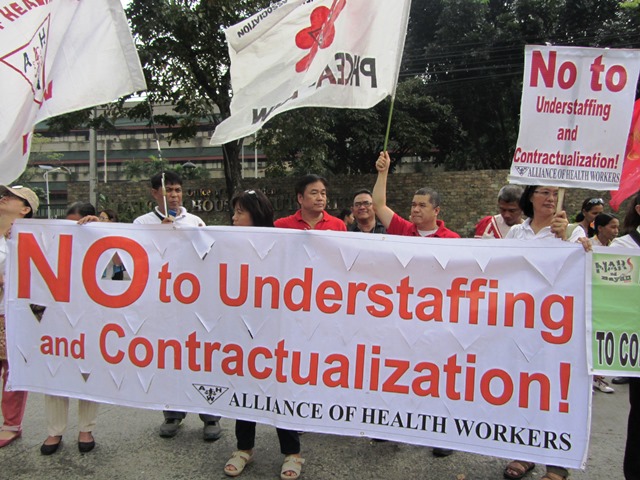
Hospitals on the ‘brink of collapse’ – health workers
AHW said understaffing schemes by hospitals force health workers to be on duty for at least 12 hours or even 24 hours while some hospitals only have skeletal forces.
ADVERTISEMENT
AHW said understaffing schemes by hospitals force health workers to be on duty for at least 12 hours or even 24 hours while some hospitals only have skeletal forces.
Halfway into the week-long stricter lockdown in the capital, health workers are still in agony over their unmet demands, with the government failing to address their call to look into their health, economic, and social well-being as they combat the pandemic on the ground.
"To match the standards of World Health Organization's positivity rate on a daily basis, We should be testing at least 130,000 individuals per day, at least 90,000 in NCR, at the current rate that we are going."
The latest IATF resolution released on Sunday lacks at least six policies that are crucial to addressing a worsening pandemic, especially when you are implementing a lockdown.
But what is even more alarming for Filipinos is that amid the surge in new COVID-19 cases, the response of the Duterte government to the pandemic more than a year into the crisis remains grossly inadequate and incompetent. While implementing the strictest and longest lockdown in the region, the Philippines continues to lag behind our neighbors in Southeast Asia in actually responding to the pandemic.
“We are puzzled. Where did the huge amount of debts go? There is no transparency how the Bayanihan 1 and 2 funds had been spent.”
The Philippines has recorded an all-time highest tally – 7,103 new COVID-19 cases – today, March 19.
A year since the world’s longest and strictest lockdown was imposed, health workers here in the Philippines are still dying due to the dreaded virus – the latest is a unionist in a government hospital.
"Duterte failed. Duque failed. They should be held accountable."
While government officials and personalities have breached protocols and got away with it, nearly 600,000 Filipinos, mostly poor, have been warned, ticketed, fined, and charged over quarantine violations.
For weeks now, the Philippines is experiencing a surge in the number of daily COVID-19 cases. The government, however, is responding to the pandemic as if it were only yesterday – still clueless, still grappling, still militarist.
"When it comes to public health and public funds, it is right and just for the people to be 'choosy' to make sure that government will procure the most number of doses to be able to vaccinate more people using the vaccine that is most cost-efficient and effective."
This year, the plight of health workers and the dire conditions of the country's public health system were highlighted amid the raging pandemic.
What Vietnam and Southern Korea have done to combat the spread of COVID-19 are exactly the opposite of what the Philippine government has been doing so far.
"This is divisive and deceptive among our ranks because all health workers whether temporary or regular are all prone to the deadly virus in hospital and health facilities."
“We cannot accept the Court’s reasoning that it is barred from compelling the executive to protect the people’s right to health ‘in a certain way or to a certain degree’ and ‘no matter how dire the emergency’ when it is obvious that the current response is a huge failure and places our people’s health and safety in peril."
At a time when health infrastructure and concerns of health workers demand to be addressed, the Philippine government takes a sharp turn and reveals it true priorities.
Gierran himself admitted to media interviews of being “very scared” with the new tasks ahead as he does not know public health. Putting another retired military or NBI officials with little or no experience may put people’s lives in peril, according to CURE Covid.
Our country, with the myriad of problems in our healthcare system even before the pandemic, is simply not equipped to adequately deal with the possible harmful effects of these clinical trials on its Filipino participants. Alongside the questionable small-scale trials of the vaccine leading up to this point and the speed at which these trials were conducted (vaccines typically take years to develop), we have all the reasons not to participate, yet here we are, once again knocking on the door of quite probably another bad decision.
Safety assessments under the corporate dominated scientific milieu are grossly inadequate and oftentimes erroneous. Pre-clinical studies and clinical trials are done or sponsored by the very corporations who sell the vaccines and they do not adequately address the plausible adverse effects that cannot be detected by the corporate sponsored studies.
A community of readers and supporters that help us sustain our operations through microdonations for as low as $1.